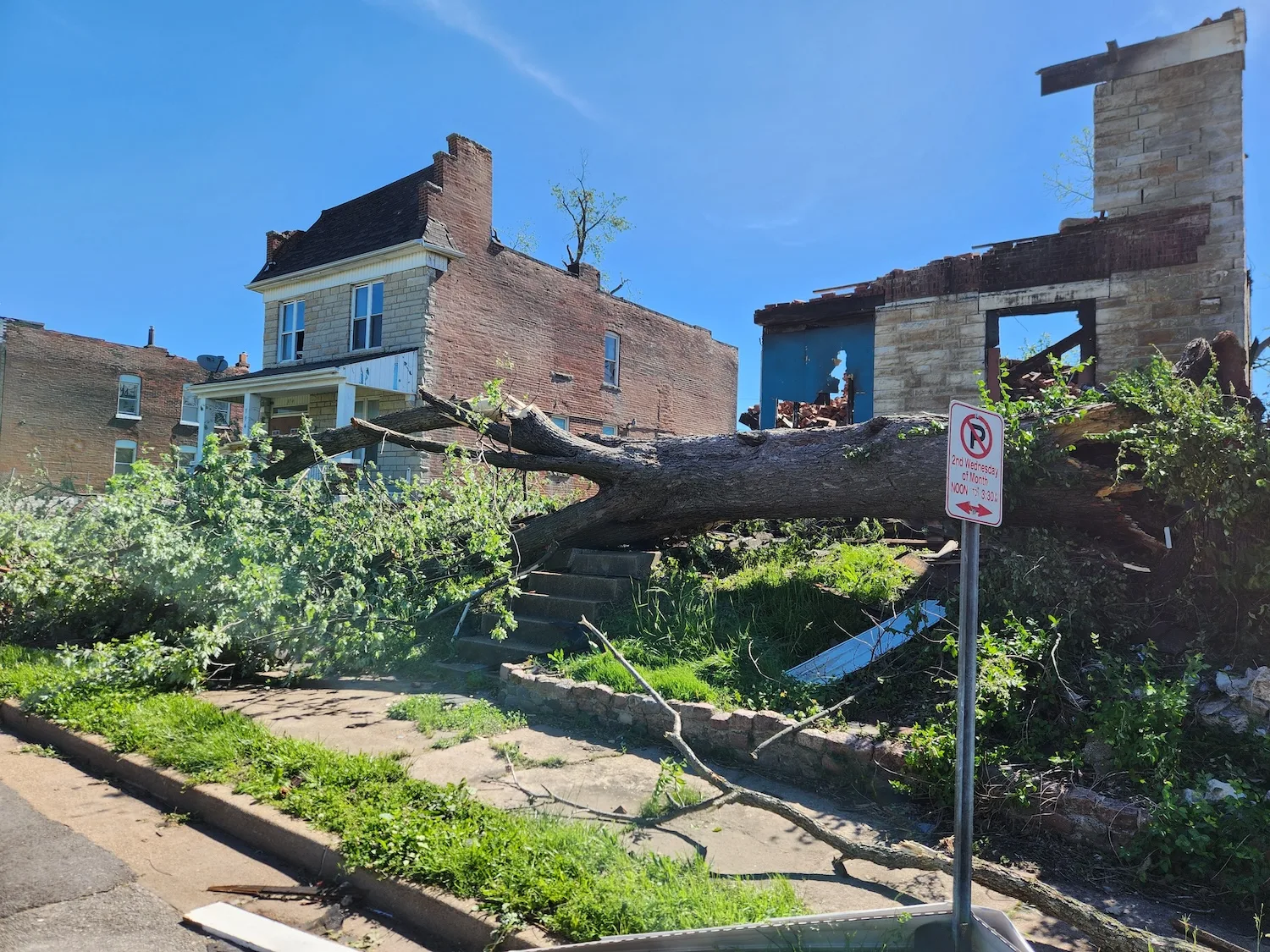
The City of St. Louis has thus far denied around 350 applications for tornado home repair, debris removal and demolition assistance, including for a Hyde Park home that had been condemned a decade before the tornado hit; a home in Gravois Park in South City, miles from the tornado’s path; and more than a dozen properties purchased from the city’s land bank after the tornado. Other denials include one for a property that doesn’t exist as well as about 20 not within city limits.
That’s according to data from the city about its denials of applications for money for home repair, demolition and debris removal—programs that received around 3,000 applications. Even as residents wait for the dollars, a few hundred applicants have gotten their denials. While city officials aren’t pinning the delay on the need to block bogus applications, they acknowledge those bogus applications have come at a level they didn’t anticipate.
Get a fresh take on the day’s top news
Subscribe to the St. Louis Daily newsletter for a smart, succinct guide to local news from award-winning journalists Sarah Fenske and Ryan Krull.
“People know that this is the program intended to help people responding to a tornado. And so the fact that we even have to sort through and find as many cases is disheartening,” says Julian Nicks, the city’s chief recovery officer.
In order to weed out bad applications, Nicks says the city looks at data points such as whether or not the city had been called to cut a property’s grass. If so, there’s a decent chance no one was living on site when the May 16 tornado hit—and at the very least, it warranted a closer look. For those properties whose applications warranted closer examination, Nicks’ team looked at whether utilities were connected and whether the property had water. A lack of either was a pretty good sign no one lived in the building on May 16, 2025. A record of the building being condemned prior to the tornado is a pretty unambiguous signal that it was not eligible, either.
Nicks noted that weeding out the applicants the city says aren’t qualified hasn’t been that much of a time suck, in the grand scheme of things: “It’s more so a challenge with the aspects of the integrity program.” He added in an interview late last month that the process is ongoing and that the roughly 350 properties denied thus far represent applications that are “clearly ineligible.”
A likely relevant piece of recent history is the 2024 scandal over $30 million of ARPA money the city had preliminarily allocated to bolster businesses in North City. The Post-Dispatch showed that a good chunk of that money appeared to be headed towards entities that weren’t businesses or weren’t on the Northside. Despite the fact that none of the money actually went out the door, then-Mayor Tishaura Jones caught hell for it. No one at City Hall is eager for a spiritual sequel.
Among those who had a property (or two) denied are a few names that may be well-known to followers of local news. Feelings vary regarding the denials.
Carla “Coffee” Wright has twice launched longshot bids for the U.S. Senate, and in 2023 ran against Laura Keys for a seat on the Board of Aldermen, getting about 30 percent of the vote.
Wright’s application for aid was denied on the basis of her house not being occupied prior to the storm, according to data from the city. Wright is not happy at all about the denial. “[There’s] fire coming out my ears, making my head spin around like The Exorcist,” she says of the denial. Her windows were blown out, she says. Her chimney ended up in someone else’s yard, she says.
The notion she was not living in the house when the tornado hit, she says, is, “A damn lie.”
This is not the first time the question of whether Wright lives at the house she owns in the O’Fallon neighborhood has come up. It was an issue in the 2023 aldermanic race when the incumbent, Keys, sued Wright, then her opponent, claiming Wright did not legally reside at the address. Keys’ suit noted that the property hadn’t had been connected to water service since 2007.
Wright argued she lived a “natural” lifestyle, collecting rainwater rather than getting water from the faucet—which, as Nicks pointed out, could have potentially led to a denial. (For her part, Keys says that as far as she knows, Wright still isn’t living in the house.)
Wright is adamant. “That is where I live,” she says. “When they’re sleeping in the bed with me, then they can make that statement [that I’m not].”
Also having his application denied is Omali Yeshitela, leader of the African People’s Socialist Party, perhaps better known locally for its sister organization, the Uhuru Movement, which had a long-running battle with the city to open a bakery and cafe in College Park. Not unrelatedly, several of its members were convicted in a federal court in Florida for conspiring to act as Russian agents. Yeshitela’s property in Lewis Place was denied for assistance because, according to data from the city, it had been condemned prior to the tornado, meaning that no one legally should have been residing in it. A second property in the name of Yeshitela’s wife, in the O’Fallon neighborhood, had its application denied because the city says no one was living there when the tornado hit. The group’s official newspaper has taken the city to task for its tornado response.
A spokeswoman for Yeshitela says, “Everybody knows that the city colludes with the businesses and the banks and the investors … they always have wiped out Black communities.” The denial of funds to Yeshitela was “absolutely” a further example of this, she says.
Significantly more copacetic to the denial was developer Vernon Gentry, who perhaps has more reason than anyone to complain. Twenty-one properties associated with Gentry’s companies were denied: six for being vacant and/or condemned when the tornado hit; seven for being outside the tornado-impacted zone; eight for having been purchased since the tornado. (They were bought from the city’s land bank.)
KMOV reported on Gentry in November. A woman named Demika Williams was connected to him by the Red Cross after her North City home was destroyed by the tornado. She wound up renting an apartment from him in Tower Grove East and then called the news, alleging that the apartment was ridden with mold which Gentry had merely spray painted over. Williams showed reporter Jordyn Burrell a text message from Gentry in which he wrote to her, ““Why are you staying? You’re stupid. You can F*** off and stop trying to play a victim.”
Gentry was much more cordial in his chat with SLM about the city’s denials. He says there’s no hard feelings for the rejections. He intimated that he may have put in some of the applications without reading every word of their fine print.
“Once we found out the actual requirements of the program, then yeah, it’s no problem. We’ve been actually doing debris removals ourselves,” he said.