Twice a month, on Thursday mornings, Tad Yankoski listens for a doorbell. A priority package that left Costa Rica three days earlier is due at the Butterfly House in Chesterfield by 10:30 a.m. When it arrives and the FedEx driver presses the button to trigger the buzzer, Yankoski, a senior entomologist, hurries to the delivery door, retrieves a 2-foot cube shipping box, and rushes it to his laboratory’s quarantine space. “It’s very much a race against time,” he says.
That’s because the approximately 200 blue morpho butterflies inside are in their chrysalis stage and only a couple of days from emerging. In the meantime, there’s work to be done. The chrysalises are delicately wrapped in a special foam packing material for the long journey north. After unpacking the box, Yankoski and his colleagues check each one for signs of disease and infection, and dot it with hot glue to attach a piece of string. The strings are pinned to large foam boards, allowing the nascent butterflies to hang in a climate-controlled space until they’re ready to begin their brief but beautiful lives.
Get a fresh take on the day’s top news
Subscribe to the St. Louis Daily newsletter for a smart, succinct guide to local news from award-winning journalists Sarah Fenske and Ryan Krull.
Morphos, like most butterflies, tend to emerge from the chrysalises early in the morning to avoid predators. When they come out, their wings are soft and damp—think wet tissue paper. The process itself typically takes no more than 10 seconds, but it will be another two or three hours before they’re ready to fly. They hang upside down as their internal fluids redistribute and pump up their wings, in a process that resembles inflating a beach ball. When they’ve dried off and are prepared to fly, the butterflies let go of their chrysalises and fall to the ground. Yankoski and his team gather the morphos and release them in the Butterfly House, completing their long journey from the cloud forests.
These vibrant butterflies, with filigreed bright-blue wings as big as a man’s hand when outstretched, live for only about a month. They’re among the most striking insects in the world, the apotheosis of butterflies. If you’ve used the butterfly emoji, you’ve likely tapped a blue morpho. They’re crowd-pleasers, good enough reason for the Butterfly House to stock them year round and not just for the popular annual Morpho Mardi Gras event. But the conservatory has bigger reasons for importing these delicate creatures: Doing so not only gives visitors ample opportunities to interact with these photogenic creatures but also helps fund the prolific and charitable Costa Rican farm that fosters them and the conservation efforts the farm supports.
“We tell people that you can draw a straight line from the ticket that you buy to come in, or your membership, to our conservation fund,” Yankoski says. “You buying that ticket helps pay for our butterflies and helps support the very real conservation that’s happening in Costa Rica.”
BUTTERFLY FARMING NOT ONLY HELPS BOOST CONSERVATION EFFORTS BUT ALSO DRIVES MONEY INTO SMALL COMMUNITIES.
The box of butterflies that arrives in Chesterfield is one of many that Ernesto Rodriguez and his crew at the El Bosque Nuevo butterfly farm diligently put together for buyers around the world. Rodriguez sells 600,000 or so pupae each year from El Bosque Nuevo’s nearly 700-acre ranch located in the country’s northern region. Nine greenhouses are surrounded by the lush greenery of the cloud forest; it’s a countryside where toucans fly past at eye level.
El Bosque Nuevo operates as a nonprofit rainforest conservation, and the proceeds from butterfly sales have helped it plant more than 60,000 trees, and protect more than 90 species of birds, and four species of felines. “[There are] 180,000 acres in the area that we have been able to invest in and protect,” Rodriguez says.
Although many of the butterflies sold by El Bosque Nuevo are fostered on the ranch, scores more are raised by families of farmers with whom Rodriguez has partnered. He and his crew teach these families the process for growing and protecting the insects so that they, too, can earn money. These farmers, Rodriguez says, are typically from rural areas where there are few opportunities to find lucrative work. So butterfly farming not only helps boost conservation efforts in the country but also drives money into those small communities. The Butterfly House spends $3 for each blue morpho it sources from El Bosque Nuevo. Half of the sale goes to rainforest preservation efforts, and the other half is routed to the local farmers.
“Some of these families are producing $500 to $1,000 worth of butterflies per week,” Yankoski says. “So some of them are getting running water for the first time. They’re getting electricity or motor vehicles for the first time—things that we take for granted. They can get these things by selling butterflies.”
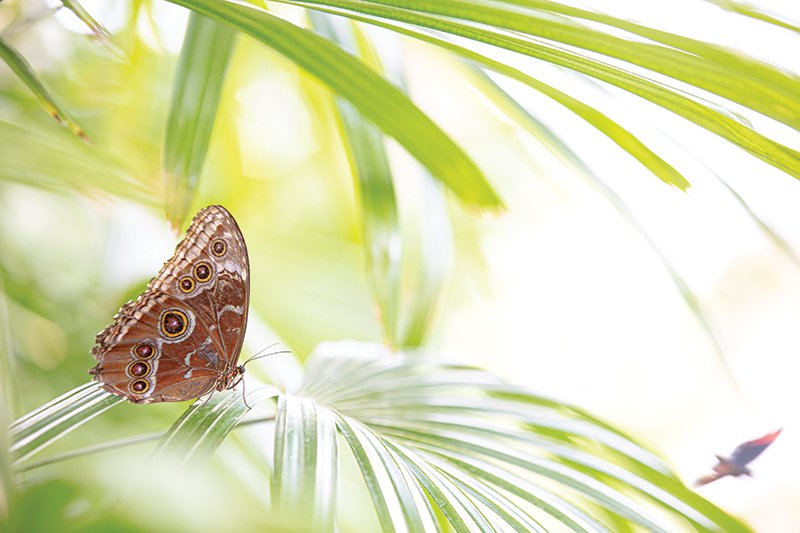
Their work is appreciated, by the children who love being tickled by the butterflies as they float past and by the adults who admire the insects’ dazzling color. The morphos are almost magical: They’re not actually blue. Their color comes from a trick of the light. Morpho wings are covered in scales pigmented with a reddish-brown. But when touched by light, the scales absorb every color except blue, causing them to reflect the vibrant, iridescent hue that gives them their allure.
“They’re also some of the biggest butterflies that we have, so it’s hard to miss them,” says Chris Hartley, the Butterfly House’s science education coordinator. “The morphos are very active. It’s common for them to fly right in front of your field of vision while you’re walking through. So not only do they have those big, beautiful, blue wings, they’ll [actually] fly just a few inches in front of your eyes. It’s, like, Whoa! That’s cool!”
They’re obviously impressive to visitors. For Yankoski, knowing the long journey they make from the Costa Rican cloud forests and the hard work they undertake in hatching from their chrysalises, makes them that much more incredible.
“I’ve raised over half a million butterflies,” Yankoski says. “I hope I never get to the point where I don’t just stop and appreciate how incredible it is to watch it all happen. Thankfully, I’m not there yet.”