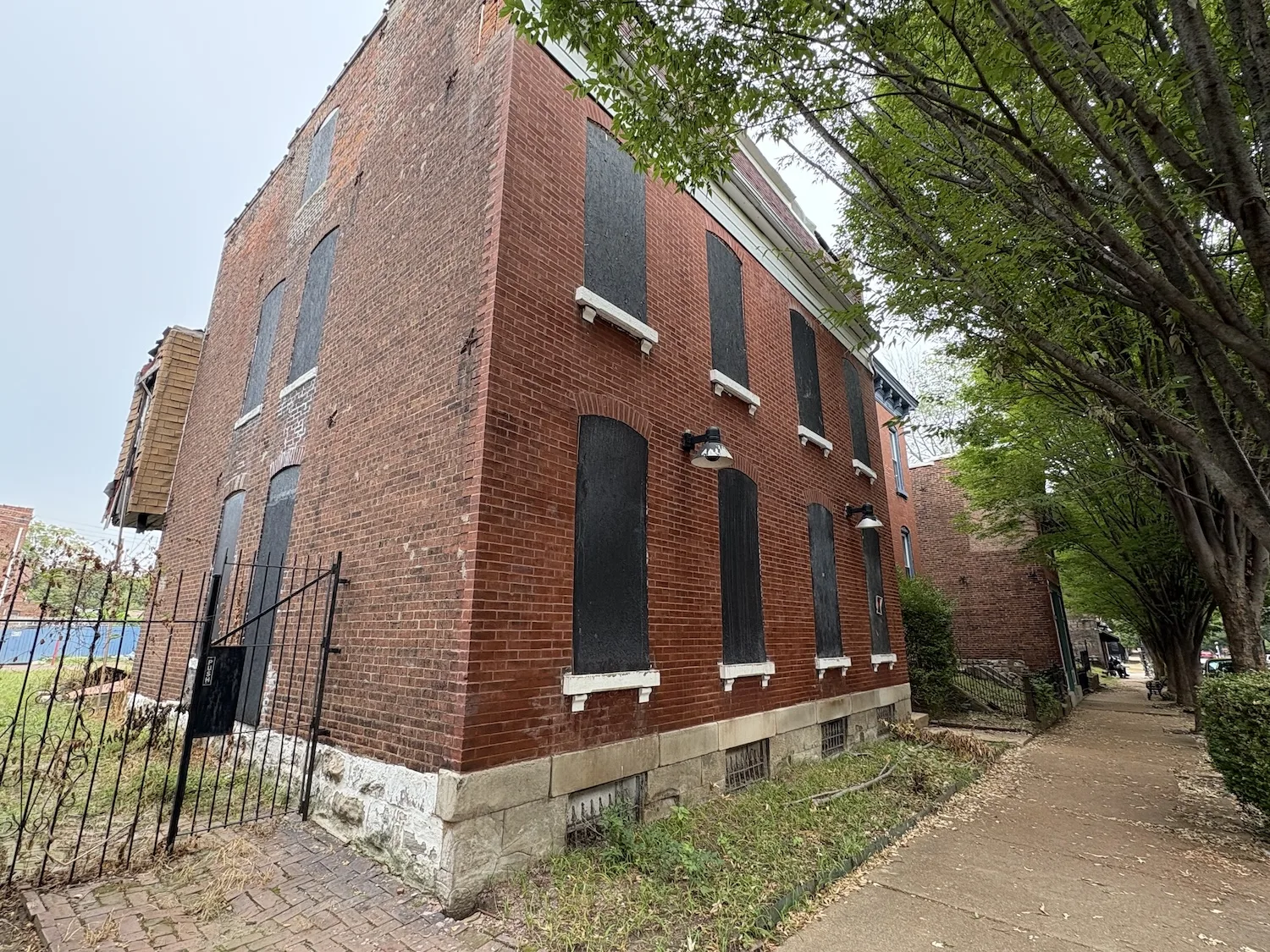
Earlier this year, a neighborhood group wrested control of an abandoned property in the heart of Cherokee Street from a notorious slumlord. They spent $173,000 fixing it up, with an eye on converting the property into a pair of sleek townhomes. But then, after a few months of work, the property was returned to its original owner, under whose previous stewardship the property had been condemned by the city and racked up a slew of code violations.
The saga of the two-story brick building on Cherokee Street’s Antique Row seems to demonstrate the extent to which accused slumlord Dara Daugherty is willing to go to retain her real estate holdings—a significant matter given that the city of St. Louis is currently trying to wrest control of dozens of properties away from her.
Get a fresh take on the day’s top news
Subscribe to the St. Louis Daily newsletter for a smart, succinct guide to local news from award-winning journalists Sarah Fenske and Ryan Krull.
The city previously sued Daugherty in a wide-ranging complaint, alleging that she and her associates devised an illegal rooming house scheme in which they rented out rooms all across south city to vulnerable people in houses condemned for occupancy and unfit for human habitation.
The Benton Park Neighborhood Association had taken action months before the city. They were represented in court by Peter Hoffman of Legal Services of Eastern Missouri, whose focus is on using the legal system to fix nuisance and problem properties. (He declined comment for this story.)
In a lawsuit filed in October 2023, Hoffman argued that the building’s condemned status and its numerous building code violations, along with its delinquent taxes and not having been occupied for at least six months, were sufficient grounds for a judge to declare it abandoned under the state’s abandoned property laws. Those laws allow for an abandoned property to be placed in the hands of an entity willing and able to rehab it.
After almost a year and a half of legal wrangling, Judge Joan Moriarty granted the neighborhood association temporary possession in February.
Over the next several months, the neighborhood group spent $173,000, hiring contractors to haul away trash, debris, abandoned cars, and a marooned boat. They tore down dangerous exterior stairs, boarded up windows, secured doors, and replaced badly damaged brick work, as well as paid off the delinquent taxes. The house’s exterior went from foreboding and falling apart to a sight by no means fancy, but secure-looking, with neat tuckpointing and windows and doors boarded up. The inside had been total chaos: fallen plaster, destroyed furniture, and detritus left by squatters. Now it was a clean, blank canvas.
An architect drew up detailed designs for what the neighborhood association’s Building Review Committee chair Tim Mulligan described as “a pretty innovative plan” to update the building into a pair of townhomes. When all was said and done, the association hoped to sell each of the new townhomes for around $400,000. “We were thinking we’d take a ruin and elevate it to a property worth over 800 grand, putting real estate tax back into the community,” says Mulligan. In late April, Hoffman told the court that the property was now up to code. The neighborhood association asked to be given the deed to the property, at which point they would begin renovating it into townhomes. The filing included a series of before and after photos.
However, just a few weeks later, Daugherty began working to get the property back. The abandoned property laws under which the association was able to get control of the property also allow the former owner to retake possession if a judge determines that the owner has the wherewithal to complete the rehabilitation and if the owner—in this case, Daugherty— compensates the organization for the work that had been done.
But even after Daugherty filed the legal paperwork to retake the building, there was skepticism about her actually coming up with the money to reimburse the association for repairs, which totaled $173,677.
Then came the hearing, in June. “We were stunned when she came in and presented the judge with two checks totaling that amount,” says Mulligan. “We were devastated. We truly did not think she would show up [with the money].”
Mulligan says the developer was “very emotionally disciplined.” He would not see his plans come to fruition, but at least he’d been made whole for his work. Mulligan said that he focused on the fact that the property was in a much improved state.
Now, more than three months later, the building sits boarded up and vacant. One month after forking over the $173,677, Daugherty filed for bankruptcy.
Daugherty’s attorney Elkin Kistner stresses that, at the end of the day, Daugherty funded the repairs.
Asked why Daugherty spent all that money on one house just to let it sit, even as she has numerous other legal battles to fight, Kistner said, “I can’t answer that question. The client gets to make those choices.”
Daugherty’s bankruptcy filing has slowed down, but not stopped, the city of St. Louis’ sprawling lawsuit against Daugherty and her associates. Brought by the city’s Affirmative Legal Unit in January 2024, sought to force Daugherty and her associates, including 11 limited liability companies, to clean up her properties, as well as pay damages.
Daugherty’s bankruptcy filing paused the city’s legal action against her, much to the city’s chagrin. Assistant city counselor Katherine Hummel wrote in a recent court filing that to call it a coincidence that Daugherty’s bankruptcy came the same day as a hearing in the city’s suit against her “would be disingenuous to this Court.”
The bankruptcy initially froze the city’s suit. But last week that freeze began thawing.
The city is conceding that the case against Daugherty is on pause while her bankruptcy works its way through court. However, those protections don’t extend to the five other people the city is suing: Daugherty’s associates Keith Mack, Dack Daugherty, Daniel McAfee (aka Daniel Daugherty), Steven Heinrichs, and Joseph Witthaus, who together, along with their LLCs, own 17 of the 39 properties the city has in its sights.
Based on recent filings made by Hummel, the city appears to be getting more aggressive—asking the judge to hold McAfee in contempt of court and to order Heinrichs and Witthaus to respond to the allegations against them.
Hummel says that Heinrichs and Witthaus have yet to respond to requests for discovery made almost a year ago. McAfee has failed to respond to the city’s latest filings as well, even after an April order from the judge demanding he do so. Hummel wrote in a court filing that McAfee’s “dilatory tactics have gone too far, flagrantly violating an Order of this Court.” She asked the judge to assess a $1,500 fine every day he continues to not respond to the court.
Legal experts say that the city’s wide-ranging case is of a different sort than the one brought by Benton Park. The city’s claim is under public nuisance laws and, crucially, the lawsuit does not specifically ask that the properties be handed over to a third party—though the city clearly hopes that the spectre of fines, damages, and legal fees ought to be sufficient to get the properties out of Daughtery‘s hands.
Proof of that courthouse scuttle: The city did successfully pressure Daugherty to sell one of the 39 properties, a house in Tower Grove East.
Further proof of Daughtery’s stubbornness: she sold the house to yet another one of her associates.