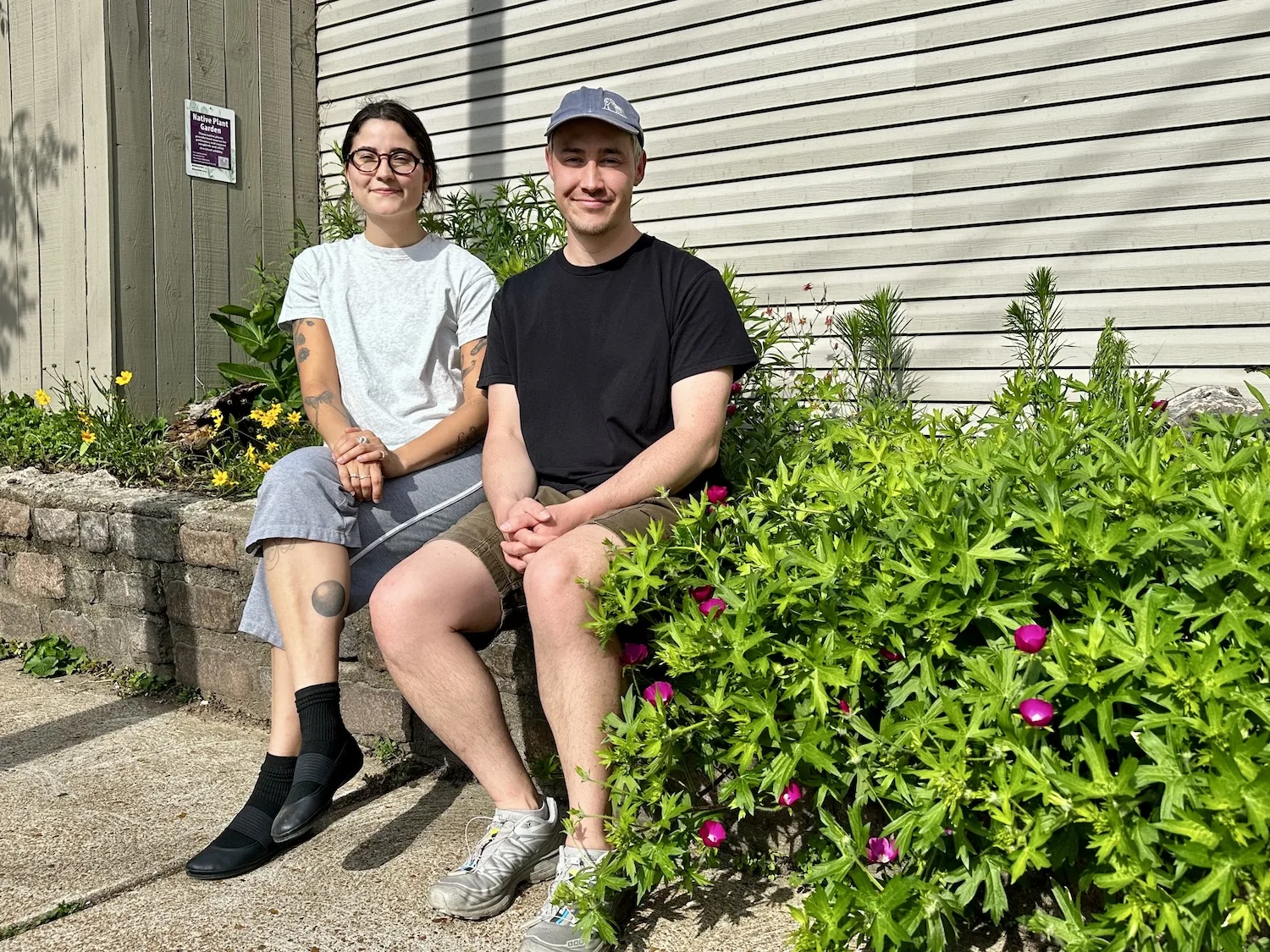
In the alleys of Tower Grove South, where most people see little more than dumpsters, patches of weeds, and clutter, Myles Tan and Rachel Rigden see possibility. It can be easy to miss at first. But squint a bit, and you too might find it in a narrow strip beside a garage, or in a bare square of dirt behind a fence, or even on an unloved and overlooked corner where grass refuses to grow.
For Tan and Rigden, such plots are prime real estate.
Get a fresh take on the day’s top news
Subscribe to the St. Louis Daily newsletter for a smart, succinct guide to local news from award-winning journalists Sarah Fenske and Ryan Krull.
Tan and Rigden are the organizers behind Alley Asters, a volunteer effort dedicated to planting native species in patches of alley-adjacent land in this South City neighborhood. Since launching the project last year, they’ve transformed roughly 50 plots spanning 1,456 square feet—many of them no bigger than a doormat—into pockets of pollinator habitat filled with such natives as milkweed, blazing star, coneflower, columbine, prairie grasses, and more.
“We want to be your introduction to native plants,” Tan says. “We’re the people that put them on your property. Maybe you’re pleasantly surprised by how formal they can be, how pretty they can be, how little maintenance they require. Then, maybe, that curiosity gets you into doing more with your property.”
The project began shortly after Tan first moved to St. Louis in 2022. After replacing the annual plants around his yard in Tower Grove South with native species better suited to the local climate, he started experimenting with the neglected spaces in the alley behind his house. Soon, neighbors wanted some too. Rigden, a former ecologist who now teaches second grade, joined the effort last spring after meeting Tan. Together, the friends have turned a gardening hobby into a neighborhood-sized effort in habitat restoration.
“Meeting Myles and seeing what he was doing, I knew I’d like to be a part of this,” Rigden says. “When you make spaces like these prettier, you’re also discouraging littering and treating the space poorly, which I feel is a really good added benefit in an urban area.”
The premise is simple: Tan carves out free time to walk the alleys of Tower Grove South in search of small spaces suitable for plants, typically a neglected space behind garages or fences. When he finds one he likes, he knocks on the front door to explain his mission. If the homeowner agrees, Alley Asters does the planting for free. Tan says most people he approaches are all in.
“Walking the alleys really changes the way you see space,” Tan says.
That potential shift in perception feels central to the mission of Alley Asters. Beyond introducing ecologically productive plants to unloved and forgotten spaces, the group is asking people to reconsider the purpose of alleys altogether.
“First and foremost, we’re trying to get plants into alleys,” Tan says. “But there is this broader idea of trying to get people to change their perception of an alley from a gross place that they don’t really pay much attention to, to something that can be beautiful.”
Some of the spaces used by Alley Asters are so small they barely register as a plantable plot. Take the mini garden outside Leviathan Bookstore on South Grand. It’s so teeny, it occupies little more than a sliver of dirt in the wall next to the shop’s door.
“No plot is too small,” Rigden says.
The duo believe the small-scale approach can produce surprisingly large-scale benefits, like attracting pollinators, absorbing stormwater, and discouraging clutter. And it helps that native plants are especially well suited to the seemingly harsh conditions found in alleys. Many have evolved in similarly unforgiving Missouri environments.
“The cool thing about natives is that they really like natural soil,” Rigden says. “A lot of these areas have clay soil or soil that wouldn’t be good for a lot of ornamental landscaping or things that people might want to plant in a garden.”
Swing by the rear of Mann Elementary, between Juniata and Hartford streets, to get a good look at the benefits in action. There, Tan and Rigden transformed a trash-prone alley plot into a dense native garden buzzing with insects. During an alley stroll on a recent afternoon, Rigden and Tan spot Monarch butterfly eggs on milkweed they planted.
“That’s pretty spectacular,” Rigden says. “That just shows that this can make a difference.”
Humans are taking notice, too. At last year’s Missouri State Fair, Tan and Rigden entered eight flowers from alley plots in the native plant competition. They won seven golds, one silver, and one best in class.
“It’s a really cool thing that plants from alleys in Tower Grove South are winning the state fair,” Tan says. “Isn’t that awesome?”