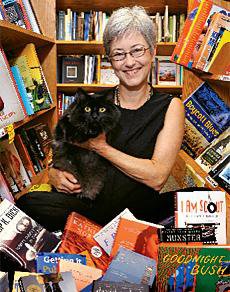
Jarek Steele co-owns Left Bank Books, a rarified center of literature and politics created in part by his wife, Kris Kleindienst. But Steele grew up—female—in a very different world: a trailer on a dirt road in Effingham, Ill., crowded with seven kids. “I didn’t have a lot of context for what I was dealing with,” he says dryly.
“I had five sisters, and they were all really pretty,” he continues. “I knew that if I was going to measure my attractiveness, it wouldn’t be by that standard. We all wore dresses. I tried to be”—he gestures helplessly—“thin or whatever. And I did try to curl my hair. It was disastrous.”
Get a fresh take on the day’s top news
Subscribe to the St. Louis Daily newsletter for a smart, succinct guide to local news from award-winning journalists Sarah Fenske and Ryan Krull.
Except for the misery of pink sponge curlers and alien, legless clothing, Steele felt little discomfort until the confusions of puberty. “I had crushes in eighth grade, and in my mind, I was meshing the two things: I was attracted to the person, and also I wanted to be that person.” Asked who his crush was, he averts his eyes and mutters “Kevin Bacon in Footloose. I’d think, ‘He’s really cute,’ and I became obsessed with learning to tie a tie.”
In her late teens, Steele played bass in a band, hung out with older people, drank: “I thought I was succeeding at being a girl. And I look at those pictures, and I have combat boots on!” At 21, she married and had a son. “I was really trying to squeeze into the role. I left three years later… I had several lesbian relationships. One girlfriend and I, in the privacy of our home, I would be a male.”
It wasn’t until Steele met Kleindienst, who’d had a previous relationship with someone transgender, that a transition seemed possible. “Before, I was too scared: I’d loved lesbians, and they loved women in women’s bodies. Why would they stay if I changed?”
Kleindienst reassured her lover: “I saw you immediately as the person I wanted to be with, and I knew from the beginning that you would transition. I have X-ray vision for these things!” She knew Steele would be skeptical. “I’d been one of the most visible lesbian activists in St. Louis, and not everybody can transition their sexual orientation,” she says. Kleindienst began referring to herself as “queer,” because the word spans more possibilities. And Steele decided to take testosterone and at least have top surgery, to get that long-imagined flat chest.
“When I started transitioning, my son was just going into puberty, so he started getting acne just about the time I was,” Steele says, chuckling. Then the fun drains from his voice. “I left him room to be pissed. And he did get mad, and he should have, because that’s a big change, and he didn’t ask for it.”
When Steele had first told her son the plan, two years earlier, explaining she’d be taking testosterone, “he said OK and then asked me a lot of questions. I told him I needed to be truthful.” Truthful wasn’t so easy midtransition, when she learned that her uncle had died. None of her relatives had seen much of the world; she had no idea what they’d make of stubble on a girl’s face. Her uncle’s funeral should be about the loss of a good man, not the acquisition of an unexpected one. She said she wasn’t going.
“No, you should go,” her mother said. She’d been confused by Steele’s lesbian years, but now the last puzzle pieces had dropped into place, making sense even of her daughter’s childhood—like the times she’d borrow her dad’s razor and pretend to shave. And the way she begged him to teach her woodworking. (He refused; Steele thinks he sensed something well beyond tomboyism and tried to shut it out.)
She mustered her courage and showed up at church. “I was walking out of the funeral, and my Aunt Mary—who’s large and loud and has a cigarette in her hand and is not sentimental at all—comes up and whacks me on the back and says, ‘You shit-ass. You didn’t think we’d love you anyway?’”
Now the sharpest sorrow is the impossibility of a full transition (too costly, for too paltry a result). “The private part is really hard to talk about,” Steele says. “I live from here up”—he slashes his finger across his neck. “The rest is…more right than it was.”
Socially, he’s seen some progress. But the fear of transgender individuals is even more visceral than the old fear of homosexuals, he believes, “because people think they’re being fooled.” Nothing’s scarier than deception in a vulnerable arena. “It challenges your vision of who you are.”
Would a biological explanation help? Research suggests a wash of opposite-sex hormones at a particular time in the pregnancy might contribute to the development of transgender identity. A biological explanation “would probably be comforting to some,” Steele says, measuring his words, “and something to weed out, for others.”
He doesn’t use alternative pronouns like “xe” in place of “he” or “she,” but he welcomes them. It sure beats the nurse who asked, as he emerged from a haze of post-surgical narcotics, whether he wanted to be called “he, she, or it.” And the only comfortable use of “tranny” he’s ever heard was his Uncle Rex complaining, about his truck, “The tranny on this thing is shot.”
After Steele transitioned, he and Kleindienst married. On Facebook, they tagged their wedding “So queer we’re straight again!” Outsiders look with amazement at this marriage: the shift of gender, the double take of sexual orientation, the 20-year age difference. But Steele says the only real stress is working together every day at the bookstore. “I love Kris’ age,” he adds. “There’s nothing not attractive about that.” Then he grins. “I was in menopause with my wife and puberty with my son at the same time.”
After that, you can survive anything.
“How Far We’ve Come”
—The Wall Street Journal, April 22, 2014
> Jared Leto won an Oscar for his portrayal of Rayon, a transgender character in Dallas Buyers Club. (Some activists said a transgender actor should’ve been cast.)
> Transgender Dysphoria Blues: Against Me! draws on singer Laura Jane Grace’s experience transitioning from male to female.
> Laverne Cox, an actress known for her work on Orange Is the New Black, was the first African-American transgender woman to appear on an American reality show, VH1’s I Want to Work for Diddy.
> Hedwig and the Angry Inch: Neil Patrick Harris as a transgender rock star, went from an off-Broadway hit in 1998 to a Broadway triumph this spring.
Click here to read “Will or Grace,” the story of one transgender teenager.