“All aboard! Next stop: Just below the surface of the Mississippi and Missouri Rivers.”
As you walk through the arched entryway to the St. Louis Aquarium, a black split-flap board near the ticket counter flips through guest information in the same fashion that train schedules are updated by the clacking of tiles switching to the next departure.
Discover fun things to do with the family
Subscribe to the St. Louis Family newsletter for family-friendly things to do and news for local parents, sent every Monday.
Upon purchasing your tickets, you’ll be whisked away on a visual train ride. The experience, projected on a large screen, takes you on a journey reminiscent of those in the Magic School Bus books. The train chugs along, flies into the air, then plummets into the water.
“It was really important for us to continue the train theme in the aquarium, to reinforce that we’re in this beautiful, historic train shed,” says Tamera Lash Brown, executive director of the aquarium.
Once guests leave the visual train ride, whose ceiling, equipped with a video display, mimics the tall arched ceiling of the Grand Lobby. The featured exhibit resembles Union Station’s clock tower. “It’ll be an operating clock, because trains live and die by the clock,” says Brown, noting that the tank will feature more than 800 discus fish, selected because their round shape resembles a clock’s. “Visually, it’ll be really cool,” promises Brown.
The first gallery, Confluence, takes guests beneath the surface of the Mississippi and Missouri rivers. Largemouth bass, longnose gar, paddlefish, and other important river fish swim beside and above guests.
The fresh water exhibits continue with Global Waters, the first place in the aquarium where visitors can interact with the animals. Guests can stick their hands in an open tank of doctor fish, a common fish in Asia that likes to nibble on dead skin. “Our goal is that every single guest will get their hands wet at least once,” says Brown.
“If you leave without getting your hands wet in this aquarium, we send you back through,” jokes Aaron Sprowl, the aquarium’s general curator.
An enclosed pop-up window allows kids to get an inside look at the piranha exhibit.
Changing Rivers will be home to the three otters, Thatcher, Sawyer, and Finn, already made famous on social media.
Upstairs, Ocean Shore provides tidal pools that invite guests to touch sea cucumbers, pencil urchins, stingrays, and sharks. (Yes, you read that right—you can even touch sharks!)
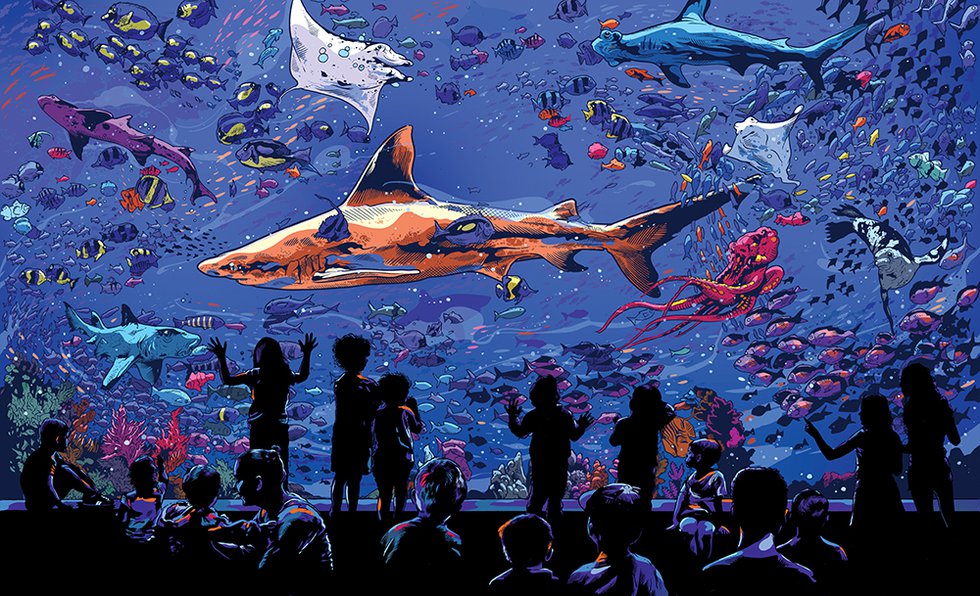
Shark Canyon, with 250,000 gallons of water, is the largest exhibit in the aquarium. There will be multiple opportunities to soak up views of more than 80 sharks and rays, including blacktip reef sharks, sandbar sharks, nurse sharks, whitetip reef sharks, lesser devil rays, and spotted eagle rays.
“Lesser devil rays can get to be 6 feet wide when full grown,” says Erin Clark, director of animal projects. The creatures are like aquatic ballerinas that glide right over you.
“There is going to be a lot of movement, no matter where you’re at,” says Sprowl. “There’s always going to be something to see.”
In total, the aquarium will be the home to 13,000 animals. When deciding which species to include, the curators considered the look they wanted to achieve. “It’s basically like a painting,” says Sprowl. “You put a splash of blue here and maybe a little red here.”
There was also the practical matter of how the animals would coexist. “It starts off as one of those fourth-grade puzzles,” says Brown. “If you put in this, you can’t have this.”
“Trying to figure out 13,000 mouths that would all work together without making it 12,000 mouths,” adds Clark.
There was one mouth the team hadn’t planned for: Lord Stanley, the blue lobster donated by Arnold’s Lobster and Clam Bar in Eastham, Massachusetts. Restaurant owner Nathan Nickerson discovered the rare blue lobster and donated it to the aquarium as a show of support for the Blues, who beat his team, the Boston Bruins, to win the Stanley Cup.
Clark recalls all the fanfare surrounding her trip to Massachusetts to bring the lobster home. “It’s the coolest thing I’ll probably ever do in my career,” she says. The lobster had his own ticket (name: blue lobster) and had to go through TSA pre-check. “Fortunately, lobsters are more common in New England,” says Clark, “so it wasn’t so uncommon for the TSA agent to open a box and see a lobster.”
As for the aquarium? “A blue lobster was not anywhere in our plans,” admits Brown. “A 1–in–20 million lobster is not something you plan for, so once he arrived, we did a little scrambling to find out where to put him.”
Ensuring that all of the animals have a comfortable habitat has been an important part of the planning process. In the touch pools, there’s a recessed area where animals can go if they aren’t in the mood to be touched. In the larger bodies of water, animals have places to find refuge as needed.
“Our highest priority,” says Brown, “is making sure our animals are thriving and healthy.”
Imagination Station
When Lodging Hospitality Management bought Union Station, in 2012, the firm didn’t yet know what it would do with the building.
“We’re hotel people, so anytime a hotel comes up for sale, we take a look,” says LHM president and chief operating officer Steve O’Loughlin. They decided the space had plenty of potential. “This is what we do: We take projects that need new life and come up with a new story.”
One of the first things that LHM did was create a light show on the Grand Hall ceiling. The firm also converted the midway into convention and exhibit space. Initially, though, LHM didn’t know what to do with the mall, just that there was potential beyond retail. They began thinking about voids in St. Louis and hit upon the idea of an aquarium.
They hired St. Louis firm PGAV Destinations to envision how an aquarium might fit into the footprint of a 125-year-old train station. Adding to the complexity: Union Station is on the National Register of Historic Places, so all of the work needed to follow strict guidelines.
PGAV vice president Emily Howard saw the project as an opportunity. “This building means so much to St. Louis,” she says. “When it was built, it was the hub for transportation; it’s where everyone came through. Trying to imagine how people could rediscover this beautiful building was a big challenge.”
One of the first hurdles was making sense of the architectural drawings, which were very different than when the station was originally built. Contractor McCarthy Building Companies digitally scanned the construction site to help create a 3D map. They decided to make the aquarium a two-story experience and accentuate the building’s features.
“For aquariums, you want it to be dark, but we have that beautiful open train shed that we couldn’t cover up,” says Howard. “So we took advantage of that with a two-story experience, where the upper story could see that beautiful train shed, and that becomes an active space, so the other spaces can be darker,” she says. “That was an opportunity that we saw within that challenge.”
In addition to honoring a St. Louis landmark, PGAV decided that the aquarium should share a local tale. “They came up with a story that tells the history of St. Louis and puts people in a position that they have never been in before: beneath the surface of the Mississippi River,” says Clark.
In fleshing out the local angle, Howard says, they kept thinking about the rivers and trains. Eventually, a theme emerged: connection. “The trains connect us to the whole country, and the rivers connect us to the Gulf, the ocean, basically our whole planet,” says Howard, who seized “that idea of connection and connecting people with these beautiful animals.”
It’s that connection to people that excites Brown, Clark, and Sprowl, all of whom moved to St. Louis to be part of the aquarium. Clark, who came to St. Louis from Abu Dhabi, says she’s always wanted to work at an aquarium and likes being able to give the chance to see one to kids who haven’t had the exposure she did, growing up on the East Coast: “Opening the opportunity for more science, more environmental causes, more animal care causes.”
“I am most excited to see the reaction of the guests,” Brown concurs, adding that education will be a significant part of the aquarium’s mission. “There is quite a buzz in the aquarium industry about this project, because it’s in this beautiful historic building and it’s uniting technology with major animal exhibits.”
Sprowl, who moved here from Australia, has helped create aquariums all over the world. He says there’s something special about opening one in the heart of the country. In some ways, he says, it goes back to connections, about being able to offer people in a landlocked area “the opportunity to see such wondrous creatures.”
Union Station through the years
1894
Designed by architect Theodore C. Link, Union Station opens September 1 after a $5.5 million construction process.
1902
Union Station is expanded to house the anticipated crowd for the 1904 World’s Fair.
1920s
Union Station is considered the largest railroad terminal in America, with more than 321 trains moving in and out in a 24-hour period.
1943
More than 1.3 million railroad tickets are sold. Traffic during this year consists of 72,621 trains and 22 million passengers.
1970
The station is declared a National Historic Landmark. In the same year, Union Station Hotel closes.
1974
Terminal Railroad Association of St. Louis sells Union Station to Union Center Venture for $2.5 million.
1978
Amtrak’s trains leave the station for the final time, Union Station Venture sells the station to Oppenheimer Properties the next year.
1985
After a $150 million renovation, Union Station is reopened with a 539-room hotel, shopping center, and dining.
2011
The facility, then a Marriott Hotel, is expanded, and the shops are moved to the train shed shopping arcade.
2012
Lodging Hospitality Management buys Union Station and the hotel is rebranded as St. Louis Union Station–A DoubleTree by Hilton Hotel.
2013
The midway retail area begins to be converted into an exhibit hall and meeting rooms.
2016
The hotel joins the Curio–A Collection by Hilton portfolio. LHM also announces plans for a $45 million aquarium.
2017
A groundbreaking ceremony kicks off the renovation.
2019
The St. Louis Wheel and The Soda Fountain open first, followed by the aquarium and other entertainment options.