They were 10 years old, and they’d read Kon-Tiki, so they built a boat. It had a compartment where they could sleep, a top deck, a sail, empty water bottles to make it float, and cargo: five giant jars of peanut butter and five gallons of milk (to last them to Tahiti).
Mike and his buddy launched their 12-foot boat into one of the labyrinthine canals of Boca Raton. It sailed smoothly all the way to the second canal, which was larger and a bit more challenging. When they tacked into the third canal, they saw alligators and, about 1,000 feet ahead, a blue strip of ocean. In between, big ships churned the water, tossing and engulfing their tiny craft. Reality sank in: They’d never make it to the ocean.
Keep up with local business news and trends
Subscribe to the St. Louis Business newsletter to get the latest insights sent to your inbox every morning.
They traipsed home and thought it through. At least Mike did—the other kid had left it up to him. How to get past the waves? Finally, it came to him. He threaded a huge length of nylon rope through an opening in the front of their boat. They’d use stakes to stretch it from one side of the canal to the other. When a boat passed, the rope would hook on, and they’d be towed out to sea.
His plan worked. A big white boat hit the rope and, with a whoosh, they swept across the waves and into the ocean, where they paddled furiously for about 20 minutes—until their boat sank.
They lost their fishing rods, their peanut butter, their boat. They swam to shore and walked home. But defeat did not stop the dreaming.
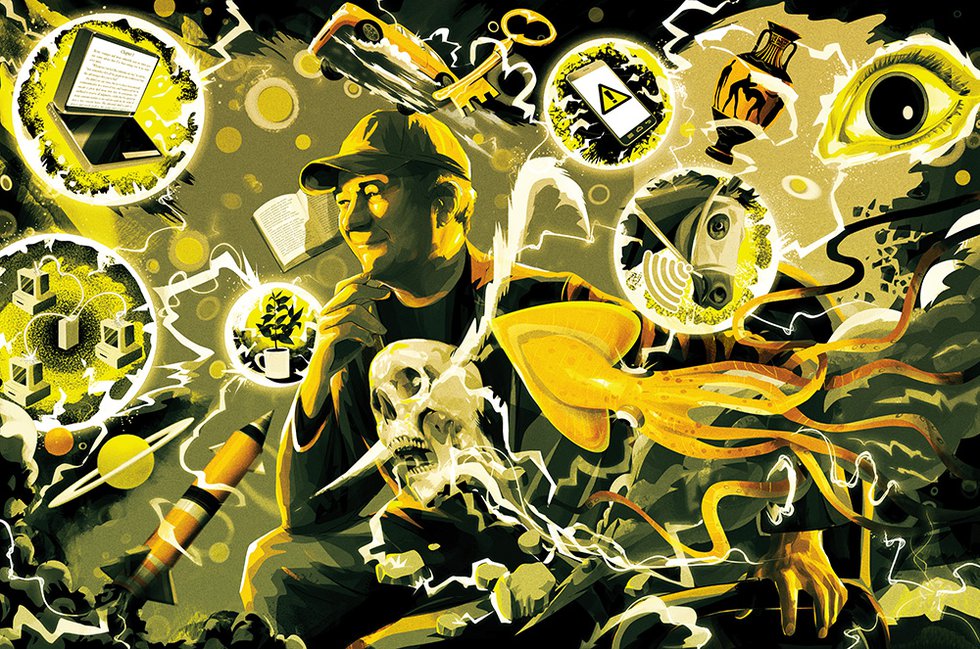
Michael Saigh would grow up to be an inventor—feverishly thinking up solutions like a gambler at the craps table, hoping each time to get lucky. Years before Kindle or iTunes, he would come up with a framework for mobile access to databases. He also envisioned an alert system that takes over your phone during an active shooter attack, an investment network that could turn masterpieces and rare antiques into liquid assets, a smart bit that just might revolutionize horse racing, and—his latest, as-yet-unrealized hope—a way to bring manufacturing back to the U.S. and stabilize the economy. Saigh would stay under the radar, living quietly in St. Louis and assiduously avoiding the spotlight, but those who came to know him would declare him a genius.
Mike wriggled down from his uncle’s lap and fished a long curl of paper out of the trash. Fred Saigh watched that ticker tape for his thousands of stock holdings, then clipped out the quote and pasted it in a notebook. When he missed one, it was his young nephew’s job to retrieve it.
Fred was quite a mentor. He had received his law degree at age 21, handled the divorce of one of Winston Churchill’s daughters, started a company, bought the Railway Exchange and Scruggs-
Vandervoort-Barney buildings, then snapped up the St. Louis Cardinals. He sold the team to Anheuser-Busch in 1953 for far less than he would have made from an out-of-town buyer because he wanted the Cards to stay in St. Louis.
Fred had a cool life—he’s in a crowd shot in Casablanca, even—but he worked constantly, even gardened in a suit. Later in life, he was convicted of tax evasion, and serving time in a federal penitentiary siphoned some of the verve from his personality. Nonetheless, he lived to age 94 and died worth about $500 million.
Business acumen coursed through the family. Mike’s grandfather, a Lebanese immigrant, had made money buying Piggly Wiggly stores. Mike’s father, Bill Saigh, was a business professor and restaurateur, founding the beloved Lettuce Leaf chain. Mike’s Aunt Rose, “had all the sweetness, but she was smarter than Fred and myself put together,” as he soon realized. “She could multiply five digits in her head, and the family didn’t give her credit at all.”
He played only one prank on his adoring Aunt Rose, and he still regrets it. Knowing that all of
St. Louis was in a tizzy about the “Athletic Bandit” who jumped on bank counters during his heists, Mike let Aunt Rose see him “practicing,” dressed all in black, wearing a mask, carrying empty bank bags he had filled with rocks, and jumping up and down on the picnic table in the backyard. That night, when they sat down to watch the news, she was holding back tears. She blurted that he was ruining the family name—and just then the news came on that the bandit had been caught. She hugged her beloved nephew in relief. He felt like a cad.

In 1965, the year after the dream boat capsized, Mike launched Operation Coffee Bean, one of a zillion schemes he dreamed up while sitting on the bench at Khoury League baseball games because his dad was the coach and insisted that he join but never let him play. After reading that coffee beans were a hot commodity, Mike dug out his little green bank passbook and cashed out the account that was meant to teach him to manage money. He ordered thousands of seedlings so his customers could grow their own coffee.
The little plant trays filled every square inch of the house and much of the yard, and bugs wriggled out and climbed into the draperies. His parents were livid. “Get. Rid. Of. Those. Plants. Now!” He pointed out that he could not drive. They hired a kid with a truck. Meanwhile, he was selling the plants anywhere he could—only to learn that they carried a weird disease that killed other plants. Plus, they wouldn’t grow in St. Louis’ climate.
His parents banished him to boarding school in England.
Summoned back from exile, he finished high school at the Whitfield School and went off to Cornell University. After college, he went to Europe and played soccer with a few second-tier teams. His times were good enough for the Olympic trials, but as luck would have it, that was the year the U.S. boycotted the Summer Olympics in Moscow. So he came home and earned an MBA and a doctorate in business administration at Webster University.
Along the way, another idea popped: self-rising pizza crust. He had realized, by paying attention to an old family recipe, that self-rising flour stayed fresher. A Chicago company bought him out, promising royalties, but went out of business shortly afterward.
Saigh told himself it was time to get serious, to invent something viable. In the mid-’80s, he was teaching business at the University of Missouri–St. Louis when he began designing a system to turn physical textbooks into e-books. Why should publishers waste money printing all those heavy tomes when a book could be sleek, contain audio of the author explaining a tricky bit, allow easy updates as information changed, and let you highlight key points? At the time, the idea felt radical. More than 500 years had passed since the Gutenberg Bible was printed. Could he really be involved in the first profound change in information dissemination since 1450?
Along with the e-books, Saigh came up with a system for video on demand, protecting intellectual property by dissolving what was rented after a certain time period and using ads (as we see today on YouTube) to pay for the cost. He hired two engineers from Emerson, started a patent process, put a clean room into the basement of a building in Webster Groves, and built a prototype. Hitachi had helped him develop a color screen for his device, the size of one of today’s large iPhones but thicker.
He was married by now, with a son, but he used every scrap of free time to work on this idea. It so consumed him, he would later blame the obsession for his divorce.
In 1989, Saigh flew to New York with no luggage, carrying his prized invention in his arms like a baby. He’d rented a banquet room in a hotel in Brooklyn and invited all the major textbook publishers. Part of his deal with the hotel was that he’d set up the room himself, so he dragged the burgundy chairs stacked against the wall into row after row, hoping for at least 500 people. Then he schlepped food from a nearby deli and cut sandwiches into small pieces, setting them on trays next to the big coffee urns. Palms tingling with sweat, he tested his presentation. It worked fine.
People streamed in, arriving from Manhattan, New Jersey, Boston. He scanned the room. Nearly all the chairs were full. Saigh rose to welcome everyone and gave an enthusiastic explanation of how cumbersome physical textbooks could be replaced with electronic versions. He moved to start his demo.
It didn’t work.
Heart pounding, he pressed buttons, rebooted—nothing.
“That’s how it always happens, Mike, don’t worry about it,” called a nice guy from Simon & Schuster. Devastated, Saigh went to his slides, which at least showed pictures of the system working. But people began to slip out of the room.
Back home, he fixed the demo, but still, nobody was interested. He kept a notebook of all the rejections. Missouri Book Co., owned by Barnes & Noble, didn’t like the idea of competing with a used book. Other publishers said, “It sounds awful—you can’t get it autographed and can’t put it on a shelf,” or, “No one will ever read electronically.” In 1998, he took what he was now calling IP Network—his way of protecting books, music, video, anything you could load onto a device—to Apple, which waved him away.
In 2000, Motorola called. They had started a new company, smallglass, and wanted his patents for the mobile environment. Their board, though, wanted to know who would control content—the hardware or the carriers? Motorola’s marketplace was its carriers; they couldn’t risk destroying that relationship. Saigh sat in the lobby, waiting for them to vote. He had now been working on this project for 15 years.
The approval was one vote short.
“The smallglass people, they saw what I saw—all these things we can do today,” he tells me. “I remember the look on their faces. We all got on a train—we were drinking, didn’t care where we went, and about three days later we found ourselves someplace and came home.”
Finally, in 2002, Paul Allen (formerly of Microsoft) bought his patents and licensed them to Google and Apple. Saigh says he received a sliver of the profit in royalties.
“Dottie’s cats keep stealing her dentures,” Saigh’s mother told her son the inventor in 2014. “They hide them behind the furniture, where she can’t reach. I told her you might be able to help.” He sighed and agreed to meet with his mom’s friend—but no promises.
She brought two dentists with her, and they met in a conference room in Saigh’s office. The dentists dutifully explained the anatomy of the mouth, which made Saigh think of dentures and devices that you put in the mouth, which made him wonder what would happen if you put biosensors in a retainer. You could take readings—maybe coaches could track the physical condition of their athletes that way…
Sensor technology at the time was too big to fit comfortably in a human mouth—but horses had big mouths. Saigh read that the equine bit had not been significantly improved in 3,400 years. About 10,000 horses are euthanized annually, and often the rationale is guesswork. Thoroughbreds get overworked on the track and wind up broken.
By adding sensors to the bit, “you can see the horse’s anxiety level,” Saigh says. “You’ll be alerted if something is off, if the training’s too intense. All that data can be analyzed to make the thoroughbred more competitive and treat it more humanely. It’s Mr. Ed—the horse really is talking to us.”
Equine SmartBits received an Arch Grant in 2018 and a Cutting Edge Award the following year from the St. Louis Business Journal. Now Saigh has formed an umbrella company called Salivāt, because sensors have become small enough to develop a human version. A smart armband can tell a coach when to sub in a different athlete; a smart retainer could have told Aunt Rose she already took her morning pill. Saigh’s team is also working on a version that attaches to a milking machine to monitor the health of dairy cows. And a companionable set of sensors will tell you if your dog is enjoying your walk as much as you are.
Five patents are pending, and a sixth was granted this year, arriving with a ceremonial ribbon. It protects Saigh’s right to explore the animal-human bond with his smart devices. He was surprised that was the first patent granted, because in his view, “it’s a kind of gamification rather than a true patent. It’s just putting a little tag on your dog’s collar. You compare biometrics when you go for a walk together, and you have a better idea how much to feed the dog, how much exercise he needs, how healthy he is.”
With sensors, “you can see your dog’s heart rate increase when you come home,” he continues. “You can tell if he’s tired; you can see how he reacts to different situations. You can learn a lot by a horse’s movement, how they hold their head. We can eventually compare: Is this a compatible horse or dog for you?” All sorts of metrics will eventually be possible with these sensors: heart rate, blood pressure, respiration, oxygen saturation, blood sugar, dehydration, nutrition, calorie-burning, body temperature, inflammation, lactic acid, medication effects, mood.
But what about Dottie’s dentures?
He grins. “She got implants.”
The need for an emergency alert system on people’s phones struck Kevin Arndt after the shooting at Virginia Tech in 2007. A mutual friend suggested he talk to Saigh. Arndt envisioned a school-based system, but Saigh said, “Why not make it for everybody?” He came to stay at Arndt’s home for a week, and they hashed out the patent application. “It was 100 percent back and forth,” Arndt says. “I’d say something, and he’d go off on this brilliant tangent that wasn’t really a tangent. I could not in a million years say I created it, or he created it; it was as close to 50-50 as you can get.”
They wanted people in an active-shooter situation to know how close the shooter was to them, what exit route to take, and when it was really over. (There had been a false all-clear at Virginia Tech.) They also wanted to overcome people’s reluctance to get involved if they saw a crime being committed; this would keep them safe as they alerted the police. The program could even take over a phone’s audio and video, and stream evidence to the police in real time.
Arndt and Saigh filed their Push to Alert patent at the start of 2008—too soon. The first iPhone had just come out; only the tech-obsessed had one. The New York City Police Department endorsed their idea, as did the International Police Association and Homeland Security, says Arndt. But most of the nation’s 911 systems were so out of date they could not interface.
Saigh and Arndt later spun off another company, Press to Protect, using the same concept but within a school, acting as instant alarm and alert, guiding to exits, corralling a shooter by triggering automatic door locks. They’ve licensed it out, Arndt says, “but now there are 100 iterations, even one baked into your iPhone.” He sighs. “We were just two guys shopping our patent. Personally, I think the big companies stole it.”
Saigh continued thinking about security: phones that could detect biochemical attacks or viruses, new ways of calibrating gun safety. He and a colleague, Shower Zhang, applied to patent a comprehensive, standard system that could disable a drone being used for a terrorist attack, cutting out its electricity and bringing it down safely, away from public areas.
He does not let frustration stop him.
“I was angry at the publishers for not having vision,” he concedes. “I’m angry at how tech hasn’t gone to the masses faster. At the utilities for not having the vision of net metering, for buying carbon credits instead of doing the right thing.” (He has also worked on alternative energy sources, spinning off a company called Coaltec Energy that gasifies manure and waste grain.) But he is getting used to being ahead of his time.
“Several of his patents, I’m pretty sure people will appreciate decades later,” Zhang says, “after he’s gone.”
Saigh’s condo used to look like a museum, lined with paintings and sculptures that his uncle had bought, paintings he’d bought himself, his baseball collection, his collection of 1870s Edison phonographs, old cylinders of tinny sentiment and frenetic ragtime…
He gave it all away and painted every wall gray. Too much stimulus. He needed to clear the distractions, calm his mind into focus.
That mind is his blessing and his curse. He moves from one thing to the next because 20 ideas are dancing in his head at once, glancing off other ideas, gathering luminosity. I picture fireflies, bits of dancing golden light that refuse to hold still, and Saigh trying so hard to catch them that the rest of the world glides past unnoticed.
“I’ll remind him that there’s a patent meeting,” says Zhang, “and he doesn’t pay attention; he goes off on his own and misses the meeting. Again. I always tell him, ‘I think God is fair, because he has given you so much and then taken away something else.’”
A chemical engineer with an MBA, Zhang is hardly dull witted, but she can never quite figure out where Saigh’s ideas come from. The team watches slack-jawed as possibilities light up; there is no visible linear path the rest of them can follow. “He is just wired differently than we are,” she has decided. “And he knows so much. He can sing every song from the classic old musicals, and he can name the composer of a piece of classical music just by listening to the beginning.” He knows Shakespeare and soaks up history, using it to understand today’s rapid-fire changes. “How could you remember all that,” Zhang asks, “and not what you ate for breakfast?”
Dorothy Jordan has helped Saigh prepare patent and grant applications for years. “He overwhelms you with information,” she says, “and his brain, once he starts, just goes from one thing to the other to the other. He invents things the way you and I read a newspaper—it’s that casual, and it’s that consistent.” She worked at a national lab for years, and it was “full of the brightest of the bright. Mike excels beyond any of the Ph.D. physicists and nuclear engineers I’ve known. He has so many new ideas, there’s no way he can implement all of them.”
He’s also funny, Jordan adds, when he knows you really well. The punch lines dawn in stages, and you laugh harder as you see the layers and connections, the wordplay, the wit.
“He’s got a beautiful mind,” says Arndt. “But I would hate to be inside that mind—it must go 24/7, and it bounces back and forth between the abstract and the concrete. When you’re doing patents, he once told me, ‘You have to let go of the reality you know today.’”
Saigh’s explanation? “I’m just plain nuts. I’m not good at any specific thing, but I can put things together.”
Five years ago, only one person in the world knew where Saigh was. He had moved to a remote place and turned off his cell phone, so no one could triangulate his location. He paid cash for everything, “went back to the Stone Age,” he says. Saigh wasn’t coming out until the trial ended.
A lawyer representing Apple had contacted him, asking him to support a lawsuit based on his patents, which they had licensed from Allen. Still bitter over Apple’s rejection of his e-book idea, Saigh says he replied, “OK, I’ll do it, if you pay me—” and named the deliberately ridiculous sum of half a million dollars.
Er, no. All they had to do was serve a subpoena, and he’d testify for free.
Of course, that meant they had to find him.
The process servers tried his home and office, his mother’s home, his place in New Mexico…
As soon as the trial ended, he came home.
“By the way,” he says, “they lost.”
“Slow down!” Zhang hisses. Saigh is heading out of the meeting, moving at his usual clip. He walks fast, talks fast, reads fast, sees no reason to linger for chitchat.
“I’m done,” he says. “I want to be efficient.”
She sighs and shakes her head. What he wants, she knows, is to go back into his own world, catch a few more fireflies.
Because Saigh’s thoughts stream so fast, says another team member, Bill Masurat, “he doesn’t wait to get signals or filter his communication.” Hired to help with fundraising and operations, Masurat is trying to get Saigh to talk a bit more about himself, just so people can trust him. “I didn’t know who he was,” says Masurat, “so I did research, and I still couldn’t find out who he was.”
Unfailingly kind, Saigh is not necessarily attentive; he is warmly concerned about others’ welfare but preoccupied by his ideas and projects. He loves dogs unstintingly—all that simple, forgiving, enthusiastic affection—and connects instantly to kids. “They wonder,” he explains. “They are intrigued by life and by new things. You have to talk to them before society discourages them and makes them conformist.”
Yet when I ask to speak to his son, Saigh conveys a message from him: “You were always there, but you weren’t there. She’ll know what I mean.”
It sums up Saigh’s deepest regret.
“Inventors are naturally introverted,” he says. “We really just don’t connect very well.” Nor does he ease up, lighten up, chill. “You take all the knocks, you have all the risk, you burn so many years. You ruin your family—and this is a common theme, not just me. I was divorced. I hardly saw my son. I’ve had all sorts of stress-related physical problems. You pay a dear, dear price for an idea.”
And when your ideas are so fresh, they are ignored? “I’ve had tremendous bouts of depression,” he says, “but you pick yourself up. You think of a new idea. Then another.” His voice brightens. “You get absorbed. You only have a couple tidal-wave concepts in your life—I had maybe three. The rest are mediocre. But you keep going.”
If his latest idea—a “trade secret” that he believes will restore U.S. dominance in textile manufacturing, bring work home, and bolster the economy—finds enough support, he will rest easy. But he’s worried that as a lone inventor in the Midwest, he won’t be able to reach the people who can make it happen. “I’d need a consortium of U.S. government and business,” he says. “If that works, my life is absolutely fulfilled.”
Just when friends had pegged Saigh as an absent-minded loner genius, he’d call and ask, “Want to talk to Paul Newman?”—and sure enough, Newman would be sitting next to him. Once Saigh was on a boat in Baja, holding steady while marine biologists stitched a gash in a baby whale’s blubber, and at the celebratory party afterward, Jonas Salk, the scientist who developed the polio vaccine, walked in. They got to chatting, and Salk invited Saigh to tour his lab.
He gets as excited about those experiences as anybody else. But stuff for its own sake? “You’d never know he came from money,” says Arndt, pointing out that he drives an ancient Nissan Altima and lives in a modest home (with gray walls).
I ask how he managed to escape the clutches of acquisition.
“I looked at a bunch of rich friends,” he says. “When you are living on Fordyce Lane”—in Ladue, where he grew up—“you have a person across the street who inherited a big company. She had a swimming pool, and that seemed to be all she ever thought about. She didn’t like it, so she dug it out and turned it in a different direction. Didn’t like that, so she dug it out again and gave it a different shape. And I thought, ‘Is this important?’”
He has used money for freedom, pursuing dreams he knows would be a luxury for people worried about their 9-to-5 jobs. “He’s not going to inquire about your net worth, the way people will subtly get around to ‘What do you do?’ as they are deciding if they want to associate with you,” says Jordan. “Mike is not that way.” Indifferent to class, race, and gender, he is a snob only about intelligence—and in tribute to Aunt Rose, he is an especially staunch supporter of older women whose brains go unnoticed by the rest of society. He made Jordan take an IQ test just for fun (never again, she warned him), and one of his rare fears is losing his own sharp edge. He cannot abide laziness, she says. “He doesn’t understand how people can not be motivated, and that frustrates him.”
It’s the hardest part about watching rich friends, he says: “the waste of time. They are going to the country club, they are golfing, and they should have other aspirations. They have the wherewithal and the knowledge to really change things, but they are out to pasture.”
Why does wealth so often replace drive? Because you are expected to do certain things, conform to certain expectations, he says. “You follow others. So people end up not having a mind of their own. They don’t have the fire in the belly. They will help you, but they won’t go out of their way to be part of what you’re doing. There’s no excitement in their life, just comfort.”
Saigh closes his eyes for a few brave seconds. He is a guest, not for the first time, at a ranch in New Mexico where Teddy Roosevelt’s Rough Riders trained. He is painfully aware that he is not a Rough Rider or a cowboy, and he is having a tough time keeping up with this roundup. But out here, he can dream himself back to 1898, and when he opens his eyes again, nothing contradicts the notion. The ranch is still 180 square miles of free range, not a wire or utility post in sight.
This is Saigh’s version of comfort. For once, he feels entirely relaxed, the coil of intensity sprung. There is peace in this cracked, dusty ground, elation in its distance from urban life, high society, and baffling social niceties. He jounces along on BJ, the mule he risked ridicule by choosing. “A good cowboy or cowgirl wouldn’t be seen on a mule,” he says. “They’re not cool-looking, and they’re slower, and they have these huge ears. But they’re smarter.” Also more sensible. “They watch everything because they don’t want to get hurt.” BJ has saved his life at least three times, he says. “And whenever I guided him incorrectly, he resisted and put me on a safer path.”
When the mule grows too old to go on roundups, he will see Saigh at the paddock fence and trot over as fast as he can, eager to be stroked and sweet-talked. He will never fail to recognize the man who knew his worth.
Liquid Rarity Exchange is another of Saigh’s inventions, and his son, Andy Saigh, is currently pushing it forward. The idea—radical, quirky, egalitarian—is to make it possible for people with ordinary incomes to invest in, say, a Picasso or a Stradivarius first strung in the 1700s.
“You basically become a shareholder,” explains Zhang, “so now thousands of us together can own one.” She’s been working on the security side, figuring out a tiny, proprietary sensor that would monitor storage conditions—“because these artifacts are very fragile”—and could also be used for tracking, should a thief as adroit as Lupin mastermind a heist.
LRE has had a slow start: “The patent office had no clue what to do with it,” Zhang says. “There was, in patent language, no ‘prior art.’” Now comes the tough part, commercializing the idea. Could this kind of investment really pay off? The Mei Moses Art Indices, which monitors sales at auction, has often outperformed the stock market. And there are already hedge funds that invest in art or wine collections, but they are available only to the wealthy. The Saighs want to open that up.
“I’d wager that a mechanic who’s working on a [vintage] Bentley is more excited and knows more about how it works than the wealthy investor who’s riding in one,” Mike Saigh told Businessweek.
Meanwhile, interest in NFTs, or non-fungible tokens, is exploding. Saigh’s idea is based in physical artifacts; NFTs exist only digitally. But as with Kindle and YouTube, he got there first.
After hours of conversation, I realize with a start that I know nothing about Saigh’s parents, just Uncle Fred and Aunt Rose. I tiptoe into the question.
“My parents, even though I loved them, shouldn’t have been parents,” he replies with his usual candor. “I grew up with constant fighting between the two of them. I’d look at my friends’ parents, and it looked so peaceful. The only thing I wanted to do was run away. Or sail away—tried that one!”
His grin fades. “I blocked most of my memories of my childhood,” he says. “Aunt Rose and Uncle Fred gave me much more love than I deserved.”
As his words sink in, I wonder where he landed, with that combination of pain and genius, on life’s deepest questions. Is he religious? What does he think we’re all doing on this broken planet?
“I was Church of Christ. I was Catholic. I was Episcopalian. I got disenchanted,” he says. “At the moment, I’m Church of Christ”—mainly because of time spent volunteering at the Mind of Christ Church in East St. Louis. Watching the Rev. Darrell Chapman feed and mentor thousands of kids, Saigh felt like he was learning “how to be a good person late in my life. He taught me humility.” If he could change one thing about himself, Saigh says, “I would see the good in people more than I would see the bad. Pastor Chapman never complains, ever. I gripe all the time.
“There’s no question that we are here for a larger purpose than eating and watching TV and trying to survive,” Saigh continues. “Every day is precious, and if we don’t accomplish something, even something little that brings a glimmer of hope… I have 20 different projects. A glimmer of hope on one, a breakthrough, a way to help society—I think inventors should fight for something good, always.”
As for God, he says, “I think he has too much to do. I believe we are not the only planet with intelligent life, and we have billions of people here all asking for help… I see God more as a spirit than as a person. But I do think there’s a real battle between bad and good. It’s continuous, and it’s insidious.”
If he could change one thing about the entire world? He snorts. “How could I change just one thing? Got to have 20!”
Another recent epiphany was realizing how much he needs other people on his side. “You can’t force anything down anyone’s throat. You have to have people around you who are just as tenacious as you are.” Assembling a team instead of blazing through alone has brought an unfamiliar contentment—and it’s shoring up his ability to turn ideas into reality.
“A patent lives only 20 years, and then it goes into the public domain,” he explains. “A lot of what makes one succeed is the ability to gather the cast that will actualize the invention. It’s like Citizen Kane: You need producers and directors and actors. Without that, your idea’s going to break apart like an old raft.”
And then you’ll just have to come up with something else.