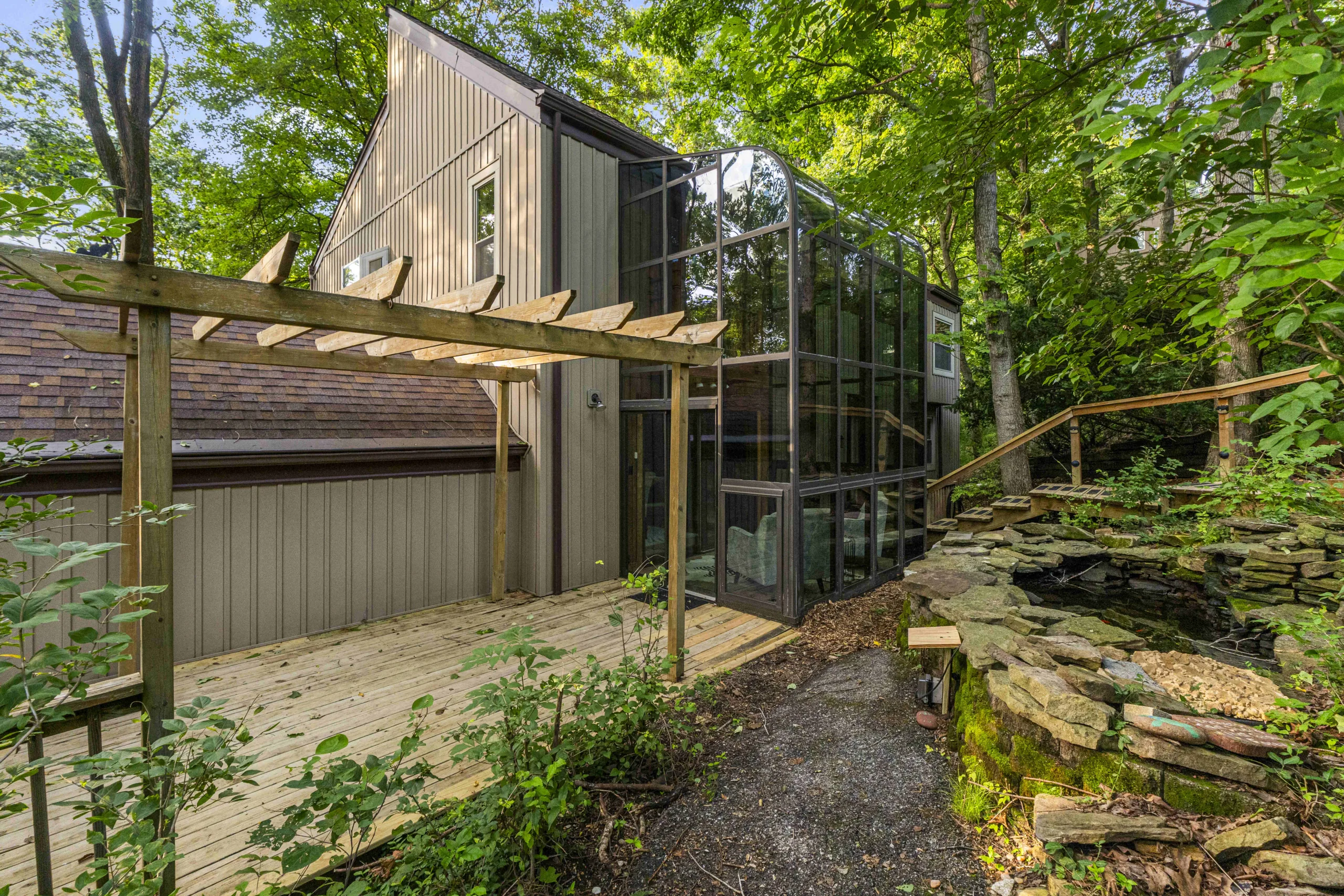
Located between Spoede and Mosley roads on land that was once the site of a dairy farm, Ladue Estates is a neighborhood known for its Midcentury Modern architecture and green spaces that run unobstructed from one property to another.
The development’s homeowners embrace the open countryside atmosphere intended by designer Cay F. Weinel and builder Goldberg & Co.
Get a weekly dose of home and style inspiration
Subscribe to the St. Louis Design+Home newsletter to explore the latest stories from the local interior design, fashion, and retail scene.
“They wanted the neighborhood to look like the country,” says Mario Conte, a resident and trustee of Ladue Estates, during a recent walking tour of the area. “They didn’t want it to look like a city environment.”
In some St. Louis neighborhoods, subdivision indentures prohibit the building of fences, except in cases where there is a swimming pool on the property. In addition to imparting an open feel, the lack of barriers makes it easier for residents to build community and friendship.
Homeowner Becca Medler lives in Richmond Heights. The bylaws in her neighborhood, off Lay Road, forbid hedges and other shrubbery extending beyond the front building line of homes, yielding a park-like feel that enables neighbors to easily socialize.
“We are so fortunate to live in a community where neighbors wave to one another from their backyards and patios,” she says. “Children run and ride their bikes from yard to yard, friends meet to walk, older kids babysit younger kids, and many pets are known by name.”
The development of suburban neighborhoods with yards that flow from one to another continued well after World War II, says Michael Allen, a senior lecturer of architecture, landscape architecture, and urban design at Washington University.
“Landscape design was as critical to postwar suburban neighborhoods as the houses themselves,” he says. “To ensure open views and complementary elements, many subdivision developers inserted strong deed covenants restricting fencing or stating where trees could be planted.”
In Ladue Estates, located in Creve Coeur, stately pin oaks grace front yards and the absence of sidewalks allow for the continuity of greenspace. Most important, the lack of fences that could block views provides unspoiled vistas across hundreds of feet of ground. The concept of leaving the natural environment unimpeded even continues into the design of the houses.
“The windows are floor-to-ceiling, completely open to the outside,” says Conte.
Although most of the houses in Ladue Estates are ranch homes, even the more traditional designs of the later houses, from the 1960s, possess tall windows that allow unbroken views of the expansive 1-acre lots.
“As trustees, we always encourage homeowners to build living fences. It’s a little more difficult, but the end result is always better,” says Conte.
These “living fences” are made up of native plants and flowers planted in collaboration with the Nature Conservancy, all the while maintaining the subdivision’s views and openness. Conte references Robert Frost’s famous line about fences making good neighbors.
“I don’t subscribe to that,” he says. “You’re more likely to interact with your neighbor [when there isn’t a physical barrier in place]. You’re more likely to protect your neighbor. You could wave to a neighbor on another street. It’s good to know your neighbors.”
This story appears in DesignSTL’s “The Power of Neighbors” feature. Read more of those stories here.