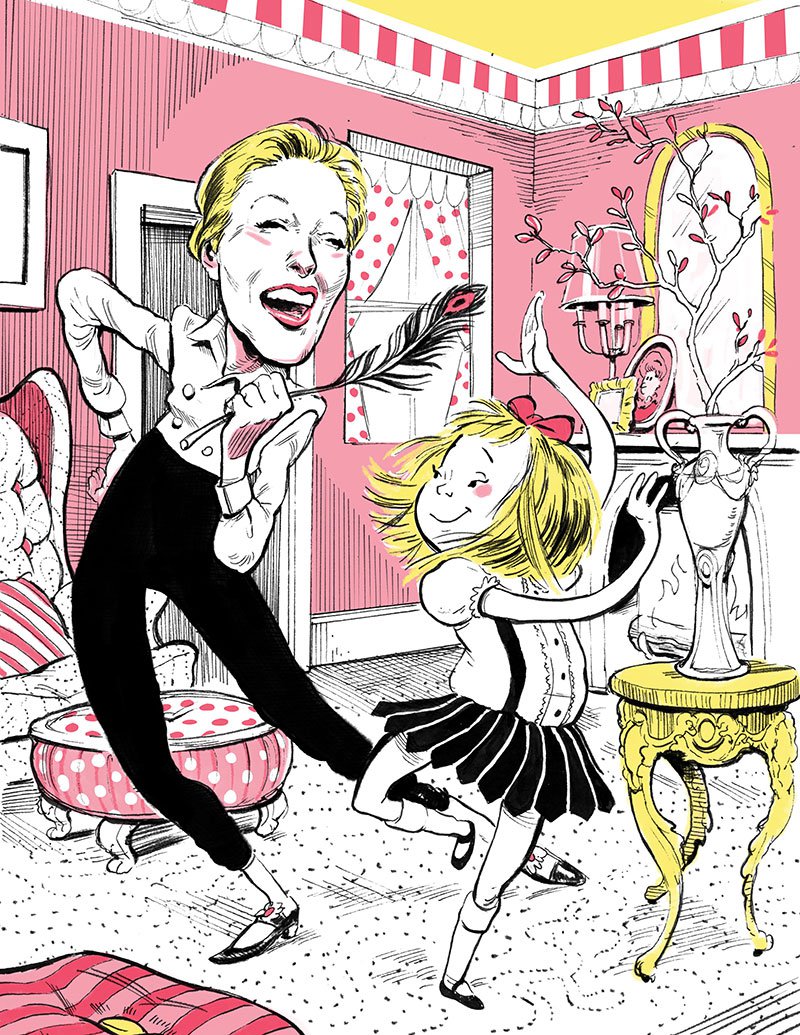
“I am Eloise. I am six.”
Those are the first words of the first book by Kay Thompson. A simple enough declaration, but once you’ve met Eloise, you can hear the tone beneath it: all that childish imperiousness and determined energy. And, above all, the sense of fun that drew readers to both the character and her author.
Stay up-to-date with the local arts scene
Subscribe to the weekly St. Louis Arts+Culture newsletter to discover must-attend art exhibits, performances, festivals, and more.
Eloise was subtitled A Book for Precocious Grown-ups; Thompson wasn’t the least bit fond of kids and had no intention of writing for them. Yet kids adored the book, precisely because it refused to placate or preach. Sophisticated and gleefully self-indulgent, it arched an eyebrow at the world.
Three books followed in quick succession, taking Eloise to Moscow and Paris and letting her make holiday mischief at The Plaza. But when the fifth book was complete, Thompson maddened everyone around her by refusing to sign off. Instead, she withdrew the licenses for everything (movies, merchandise, reprints) but the original book.
Decades later, after her death, the franchise exploded with Eloise reissues, collections, special editions, audiobooks, shows, documentaries, events, and swag. Demand has yet to abate. Today’s kids are well used to being ignored by over-busy parents; they commandeer credit cards and monitor the adults’ martinis. Eloise’s worldliness, loneliness, and self-invention grow more recognizable every decade.
The character we understand less well is Thompson herself.
The Launch
Catherine Louise Fink, called Kitty by all, was born on November 9, 1909. Her father, Leo Fink, had come to the States from Austria. A jeweler and occasional pawnbroker (Kitty never mentioned that part), he still spoke broken English with a Yiddish accent. Kitty’s mother had been waiting tables at a coffee shop when they fell in love.
The second of four children, Kitty went to Soldan High School, where she threw herself into every possible extracurricular activity. She sang and acted in operettas, and moonlighted as a pianist for the St. Louis Symphony. Disdaining study, she graduated 209th in a class of 214. At Washington University, she focused on sorority life—and didn’t graduate at all.
As kids, Kay and her brother had hung out a bit with another future author, Tennessee Williams—whom they called Tom—and his sister Rose. The Williamses lived on Westminster Place, the Finks just blocks away at 17 Parkland Place. Vincent Price was two years younger and lived a few miles west on Forsyth, but Kitty would strike up an acquaintance with him—and with another St. Louis native, Agnes Moorehead—in adulthood. By then, Thompson was, as one friend put it, “very New York.”
Music had bought her passage.
As a teenager, she’d set out to lower her voice so she could horrify her father by becoming a throaty blues singer. It worked. She left home for Hollywood, changed her name immediately, and found work singing on radio. Soon she was coaching smoky cabaret voices from Judy Garland and Lena Horne, too. She infused Rita Hayworth with confidence, created a nightclub act for Marlene Dietrich, taught Carrie Fisher to sing, and told Lucille Ball to not even try, just to “vocalize” with a rhythmic beat.
Charged with talent and eccentricity and the extra energy of a young woman who’s been told she’s plain, so she’ll have to try harder, Thompson developed style, charisma, and quite a following. She married a trombonist but only stuck it out two years. In 1947, just divorced from her second husband, she took Andy Williams under her wing—and into her bed, according to Williams’ 2009 memoir. (He was 19, half her age, but they reportedly enjoyed a clandestine relationship for years, until he fell in love with Claudine Longet.) Thompson created a nightclub act with Williams and his brothers and, according to her biographer, Sam Irvin, she earned more money at cabaret than anyone had ever made before, sailing past $1 million.
She was singing, writing music, choreographing, turning simple songs into production numbers.
“It’s no exaggeration to say that Kay Thompson changed the face of American popular music in the 20th century,” singer and music historian Michael Feinstein told the Los Angeles Times in 2010. “She started to do these complex vocal arrangements combining jazz, blues, and pop music with classic influences in a way that no one had done before.”
She also acted—most famously as the fabulous and formidable fashion editor in Funny Face, upstaging Audrey Hepburn. But because Thompson wasn’t conventionally pretty, she wound up working more behind the scenes—which stung. She pumped up the personality instead, dressing with dramatic flair (hot-pink zebra-print pants, turbans). She also underwent multiple nose jobs (one source counted five). Without the first one, at 18, she remained convinced that she never would have gotten her first real job, singing part time with a band. It had been her first experience of financial independence and her first taste of fame.
The Birth of Eloise
Blazingly talented, Thompson did just about everything but write—at least, until friends begged her to capture her impish alter ego, Eloise, on paper.
Legend has it that Thompson had invented Eloise when, late for a rehearsal, she drove across a golf course, screeched into the parking lot, and tore inside. Someone asked her who she thought she was, showing up late, and she replied in a high-pitched voice, “I am Eloise, and I’m 6.”
In truth, she’d been Eloise at least since her teens. In Kay Thompson: From Funny Face to Eloise, Irvin writes that she even had an imaginary friend named Eloise as a child. By the time she was a counselor at Minne-Wonka Girls’ Summer Camp, Finky, as she was then known by her peers, was warning the younger girls, “You better do what I say, or you’ll have to answer to me—Eloise!”
In adulthood, Eloise could be counted on to emerge whenever Thompson needed forgiveness or permission. Irvin quotes Edith Head’s description of Thompson making demands at Paramount Studios “in the squeaky voice of a little girl shot with arsenic.” He also quotes Tiffany’s director of design; “Kay had the mind of a grasshopper. Whenever she got exasperated with me, she’d go into her Eloise voice and say, ‘Well, goodbye! I’m going to play in traffic!’”
Not everyone was amused by the fiction, but those who were urged Thompson to capture Eloise on paper. A fashion editor at Harper’s Bazaar even introduced Thompson to a young illustrator named Hilary Knight. After watching Thompson’s nightclub act at The Plaza, he drew her a Christmas card that showed Eloise riding on Santa’s sack as his sleigh glided among the stars. Knight’s impression of Eloise had been inspired by a drawing his artist mother once made of a little girl in striped socks.
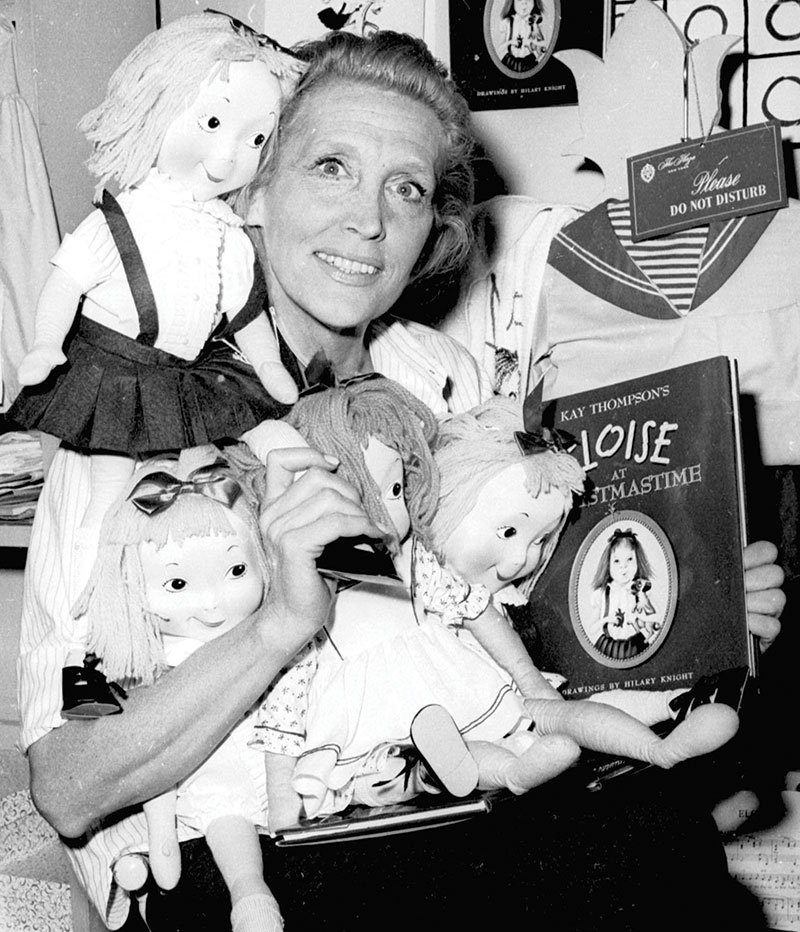
Thompson smiled when she opened the envelope. He’d gotten it right. And so began the famous collaboration. Instant hits, the books soon floated on a sea of Eloise bonnets, Eloise toys, Eloise doll clothes, Eloise emergency kits. Room 934 at The Plaza became The Eloise Room, decorated in perfect imitation of the book, and little girls could order from an Eloise menu or visit the Eloise ice cream shop or host an Eloise tea party.
Often, Knight watched Thompson “veer back and forth between Kay and Eloise.” When Francis Ford Coppola called, hoping to include Eloise in his New York Stories, “she would answer either as Eloise or as Kay Thompson,” Knight later told Renée Montagne on National Public Radio. The conversation lasted hours, and when Thompson finally made it clear that she was saying no, Coppola replied wearily, “All right. Good night to both of you.”
The similarities were, after all, striking. Not so much in appearance—Eloise had dirty-blonde flyaway hair, and she lacked the skinniness of her creator, who reportedly subsisted mainly on Fig Newtons and Coca-Cola. (She found the red can chic.) Thompson was 5-foot-5, but so lean and angular, she reportedly looked 5-7; she referred to herself as “a tall drink of water” and heightened the effect by wearing pants (shocking at the time) that she had designed herself. Kay Thompson’s Fancy Pants were sold at Saks Fifth Avenue. Alas, they would not have suited Eloise, who was not tall at all and wore an oft-untucked white puff-sleeved blouse and a pleated black skirt that tended to slip beneath her little potbelly.
What the two shared was a love of mischief, a rebellious spirit, a need for attention and excitement, and an utter indifference to convention. They indulged their own cravings. They kept their nerve and confidence up at all times.
“She is not yet pretty,” Thompson wrote of Eloise, “but she is already a Person.”
Readers soon learned that Eloise’s mother was 30, had a charge at Bergdorf’s, and knew Coco Chanel personally. In a rough draft, Thompson wrote, “I overheard Mabel, the afternoon maid, saying that mother was a nymphomaniac”—but that observation didn’t make it to press. Readers did discover, however, that Eloise’s mother traveled with a lawyer who liked martinis; as for Eloise, she liked grass. (Later, more cautious editors replaced “grass” with “dandelions.”)
Eloise kept a bottle of gin in her bedroom. (Her author preferred vitamin B-12 injections that were, according to Irvin, mostly speed. A newspaper exposé later outed the good doctor’s prescribing habits.) Eloise poured water down the mail chute and ordered a single raisin from room service for her turtle, Skipperdee. When a hotel door was open, she’d walk in: “I pretend I am an orphan and sometimes I limp and look sort of sad, and they give me a piece of melon or something.” In Paris, she turned a bidet into Skipperdee’s “own private swimming pool.” Back in New York, she burst into The Plaza’s Rendezvous Room and interrupted a couple canoodling (and it was somehow obvious that they were married to other people). When she visited Moscow, her worldliness turned political: “They give you your key,” she reported. “Here’s who else they give it to—everybody.”
“I admire Eloise enormously,” said Groucho Marx, “and I am very happy that I am not her father.”
The Tantrum
If Eloise was a handful, just imagine her creator.
In 1960, the portrait Knight painted of Eloise, which had hung in The Plaza for years, disappeared. Princess Grace of Monaco was crushed; she’d brought the royal children to see it. Walter Cronkite announced the kidnapping on the evening news. When the painting failed to materialize, Knight did another, this one Neoclassical. Eloise struck a George Washington pose, with Skipperdee and Weenie (her pug, who looked like a cat) at her feet.
Two years later, Knight received an anonymous phone call telling him he could find the portrait in a trash can in uptown Manhattan. It had been torn from its frame and slashed across the knees. He winced and threw it in the back of a closet. But according to Tablet, an online Jewish magazine, “in 1993, Thompson idly mentioned to a reporter that she’d found the painting in the trash. It was probably a coincidence that she’d been furious at Knight because critics had praised the art in Eloise in Moscow and panned the text.”
The collaboration did continue, with Knight flying several times to Rome to work with Thompson on a fifth Eloise book. In July 1964, Ursula Nordstrom, who was in charge of children’s books at Harper & Row, bought the front cover of Publishers’ Weekly to announce Eloise Takes a Bawth. But when Thompson saw Knight’s final sketches, she said she didn’t like them—then went incommunicado. In November, Nordstrom wrote to Thompson: “I wonder if I’m dead and don’t realize it, and that’s why you can’t get in touch with me.”
After pulling the plug on the bawth, Thompson took back all licensing rights for Eloise the character and all publishing rights for the last three books. Only the original Eloise, which she felt was the best, would remain in print. She stayed in Rome, renting a palazzo at the foot of the Spanish Steps, riding a Vespa, and feeding her pug lime-green Chuckles. When he died of diabetes, Thompson, devastated, came home.
Knight remained as gracious as humanly possible, sending flowers and little drawings on her birthdays (unacknowledged) and valiantly ignoring the fact that she’d deprived him of substantial royalties his work could have earned. His exasperation didn’t surface until years later, when he drew a parody of his own Eloise cover for Vanity Fair. In this version, Thompson was on the cover. Having kicked the chair from beneath the little girl, she’s scrawling, “I am Eloise” in lipstick on the vanity mirror.
The Later Years
In 1950, society photographer Cecil Beaton tried, hard, to analyze Thompson’s charisma: “The facts about her are that she sings and prances in cabaret between Los Angeles and Istanbul; that she is skeletal, hatchet-faced, blonde and American; that she wears tight, tapering slacks and moves like a mountain goat. The proper language in which to review her is not English at all but Esperanto. Or possibly Morse code.” She was, like Eloise, her own creation. And she became, noted critic Emily Nussbaum, “a kind of skeleton key to midcentury Broadway and Hollywood.”
Then it all changed. In 1973, Thompson was evicted from The Plaza—no more Eloise books, no more free rent for a difficult guest. She threw herself into music, film, and theater, staged a fashion show at the Palace of Versailles. Her eccentricities multiplied; in short, she grew squirrelly. Friends pronounced her a control freak.
Granted, this wasn’t new: Irvin recalls her fury with Paramount Studios when Audrey Hepburn got to wear Givenchy and she did not. Thompson also feuded with Fred Astaire, according to Irvin, and the coolly gracious Hepburn said only, “Yes, well, ’tis a bit of a strain.”
Now, Thompson was growing steadily (or, rather, unsteadily) more erratic. “Not to take anything away from her talent,” Feinstein said, “but she was crazy.”
Still, she never lost her spirit. In 1988, Donald Trump bought The Plaza, and the following year, he wanted to use Eloise to promote the hotel. Thompson said no.
By the ’90s, she’d grown reclusive. She was living with her beloved goddaughter, Liza Minnelli, and going out less. When she did emerge, she was often clad entirely in black, her head wrapped—and was infuriated by comparisons to Isak Dinesen.
Minnelli cared for Thompson until her death, in July 1998. She was 88, though no one knew it at the time; she’d lied about her age or refused to disclose it for years.
In 2003, her star was added to the St. Louis Walk of Fame.
Posthumous Publications
Thompson bequeathed her estate—including all licensing rights—to her sister Blanche. Suddenly the way was clear to publish all her books, make audiobooks (Bernadette Peters narrated three), sell Eloise lip gloss and Eloise purses. In 2006, an animated children’s TV series premiered, and one episode drew on the time Thompson spent on the set of Funny Face to send Eloise to Hollywood.
First, of course, Eloise Takes a Bawth was rescued. (The cover bore a note, “additional plumbing by Mart Crowley.”) More posthumous books followed, some illustrated by Knight, others just inspired by the original series. Simon & Schuster did Ready to Read books that had Eloise skating, visiting the zoo, going to a ball game, giving advice, sending kisses—but without Thompson and Knight, the books are a bit…ordinary.
The originals, however, retain their power.
A keyword search for “oooooooooo” is guaranteed to pull up articles about Eloise, scads of clever reporters skibbling, swiggling, and skiddering over Eloise. In 2017, Lena Dunham—who has a winged and haloed Eloise tattooed on her lower back—released a documentary about Hilary Knight, the man who best knew the sharp edges and sadness beneath Thompson’s gaiety.
You can find that sadness in the books if you look for it.
“Everyone knew we were going, but no one cried,” Eloise says, leaving for Paris.
“So if no one remembers me/and no presents I can find/I’ll know I don’t deserve them/It doesn’t matter/I don’t mind,” she announces at Christmastime.
Her mother is rarely around; Nanny is the closest thing to a loving and companionable adult presence. When she watches the fights, Eloise orders her pilsners—and sometimes Johnnie Walker Black, straight up. “And charge it, please.”
Thompson insisted that Eloise’s charisma lay in her personality. “She is a free spirit living in an enchanted world,” Thompson told the Associated Press. “She has so much to do and never enough time.”
But as Marjorie Ingall noted in Tablet, the dark side of Eloise was just as compelling: “Children understand greed, sorrow, rage, and mania more than we know.”
Like her creator, Eloise bundled contradictions, with pain and delight, nerve and exuberance each taking its turn.
“No birds and bees for Eloise,” Thompson once wrote as a song lyric. “So young, so bright, and so shy, and so shy, and so delightful, so frightful, she really had a house that was a home. The Persian Room, diversion room, perversion room. So on your knees for Eloise. The beautiful queen called Eloise.”