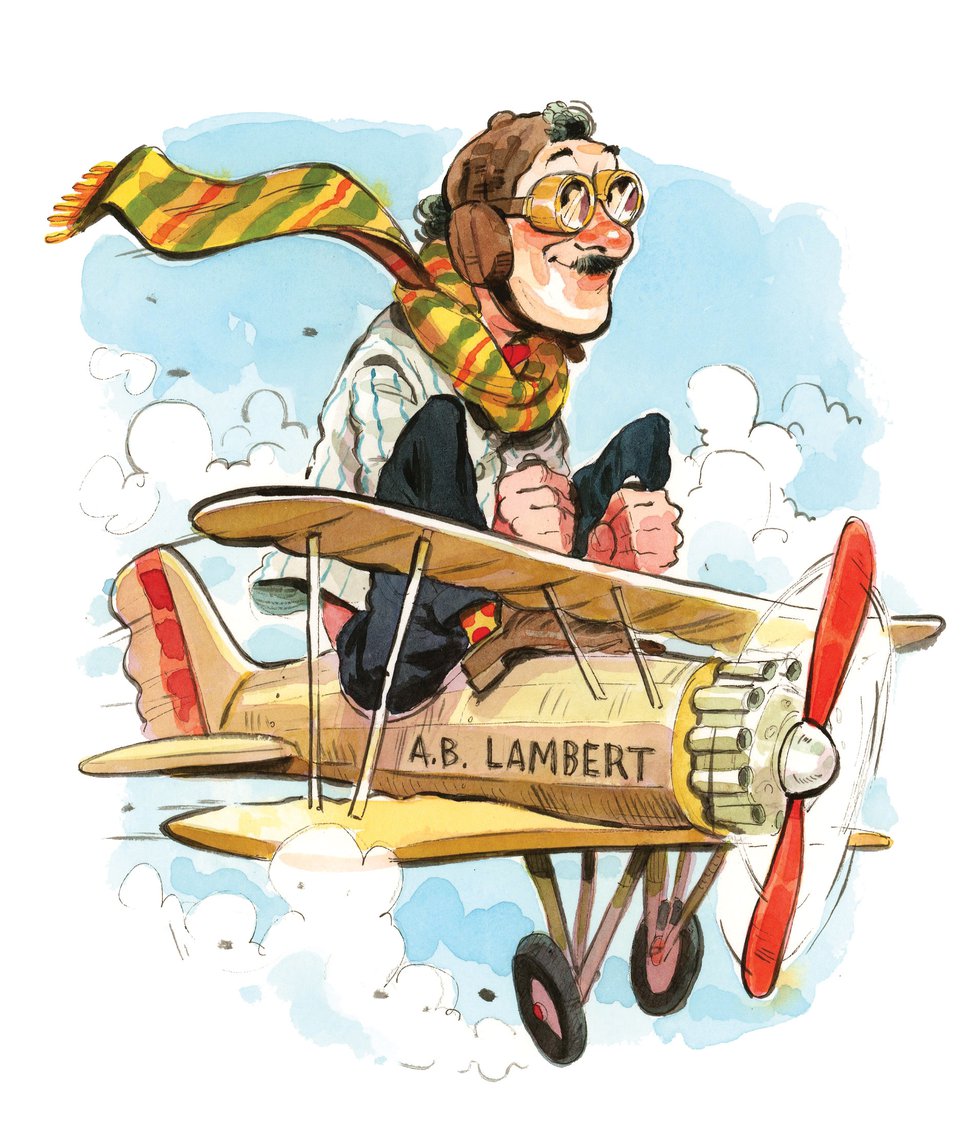
This year, St. Louis Lambert International Airport is toasting a century of aviation on the plot of land it occupies 11 miles northwest of downtown. But few people know much about the bespectacled dynamo who assembled that land in the first place: Albert Bond Lambert.
Lambert was born in 1875 with the “proverbial silver spoon” in his mouth, wrote one observer in the St. Louis Star, “but didn’t seem to care a whoop for the spoon.” His father owned Lambert Pharmacal, which made Listerine. At the family’s home, on Vandeventer, the young Albert staged musical and circus-style shows. In his twenties, he excelled at golf, playing in the 1900 Olympic Games, in Paris, and then at the 1904 World’s Fair, in St. Louis, when the Olympic competition was held on his father-in-law’s course, at Glen Echo Golf Club.
By that time, Lambert was working for the family business. He set up factories in France and Germany. While in Europe, he grew intrigued by hot-air balloons and learned to fly them. He later brought a major balloon race to Forest Park and even trained balloon pilots for the U.S. Army, earning the rank of major.
Fatefully, Lambert fell in love with airplanes. He received lessons from one of the Wright brothers, earned his license, and, in 1920, leased the farmland in Bridgeton that would one day become the airport. Lambert used his own money to have the land cleared and graded into an airfield; he even erected a hangar that any aviator could use for free.
In 1923, the site played host to several days of airplane races. The event drew nearly 200,000 spectators, as well as a young pilot named Charles A. Lindbergh. When Lindbergh decided to attempt the first transatlantic flight, he asked wealthy St. Louisans such as Lambert to sponsor his effort. They agreed, and Lindbergh named his plane Spirit of St. Louis.
After the lease on the airfield expired, Lambert bought that property and sold it to the city of St. Louis; that ownership endures today, even though the airport lies in the county. Lambert remained a staunch airport backer for years afterward.
A resident of the upscale Hortense Place, in the Central West End, Lambert channeled his energies elsewhere, too: He was an avid fisherman, motorcyclist, and member of the Board of Police Commissioners (he sought to crack down on gamblers and reckless motorists). But his most enduring legacy is the airport. As Daniel L. Rust wrote in his 2016 book The Aerial Crossroads of America: St. Louis’s Lambert Airport, “Aviation history, and the history of St. Louis, would have been much different but for the vision of Albert Bond Lambert.”