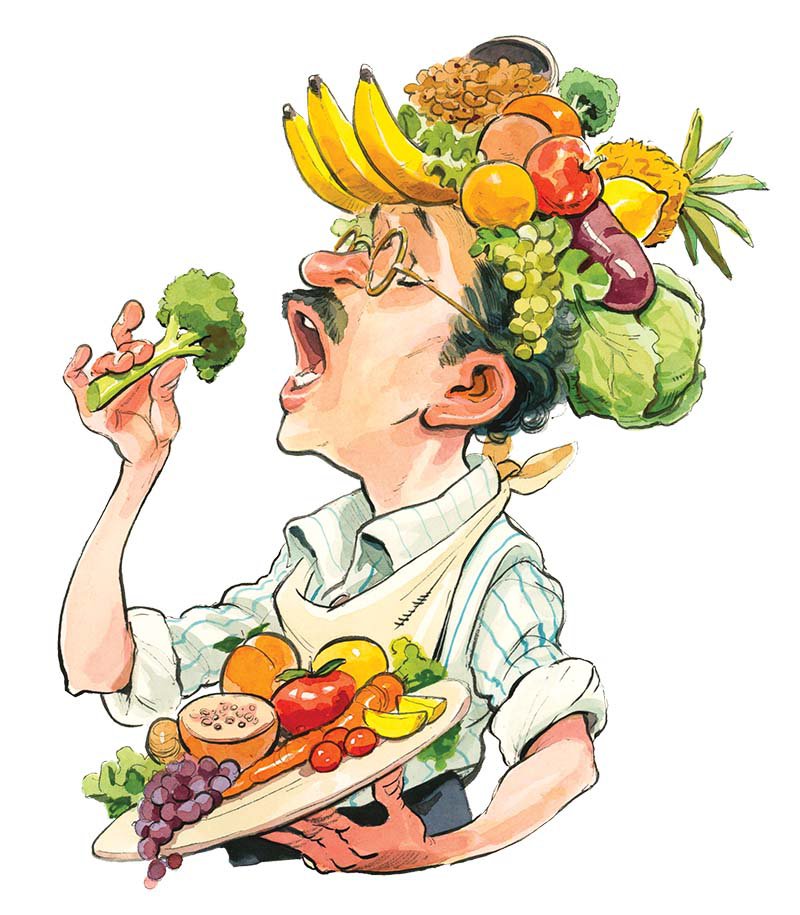
The city’s first vegetarian café was less a culinary project than a political one, catalyzed by the St. Louis Vegetarian Society. Formed in 1901, the society met twice each month in members’ houses until about 1903, when members began holding public meetings in the Aschenbroedel Hall on Pine. The agenda featured testimonials from Civil War veterans, athletes, and successful business people who raved about the health and moral benefits of meat-free living. Talks were followed by performances from the Self Culture Club and Vegetarian Orchestras. Local newspapers directed a steady stream of ridicule at SLVS while inviting members to pen food columns. In 1902, the group’s president, George Heid, a local chemist, explained how to forage and cook with wild mushrooms (which have a meaty texture) without accidentally poisoning yourself.
In 1903, club secretary Edgar Perkins went on the hunt for an adventuresome restaurateur willing to make dishes purely “of vegetable origin”—what we now call plant-based or vegan. “Mr. Perkins avers that he can take one pat of butter and one pat of substitute butter and let a man eat them in the dark,” the St. Louis Post-Dispatch wrote. “He will wager to the eater that he cannot tell which is butter and which is substitute.”
In March 1904, the entire society attended the grand opening of “a physical culture restaurant,” located “at a point on Olive Street calculated to catch the eye of World’s Fair visitors.” And that fall, surely many of those sitting at the lunch counter ordering nut-brown milk and protose (that era’s fake meat) were folks traveling from as far as Liverpool to attend the International Vegetarian Congress, held that year at the fair.
Rising meat prices and Upton Sinclair’s stomach-turning 1906 novel The Jungle increased the ranks of American vegetarian societies. But on New Year’s Day, 1908, the Post broke the news that at the St. Louis Vegetarian Café, the smell of “chicken croquettes (made of peanuts), mock tenderloin (made of peanuts), imitation veal loaf (made of peanuts), peanut flour biscuit, peanut meal pudding and peanut coffee” now mingled with the “savory odor of real steaks, chops, and roasts.” St. Louis, the proprietor explained, “has not the real culture of the East, nor the radicalism of the Far West,” and wouldn’t put up with eating peanut steaks during brutal Midwestern winters.
In a world where veganism is now mainstream, it’s shocking to realize that in 2002, a century after the founding of the SLVS, there was still really only one downtown café, The Hungry Buddha, where vegetarians weren’t forced to make do with iceberg salad and French fries.
Vegetarian Visitations
St. Louis fêted a steady stream of vegetarians in the early 20th century.
May 1903 J.E. Mizee of Sparta, who claimed he’d subsisted on “parched nuts and fruits, cracked wheat and bean soup,” for 15 years, demonstrated his strength at an SLVS lecture, asking an audience member to drop a 100-pound stone on his stomach.
October 1907 Charles Kramer, member of the Chicago Vegetarian Society, walked from Duluth to San Francisco, catching his “third wind” at the Pontiac Hotel in St. Louis before heading out to “skim over the Rockies on Norwegian skis.”
November 1911 Bernarr MacFadden, America’s first celebrity bodybuilder, expanded his chain of meat-free “physical culture” restaurants to St. Louis. He had sentimental reasons: MacFadden spent his sickly teen years in St. Louis, and it was here that he committed to a life of vegetarianism—and dumbbells.