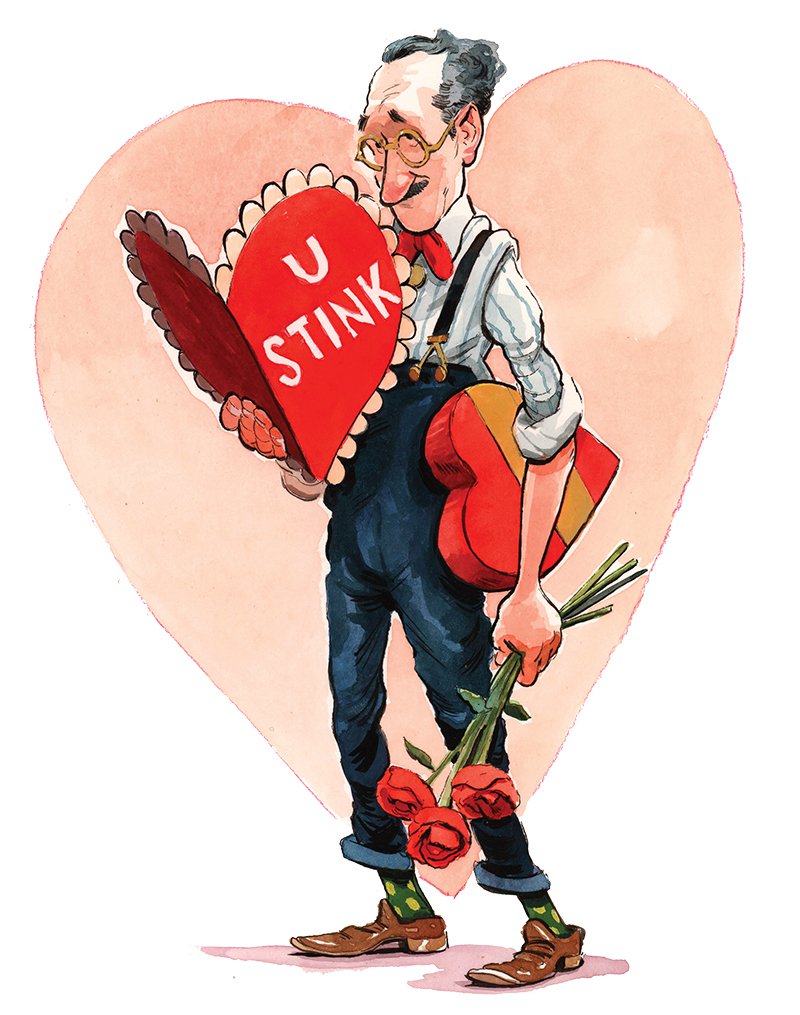
It’s February 1875. You’re chilling on the horsehair sofa in the parlor when you hear a faint sound in the foyer. As you walk down the hall, you see it: an envelope slipped under the front door. Is it what you think it is? You grab the letter opener and slice the flap. Yes, it’s exactly what you suspected: one of those depraved penny valentines with a few lines of bad poetry about your caterpillar eyebrows, your stringy hair, your patchy social skills. These mean-spirited little missives had many names, including comic valentines, “hit-em-hards,” “poison darts,” and “vinegar valentines.” That last nickname rolls off the tongue, but often they stung more smartly than vinegar—more like carbolic acid.
No one knows who invented vinegar valentines. When the Missouri History Museum exhibited its collection of these nasty little missives in 1955 (then-director Charles van Ravenswaay described them as “masterpieces of the grotesque”), it gave their time span as the 1840s through the early 20th century. But they persisted much longer than that.
At the missives’ peak, in the late 19th and early 20th centuries, senders could find toxic valentines featuring a brutally precise insult for anyone. Despise your pharmacist? Try this on for size: Knight of mortar and pestle/with your stinking rhubarb wrestle./Keep on grinding poisonous pills,/see that each cathartic kills./Strive to play a doctor’s art./Of quack nostrums sell your part;/Never attending pharmacy school,/you’re a murderer and a fool. There were cards with which to insult your neighbor, teacher, grocer, even the postal worker delivering your valentine, if you opted to send it through the mail—though often people didn’t, because postcard versions got confiscated and destroyed.
As long as vinegar valentines existed, newspaper op-ed sections spilled over with editorials ranting about the mischief and evil they caused, insisting that they grew more terrible by the year. In 1908, the St. Louis Post-Dispatch claimed that they directly resulted in injuries, murders, and suicides. “With the improvement in color printing comic valentines appear to have increased in vulgarity,” it noted. “If the gentle art of caricature by wholesale has been so highly developed that for one or two cents one may buy a lampoon cruelly fitting almost any individual in private life, it is probable that the authorities should take cognizance of the matter.” If the news of the day is any indication, vinegar valentines kept the local authorities busy indeed.
By the late 20th century, however, it was hard to find anyone who remembered vinegar valentines. Though the art form (if it could even be called it that) disappeared, human nature didn’t: Today, we just call it trolling.
No Joke
Over the years, local papers documented some not-so-funny outcomes for senders and recipients of comic valentines.
1896
Mr. J. Rosendahl, disciple of the Kneipp system, “whose promoters hold that cold water will cure everything from measles to marasmus,” receives a valentine from his wife bearing a cartoon of “a quack doctor, and emphasizing its sarcasm with several lines of cruel doggerel.” Rosendahl raises “a fine hullaballoo” as well as a chair, brandishing it in the direction of his wife. A friend who owns a liquor store (likely not a Kneipp disciple) bails Mr. Rosendahl out of jail the next day.
1897
Joe Runge goes out to buy a bucket of beer, only to discover upon his return that some miscreant has slipped a comic valentine “reflecting upon Runge’s mental, moral, and physical attributes” under the door. Runge decides that the only fellow rude enough to play such a trick is his friend Dick Wellmes—who denies it. Nevertheless, the two men fight. The conflict ends with “Runge flooring Wellmes” with the beer bucket.