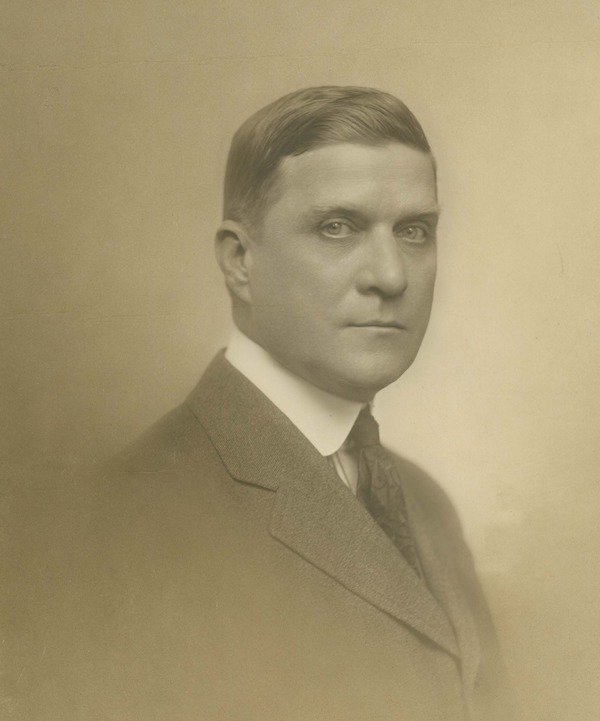
On October 7, 1931, over a decade after Prohibition—which sent his family’s brewery in to a tailspin form which it never recovered—Louis Lemp died in his apartment in New York. He had lived there since 1906, after selling his interests in the Lemp Brewery to his family and taking up residence not only in the Empire State but in Boulogne-sur-Mer and Tappan, New Jersey. His younger brother Edwin, who lived out west of the city, had announced the news of his death to the newspapers.1
A look at the treatise Louis Lemp wrote when he was a young brewing student
Sadly, like many of his siblings, Louis was not able to rest in peace after his death. His housekeeper, Ms. Minerva Morgan, sued the estate of the former brewer for $85,000, claiming that in 1922, Louis had promised her $300 a month for the rest of her life. This was in January 1931, and the claim factored in a life expectancy of another 17 years (how this was calculated was not related in the newspapers at the time). Morgan had not only taken care of the apartment in New York, but had also maintained the two residences for Louis in France and New Jersey. She had even scandalously lent the wealthy heir $15,000 in Paris.2 The basis for the lifetime of payments in the oral contract was that Morgan had given up her career as an interior decorator to become Louis’ personal housekeeper. The outcome of the lawsuit remains shrouded in mystery.
Louis Lemp’s life had not been beset with such legal problems. By all accounts, he was in many ways the “responsible” son of William Lemp Sr., busily working up the ranks of the family business. William “Billy” Lemp Jr., after all, was the one ending up in the gossip columns and the courtroom due to his reckless philandering and very public divorce from Lillian Handlan. But the reality of Louis’s life, even before his estate was sued by Minerva Morgan, is much more interesting and nuanced, and his ability to stay out of trouble for the most part seemed almost to be a talent of the grandson of brewery founder Adam Lemp.
Louis, like most of his siblings, never knew his grandfather, who died of cirrhosis in 1862. But surely, he would have known at least in passing Louise Bauer Lemp, his grandfather’s third wife, and as was shown last year, there was clearly no love lost between her and the grandchildren of his second wife, Justina Baum, whom Adam had abandoned in Hesse, Germany. But one wonders if there were still attempts at rapprochement in this era; Louis is obviously the male cognate of Louise, and perhaps his father William Sr. was attempting to make peace with his stepmother and next-door neighbor by naming his son thus. Of course, the German equivalent of Louis, Ludwig, was a very popular name at the time, and nationalism was a powerful component in brewers’ marketing and self-identity.
Louis, just like his brothers, received the standard training that is familiar to many sons of brewers, but interestingly, apparently had his own apartment in the brewery by 1901.3 Any traces of that apartment have now been removed, wherever that may have been. The most likely location may have been in the now-demolished office building that was replaced with the New Stock House facing Cherokee Street at the termination of what is now DeMenil Place. Louis would eventually rise to the rank of Vice President of the Lemp Brewery.4
Who was Louise Bauer Lemp, Adam Lemp’s mysterious third wife?
Unlike the rest of his siblings, however, Louis Lemp was the target of a kidnapping plot in 1904, only revealed by Mayor Edward A. Noon a year later, when the ringleader, Pat Crowe, was safely in prison in Butte, Montana. The kidnappers planned to demand $25,000. Louis was to be followed to the West End, drugged and thrown in a car, and taken to a house on the St. Charles Rock Road. There, he would be forced to write a letter to his brothers or his bank for the money, saying he needed the money for an important real estate deal. If he did not, he would be killed. Luckily for the brewery heir, the plot was betrayed by one of the conspirators who realized he was going to cut out of the ransom money; he learned of this double-cross by listening to his treacherous comrades through the thin walls of the run-down boarding house on Jefferson Avenues where they were staying. Mayor Noonan got him a job for his trouble.5
Relieved from the burden of the kidnapping, Louis Lemp could turn towards the sporting life, particularly an unfortunate interest in cockfighting. By 1895, he possessed a reputation for having more fighting chickens than any other breeder in St. Louis. In particular, his flock consisted of “fancy black-breasted red chickens,” that “have won all over the West.” Secrecy surrounded the fights because “the police frowned on the sport.”6 Louis Lemp also had a brush with the law when it was discovered that he did not have a driver’s license several years later. For whatever reason, he went to Clayton to get a license. The St. Louis County Courthouse being closed, Louis left a deposit at a nearby hotel, and when he came back, Deputy Sheriff Moss was waiting for him. He was released on his own recognizance and returned to the City.7 A recent book on Egan’s Rats also suggests that Louis handled the brewery’s contacts with the infamous Irish American gang’s enforcement of misbehaving saloons before Prohibition.8
How William J. Lemp set a new bar architecturally for St. Louis breweries
Despite those “Gentleman’s Problems,” Louis exceled at horsemanship, joining the Gentlemen’s Driving Club in 1894 and helping increase the profile of several racetracks around the region; his horses were frequently the best performing, with their rider wearing a red jacket and black cap.9 When the old Fairgrounds track became obsolete and closed, he worked with other equestrian enthusiasts to open the Kinloch track out in the plains of Bridgeton.10 Before the closure of Fairgrounds, Louis’s horses Macon and Terra Incognita were known winners.11 He also would show his horses Elastic and the May Queen at the old Coliseum at Jefferson and Washington, the site of the old Uhrig’s Cave.12 Louis even went to Chicago to make peace over conflicts with race dates over the Kinloch track, in conflict with leaders of the Western Jockey Club.13
Perhaps the final interesting legacy of Louis Lemp to the sporting world was in the field of boxing, but also in cinematography. When St. Louis interests fought to bring the James Corbett–Bob Fitzsimmons fight to St. Louis, Louis aided in efforts to bring it to the city. Ironically, the famous fight ended up in Carson City, Nevada, despite boosters at the time worrying about the fight ending up in Dallas. Louis had his money on Corbett, as did Otto Stifel, owner of the Union Brewery, also thought he would win.14 Both were wrong, of course, as the first feature length motion picture would capture Fitzsimmons knocking out Corbett in the fourteenth round. While the full movie now only exists in fragments, its cultural importance has placed it in the Library of Congress. And to think, if Louis Lemp and his friends had succeeded, that movie would have been set right here in St. Louis.
Chris Naffziger writes about architecture at St. Louis Patina. Contact him via email at [email protected].
[1] “Louis Lemp Dies, Was Executive of St. Louis Brewery,” St. Louis Star and Times, Vol. 46, no. 6 (October 7, 1931), p. 3.
[2] “Housekeeper’s Claim Against Louis Lemp,” St. Louis Post-Dispatch, Vol. 83, No. 129 (January 13, 1931), p. 3A.
[3] “Millionaire Brewer Lemp’s Sons Apprenticed to His Trade,” St. Louis Post-DispatchVol. 53, No. 229 (April 7, 1901), p. 45.
[4] Lemp Souvenir Book, 1893. Pp. 4-5.
[5] “Would Kidnap Louis Lemp,” St. Louis Post-Dispatch, Vol. 58, No. 47 (October 7, 1905), p. 10.
[6] “Men Who Fight Game Kitchens: Men Who Enjoy the Sport of the Pit,” St. Louis Post-Dispatch, Vol. 46, No. 184 (February 10, 1895), p. 21.
[7] “Sought License, Arrest: Louis Lemp and His Auto Have Experience,” St. Louis Post-Dispatch, Vol. 58, No. 43 (November 12, 1905), p. 14B.
[8] Waugh, Daniel. Egan’s Rats. Nashville: Cumberland Publsihing Co., 2007. The author wishes to thank David Mullgardt for suggesting this book.
[9] “Love Fine Horses: Special to the Sunday Post-Dispatch,” St. Louis Post-Dispatch, Vol. No. (May 27, 1894), p. 30.
[10] “The Kinloch Track: How It Came To Be Built in Three Weeks,” St. Louis Post-Dispatch, Vol. 53, No. 13 (September 3, 1900), p. 5.
[11] “Mr. Lemp’s Horses Were in Evidence,” The St. Louis Republic, Vol. 3, No. 37 (July 15, 1900), p. 9.
[12] “Louis Lemp, 61, Dies at Home in New York,” St. Louis Post-Dispatch, Vol. 84, no. 31 (October 7, 1931), p. 30.
[13] “Mystery Enshrouds Jockey Club Doings,” The St. Louis Republic, Vol. 93 (May 7, 1901), p. 6.
[14] “Preparing to See the Fight,” St. Louis Post-Dispatch, Vol. 47, No. 42 (September 21, 1895), p. 5.