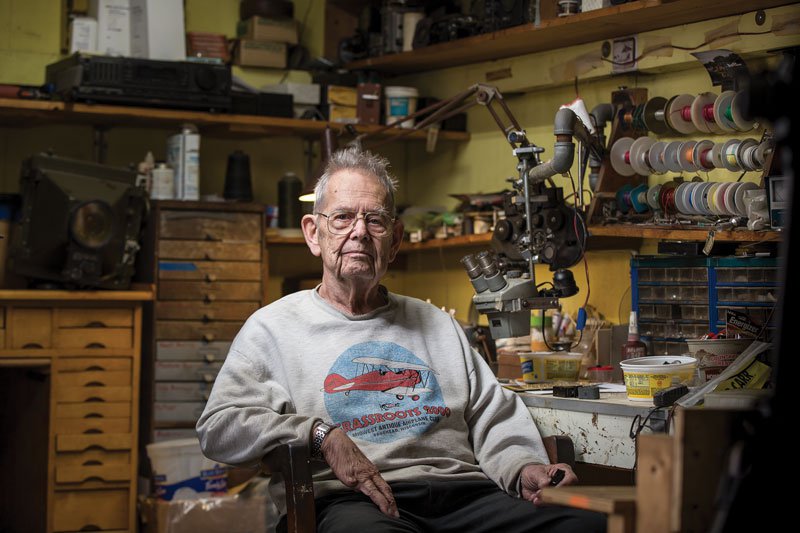
Jack Hereford took the first serial photos of a solar eclipse, built miniature cameras for the CIA, found a way to X-ray the buggy U.S. embassy in Moscow—and did a lot more that he’s afraid is still classified. He sounds cranky as hell on the phone, not in the least eager to be interviewed, but I swallow hard and make the drive anyway to New Haven, down a gravel road that dead-ends at a farmhouse. I knock, and a door behind me swings open to Hereford’s workshop, just far enough from the house for man-cave privacy.
To my relief, he drags over a squeaky chair for me, sits in front of a giant computer monitor, and starts talking. His first teacher, “an old German in South St. Louis who seemed to know everything,” helped him build a camera at age 10. McDonnell Aircraft snapped him up before he finished college. He shows me one of the mapping cameras he used there, a big black Darth Vader–ish box on top of a bookshelf.
“It’s huge,” I blurt.
“To a point,” he replies. “The word ‘camera’ means ‘room.’ They got that big.”
The practical sort of genius, Hereford is insatiably curious, innovative, down to earth. It turns out that his reluctance to be interviewed is because, at 85, the man who invented all manner of Cold War equipment for the U.S. government sometimes can’t remember a name from 50 years ago in less than two seconds. I assure him we’ll manage.
When McDonnell was building the Mercury spacecraft, Hereford was a flight test engineer running the optics shop. “Most things weren’t working,” he says. “There was a periscope the astronaut used to orient the spacecraft to blow the retro rockets, and it was a dog!” He flew out to the West Coast for help and got to talking with Frank Back, inventor of the zoom lens.
“In the late 1930s, Albert Einstein helped Frank get out of Germany,” Hereford says. Curious why the sun’s corona was so hot, Einstein later urged Back to photograph a solar eclipse from above the clouds. Back tried, but his solo flight was a disaster: His flotation jacket accidentally inflated, and he couldn’t maneuver the camera.
Intrigued, Hereford went to the Palomar Observatory. The principal observer emerged from a long, chilly night with the telescope, “grabbed a piece of paper, and wrote down why the light was radial,” Hereford says—meaning that the sun might be injecting particles into the atmosphere and heating it. “And not one single stroke of the pencil did I understand.”
Hereford, then 27, persuaded McDonnell (whose flight department thought he was crazy until word came that the Russians wanted to do the same thing) to let him photograph a solar eclipse.
“It was the greatest adventure you can imagine,” he says, pulling up a photo of an F-101 Voodoo supersonic jet—so new, it had yet to cross an ocean. Radio communications went silent over the Atlantic, and Hereford and pilot Irv Burrows were delayed at gunpoint on a base in Africa because they couldn’t ID themselves from the air. OK’ed at last, they navigated to the island of Terceira, where they practiced for five days.
On the day of the eclipse, their electric camera failed, but the four film cameras recorded thousands of shots as the jet raced to keep up with the eclipse, a 30-mile-wide black circle on the ground below them. Then the plane made a terrible noise—“Irv said a rumble, and I said a squeal,” recalls Hereford. “One engine ceased to perform, and we gave up the astronomy and went back to the island.
“That was the damnedest technical proposal we ever got,” the agent said. “Fifty, as fast as you can make ’em.”
“Still, we got some information. There’s one fair disagreement between astronomers and physicists as to the meaning of the light we found.” He shakes his head. “I don’t know why NASA’s astronomers haven’t punched through that area in some way that could spill the beans.”
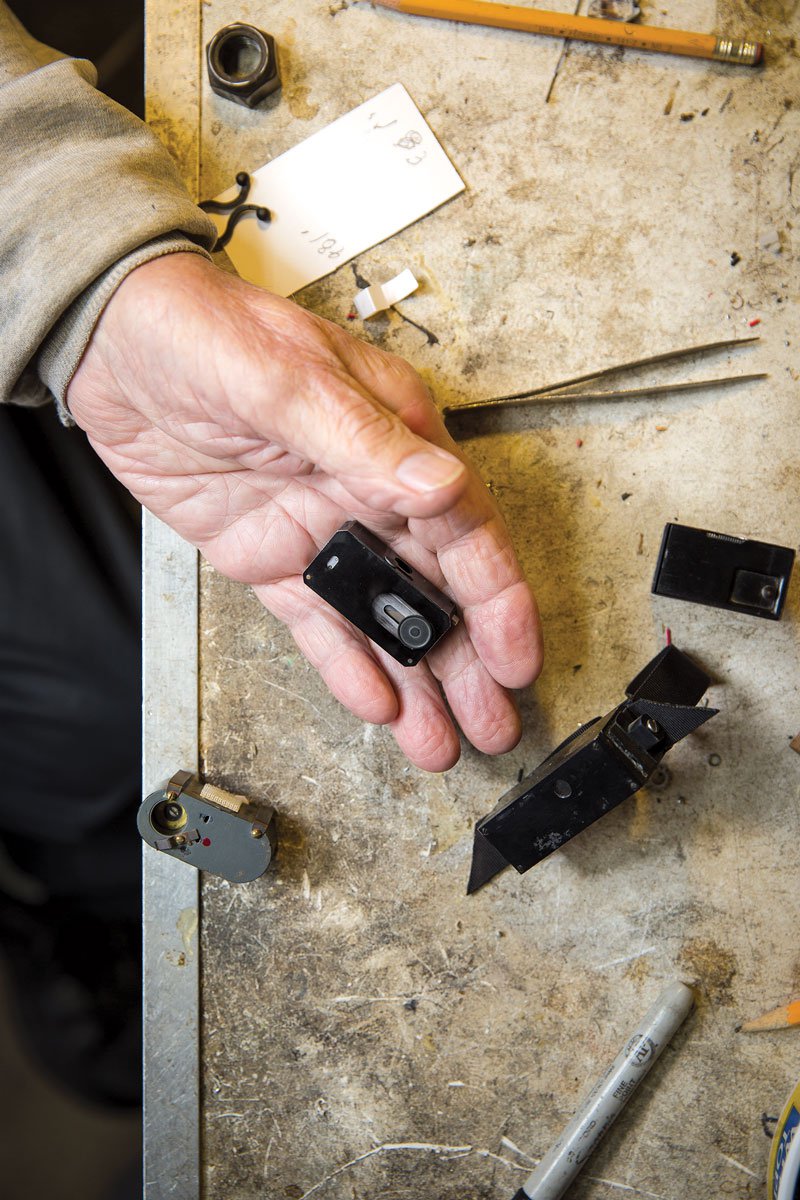
Hereford eventually formed his own company, and Eastman Kodak sent the CIA to him with “some interesting assignments.” He holds up what looks like a cigarette lighter. “You know Penkovsky? This was the kind of camera Oleg had”—when he was arrested by the Soviets as a traitor. “It’s big, it’s noisy, it’s shiny, and you can’t work it with one hand—that was the killer. They needed a new casing camera right away.”
Overnight, Hereford designed a black camera and document copier about an inch and a half long. He placed the prototype in his infant daughter Molly’s palm, took a picture, and mailed it to the address he’d been given with no explanatory text. A few days later, his phone rang. “That was the damnedest technical proposal we ever got,” the agent said. “Fifty, as fast as you can make ’em.”
Hereford also built a special X-ray scanner for the U.S. Embassy in Moscow. (“I think the building turned out to be about half microphone!”) Another of his tiny cameras was harnessed to pigeons so suspicious arrays could be photographed. His 10 kids trained the birds to roost to Mozart and helped their dad test long-distance infrared photography on moonless nights. And every time a government car drove into town, the guy at the filling station called and said, “Hey, Jack, the revenuers are coming.”