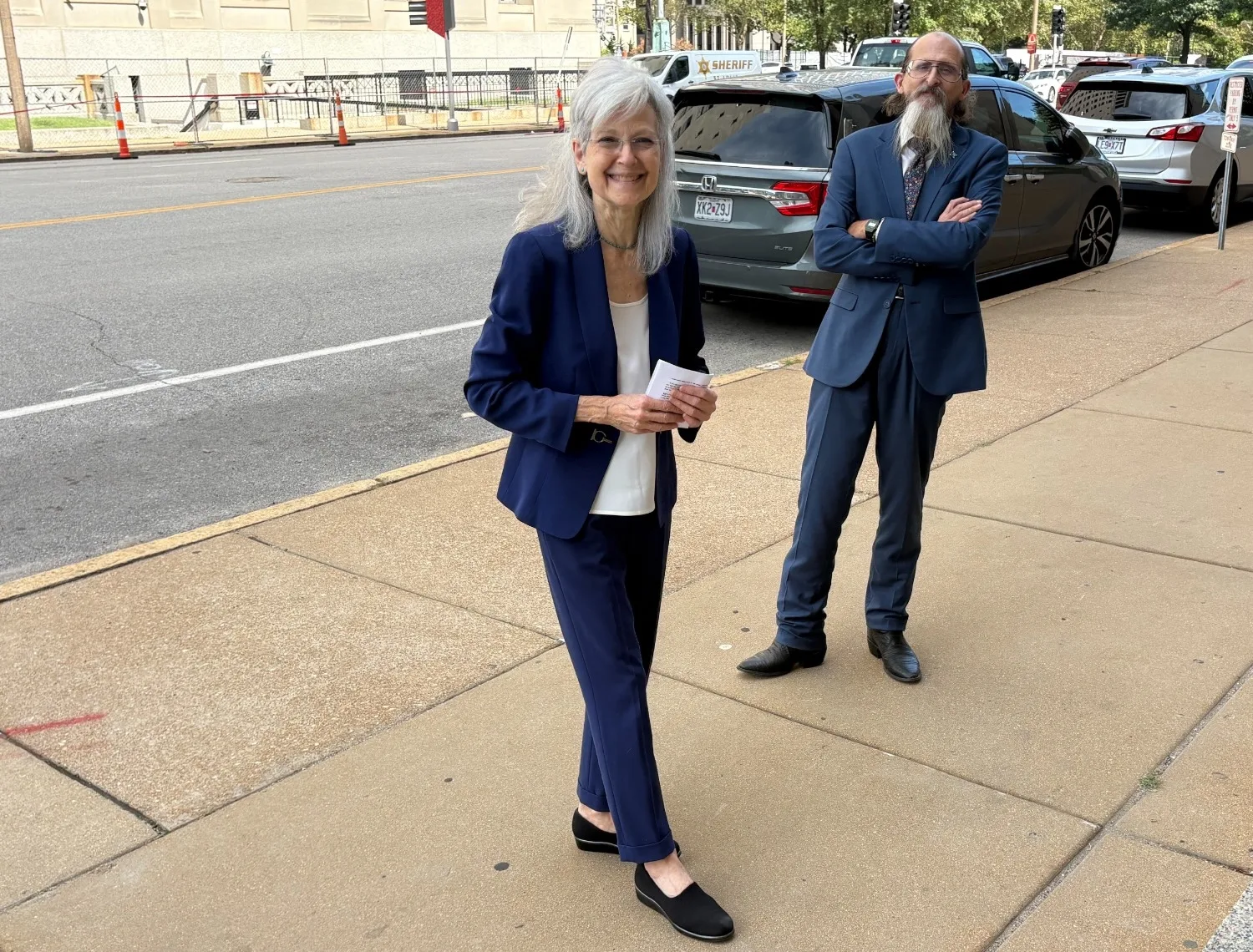
The City Justice Center smells better since commissioner Nate Hayward took over nearly a year ago, Mayor Cara Spencer says. On top of that, there have been some cosmetic changes, like a fresh coat of paint and flower beds outside.
“If you have ever been over there, the smell was always overwhelming and overpowering and awful, and now it just smells so much better,” Spencer said at a news conference yesterday.
Get a fresh take on the day’s top news
Subscribe to the St. Louis Daily newsletter for a smart, succinct guide to local news from award-winning journalists Sarah Fenske and Ryan Krull.
Spencer, Hayward, and St. Louis’ public safety director Shawn Dace acknowledged at the meeting that the city jail still needs work, but Spencer and Dace said Hayward has made a marked improvement on the jail overall.
The trio also reacted to the recent NAACP report highlighting serious concerns with the jail, including the crowding issues brought on by the closing of the Workhouse in 2021 and its demolition in 2025. (The NAACP report asked for either a new jail or expansion of the current facility, but said it “does not take a position … on whether the city should build a new jail.)
While that report had criticisms of the jail, Spencer pointed out that it had good things to say of Hayward. She also made clear that there isn’t sufficient money to build a new facility.
Advocates for prison reform had pushed for the Workhouse’s closure, with ArchCity Defenders calling it “unspeakably hellish and inhumane.” Spencer was initially supportive of calls to close it, but said she changed her mind after realizing it held some advantages over the CJC. It was much bigger, had more outdoor space, and had just seen a $10 million HVAC overhaul when it was torn down, Spencer said. Now, the city is left with no money to build a new jail, and its sole correctional facility is a downtown high-rise where it’s hard to get the hundreds of people detained there access to fresh air.
“From my perspective, closing it—certainly demolishing it—while I do recognize the harms that building perpetuated in [the] community, the building itself and that asset, demolishing it, is unfortunate,” Spencer said.
As of Tuesday morning, Hayward said there were about 834 people at the City Justice Center, up from around 750 from when he last spoke with SLM in March. Dace said it’s common for the jail to get to near-capacity when late summer comes around.
The jail almost entirely houses people awaiting their day in court, and Hayward told SLM in that March interview that he would look to have standing meetings with judges to see which detainees could potentially await their sentences outside of jail on pre-trial release and expedite getting people through the justice system. The city is actively hiring for a role to do just that, he said yesterday, and initial meetings have been promising. Without adequate funding for jail expansion or a new facility, programs like that seem like the most plausible path forward for reducing overcrowding.
Despite the ongoing challenges, Spencer and Dace are outwardly optimistic about the jail under Hayward’s leadership. Public safety officials handed reporters Tuesday a packet listing more than a dozen programs that have begun since Hayward started. That includes rolling out a program to get ServSafe certifications (which certify people for work handling food and beverages) to women held at the jail; previously that program was only available for men. Its first class of women recently got certified.
Staffing remains a key priority for Hayward, who started at the city justice center just shy of a year ago (Wednesday will be his work anniversary, he says). Since he started he’s hired more than 60 people, he says, including more than 40 correctional officers and more than 20 support staff. There are currently around 100 people working there, Hayward says, 60 officers and 40 support staffers, though there are still roles that need filling. However, he says the basics can be done by the team.
Hayward said he’s had to make some cuts and let go of some people when necessary.
“I probably let go of some people, but the people that left is the ones that didn’t like the direction that we’re going,” he says. “I preach professionalism all the time. You know, when I first arrived, people [were] yelling over the radio. … So, I sent out an email. No more yelling over the radio.”
Overall, Hayward projects an attitude of responsiveness to the headline-grabbing aspects of running the oft-criticized jail. When a power outage during a heat wave potentially endangered people detained there last month, contractors came as fast as they could and rectified the issue, he says. When asked about the use of force policy he pledged to reform at the jail, he says officers no longer use restraint chairs.
Another aspect of the NAACP report was the “shared responsibility problem” between the city and St. Louis Metropolitan Police Department for the first-floor processing center staffed by the police, which has seen two in-custody deaths. The report called it “a de facto long-term holding area rather than the three-to-four-hour holding zone it was designed to be,” referencing statements from the SLMPD. Hayward was quick to dispense with that issue, too.
“It’s a problem, but once Director Dace gets an email, he’ll call me—and I’ll call the captains if I’m not there—and we’ll move people up, and that’s what we’ve been doing,” Hayward says. “Every once in a while, they’ll [SLMPD] send out an email saying they have to close because of overcrowding, and once I see the email, I wouldn’t even wait till he called me. I would go ahead and call staff and tell them to start bringing people upstairs. So, we’ve been addressing it.”
The trio was quick to make a pitch for the remaining positions at the CJC. Hayward is looking forward to filling its open spots. He says the many contacts he made in his years working for St. Louis County corrections have been an asset.
“When I leave work at night, I go home, get on Indeed, I get on LinkedIn, Facebook, and I put out all our positions,” Hayward said. “This is how I received a lot of people because they contact me and say, ‘Oh, you at the city now?’ I said, ‘Yeah, I’m at the city.’ and then we got a lot of people that came from different places that I knew, and came to work over at CJC.”
“Because of his reputation, they have stolen a lot of people,” Dace said.