Here’s one of the quirkiest gigs in St. Louis you’ve never heard of: weekend manager at the Campbell House Museum, a 169-year-old mansion at the corner of Locust and 15th.
Set aside the curiosity of the building itself—a townhouse among high-rises, its prim façade hiding a truly bonkers display of Gilded Age opulence indoors. Set aside, too, the epic bio of former resident Robert Campbell. He emigrated from Ireland to America in 1822; joined the fur trade out West; battled and befriended Native Americans; built a fortune; settled in what was then St. Louis’ toniest suburb; expanded his holdings in real estate, banking, and riverboats (one of which Mark Twain piloted); hosted President Ulysses S. Grant for dinner; saw 10 of his own progeny—10—perish during childhood, with only three sons surviving him, none of whom married or produced an heir, all of which set off an international scramble to divvy up today’s equivalent of $69 million in assets, including this house, which became a privately funded museum in 1943.
Sound like a unique workplace? Consider the weekend manager: This employee leads tours on Saturdays and Sundays but lives full-time and rent-free at the back of the property, in the standalone brick carriage house, where the male servants used to sleep.
Turnover is fairly high, says museum executive director Andy Hahn. At least 10 have cycled through in the past two decades: a costume designer, an UMSL undergrad, a St. Louis Symphony Orchestra staffer. When one departs, the museum recruits the next through word of mouth or a Facebook post. Says Hahn: “We’ve had quite a parade over the years.”
The current weekend manager is Victoria L. Schultz, who gave a private tour of the carriage house on a recent morning. The ground level still affords a whiff of mud and manure; it also has two carriages on display. Schultz lives above them in the second-floor studio apartment. That’s where she spends her off-time, sipping tea and typing novellas in the steampunk genre. “I feel culturally fed,” she says, seated at her dining table, the whole unit trembling because a construction crew outside is at work on the museum’s new welcome center. “It’s like my brain is on fire and I don’t have time to extinguish the flames or get the ideas into my laptop.”
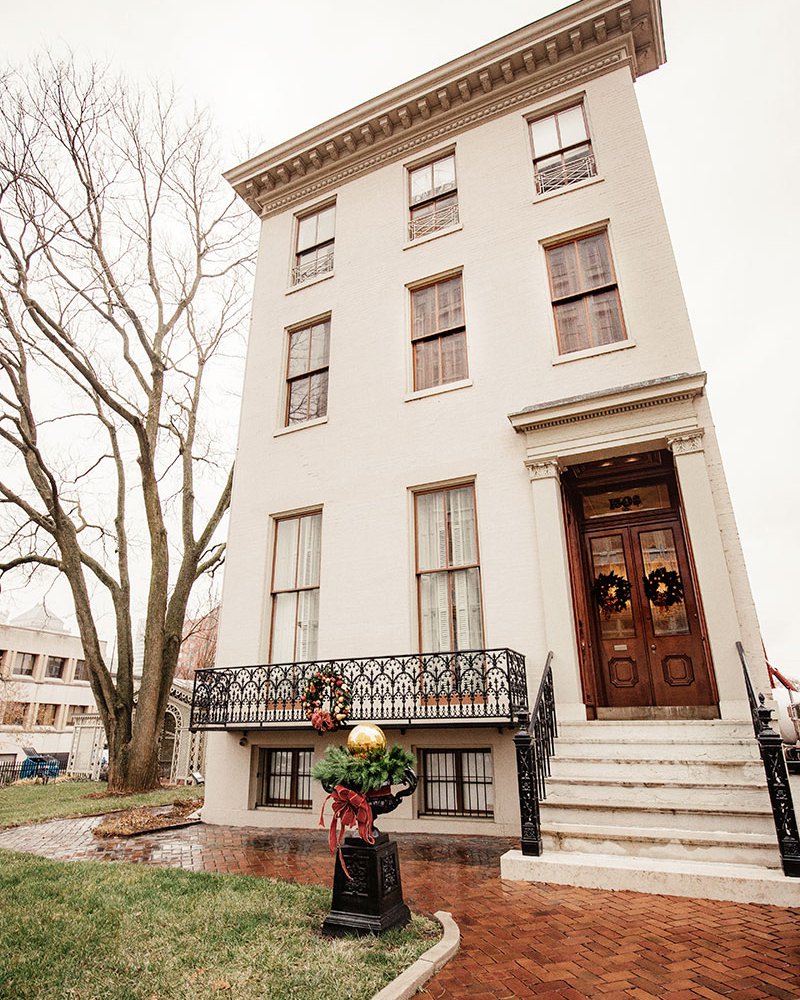
The house that inspires her teems with the Campbell family’s original furnishings. They’re staged with historical accuracy, thanks to the discovery of 53 interior photographs snapped in the 1880s. Schultz believes that the place is haunted. In November, she saw the motion-sensor light go on up in the cook’s bedroom but checked the surveillance feed through her phone and verified the house was empty.
David Newmann, who served as weekend manager from 2012 to 2015, says he was content to simply imagine past caretakers. When he awoke in the studio, he knew that the coachmen and groundskeepers would’ve brewed pots of coffee on a wood stove just steps away. Outside, they would’ve mowed the grass—a chore that now falls to weekend managers. “I did feel a connection to the staff who used to work there,” says Newmann. “Thankfully, we now have power tools.”
Details of that original labor force have emerged. Most were women, many of Irish stock. In the kitchen, they prepared as many as 60 meals a day, their ears attuned to the wall-mounted servant bells that jingled when someone in another room tugged a string (yes, just like in Downton Abbey).
Researchers also recently uncovered the story of Eliza Rone, who arrived as a slave—the only one known to have lived at the house. She worked as a nursemaid. Robert emancipated her in 1857 (possibly at the behest of his mother-in-law, Lucy Ann Winston Kyle, who had just moved in and, as a Quaker, abhorred slavery). Even after Rone’s emancipation, she stayed on as a paid worker for about a decade. She later settled in Kansas City, where her husband, John, founded a black masonic lodge and her son worked at a black newspaper. As late as 1918, she wrote a letter to the Campbell bachelor sons, whom she’d helped raise, thanking them for a Christmas gift.
This new research, now added to museum tours (because there’s no set script), hadn’t been available to Megan Power, who served as weekend manager from 2004 to 2007. To her, one of the most valuable parts of the job was connecting to those not in the past, but rather, in the present. She was 15 years younger then. On hot summer nights, she and her friends would unwind in the cool shadows of the Campbell House garden and sample the liqueur that she’d concocted from its rose bushes. During the day, she got to know the museum’s senior volunteers. She watched, over time, how they handled the loss of spouses, friends, and good health. “I got a lot of life lessons there,” she says.
Collisions of age, race, and class may just be unavoidable at this institution. Newmann, a twentysomething without much money, liked banging on his drum set up in the carriage house. (He had few neighbors.) One autumn night, after his rock band finished a song, they peered out the opened window to see a group of homeless folks below, applauding.
Schultz has lived there since March. She’s incorporating the museum into her steampunk fiction, which she’s self-publishing for now. She plans to stay a while: “I’d have to be a millionaire to want to leave.”