When we brought my mom to our home for hospice care, I was feeling a little overwhelmed, not to mention sad and scared, and I confided as much to a friend. She pulled out her phone and sent me a link to the Bach Original Flower Remedies.
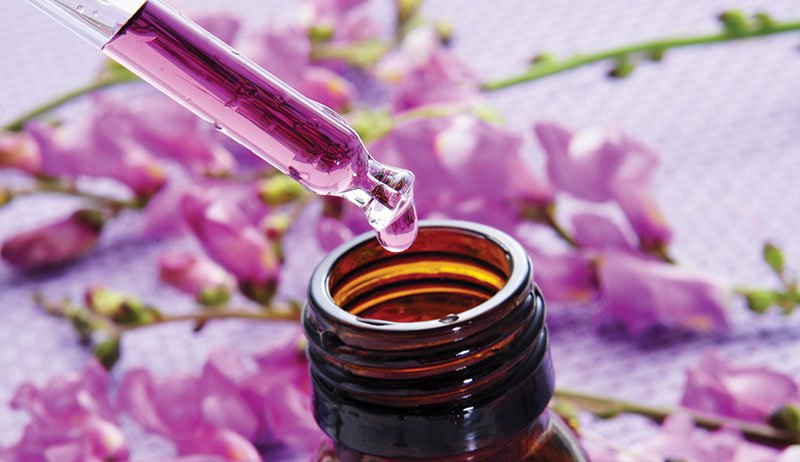
There are 38 of these “dilutions.” Scanning them at home, my eye lands immediately on Elm (“overwhelmed by responsibility”), mustard (“deep gloom”), and Red Chestnut (“fear or over-concern for others”). People will be sending flowers eventually—when it’s too late to strengthen my resolve. Why not absorb a little now?
Your guide to a healthier, happier you
Sign up for the St. Louis Wellness newsletter and get practical tips for a balanced, healthy life in St. Louis.
Still, skepticism’s an occupational hazard, and the Bach site itself notes that its “claim [is] based on traditional homeopathic practice, not accepted medical evidence. Not FDA evaluated.” I hesitate. Then I remember the world-class botanical garden that’s St. Louis’ shared backyard. I reach out to associate curator Wendy Applequist. Is there any science or even custom to indicate why these lovely droplets of flower essence were assigned specific roles in our psyche?
“The plants used in Bach flower remedies are effective for many medicinal purposes,” she replies, mentioning willow for pain and fever and the tannins in beech, chestnut, and oak as astringents for diarrhea and skin conditions. “But most of these plants aren’t reputed for being psychoactive in regular herbal medicine, and none are among those at the top of herbalists’ lists for commonplace emotional issues such as depression, anxiety, or insomnia.”
This isn’t a medicinal use, but an exceptionally gentle, floral form of homeopathy, Applequist says: The manufacturer will “do a solar or boiling water extraction and mix that with an equal amount of brandy to make the ‘mother tincture,’” which is then preserved in brandy and spring water or in glycerin made from sunflowers. “Standard homeopathy would include multiple rounds of dilution and shaking (‘succussing’), but the end result is similar: There is so little of the plant in the finished product that you would not expect a small dose to have any real effect (except in the case of hormonal chemicals, for which, though it seems paradoxical, it is well proven that a small dose can be more potent than a large dose).
“People have tried to explain how homeopathy might work as more than just a placebo,” she adds, “but it requires reliance on life energy or the like—what we would call magic—and while it would be wrong to reject that explanation out of hand if homeopathic remedies were proven to work, the evidence for efficacy of any of them is fairly weak.
“It seems that Bach, who had some exposure to homeopathy, set out to create negative emotional states in himself and test which remedies made him feel better,” she continues—which would leave both him and his customers vulnerable to the power of suggestion.
Asked for specifics behind any of the claims (after all, the company’s been thriving for 85 years and has gathered quite a bouquet of testimonials) Bach refers me to its website, which states that “the Bach Flower Remedies remove negative emotions by flooding them with the positive energies from flowers.” When I press their spokeswoman to explain, by example, how this works, she reiterates that “the energy of the flower will flush out our negative emotions.”
Applequist isn’t buying it.
“My opinion is that Bach remedies probably have no value except as a placebo,” she says. “However, they certainly aren’t harmful. The plants used in them are mostly extremely mild, as well as extremely underdosed, and a fraction of a drop of brandy per day is utterly harmless even to a baby.”
Vaguely disappointed, I ask whether there’s at least a little folklore behind some of the pairings. Elm, for example. (I hadn’t confided my current worries, but I was secretly hoping there was something out there that would stop me from feeling overwhelmed by meds and wound care and oxygen tubing and breathing treatments…)
“Elm was associated with death—which was not then considered something to deny and be terrified of—in traditional Celtic cultures,” she replies.
And mustard, said to encourage a return to joy? “I don’t know of any traditional use of mustard for depression, but it is associated with faith in the Christian tradition—‘faith the size of a mustard seed’—possibly because it represents humility.”
Duly humbled, I go home to my new, overwhelming challenge. The flowers have done their trick by other means altogether.