The three months after giving birth are often referred to as the fourth trimester. Why? As Abby Erker, founder of the Materra Method, or any other mom can tell you, it requires just as much tender care, patience, and strength as any trimester of pregnancy. For some, it may even require more.
As a pregnancy and postpartum exercise specialist and mother of two, Erker has given this era of healing and growth plenty of thought. After her first foray into the fourth trimester fire, following the birth of her daughter Magnolia, Erker realized how little support moms receive during a time when they perhaps need the most support of all. That’s why, throughout her second pregnancy, she worked with pelvic floor physical therapist Colleen Lind to develop a fourth trimester program that is intentionally and carefully designed to ease women through the tumultuous time—an outlying approach amid the “bouncing back” mentality of most postpartum fitness plans.
Your guide to a healthier, happier you
Sign up for the St. Louis Wellness newsletter and get practical tips for a balanced, healthy life in St. Louis.
“Once baby is here, it seems like most of the attention is focused on baby instead of mom,” Erker says. “This program is meant to focus on mom and support her and her body during this time in a really gentle way.”

The virtual fourth trimester program, set to launch by the end of this month, was curated to fit into the early-postpartum lifestyle, in easily accomplishable, 10-minute sessions that moms can complete from home.
“The big difference for me this postpartum period is that I have two kids now, so I knew that I wanted to make these videos truly attainable,” Erker says. “If I actually only have 10 minutes, how can I fit this in and have this 10 minutes for myself? In this season, I don’t have 35 minutes to work out. I know that will come again someday, but with both girls at home with me right now, I don’t have that. So a lot of what informed this program was the desire to give that as a gift to other moms in a similar position.”
The progression of the classes is a gradual one, keeping in mind the fact that many women—Erker included—tend to push themselves too far too fast after childbirth. “I wanted to create something that felt like a hug or like someone taking care of you, not like something that was pushing you beyond your limits too early,” she says. “I also wanted to create something that was really supported by the research, and in this case, a pelvic floor physical therapist who understands the body at this time in a really specific way.”
While all of her classes cater to movement through the lens of motherhood, Erker says the classes in this program are defined by reconnecting with and nurturing your body and giving love to the vessel that created and carried your baby in those immediate days after leaving the hospital.
“With my second kid, I was more familiar with the fourth trimester,” she says. “This time around, I’m fully bought in to the idea that this is another 12-week period that deserves intense respect and support in a way that I did not respect fully the first time.”

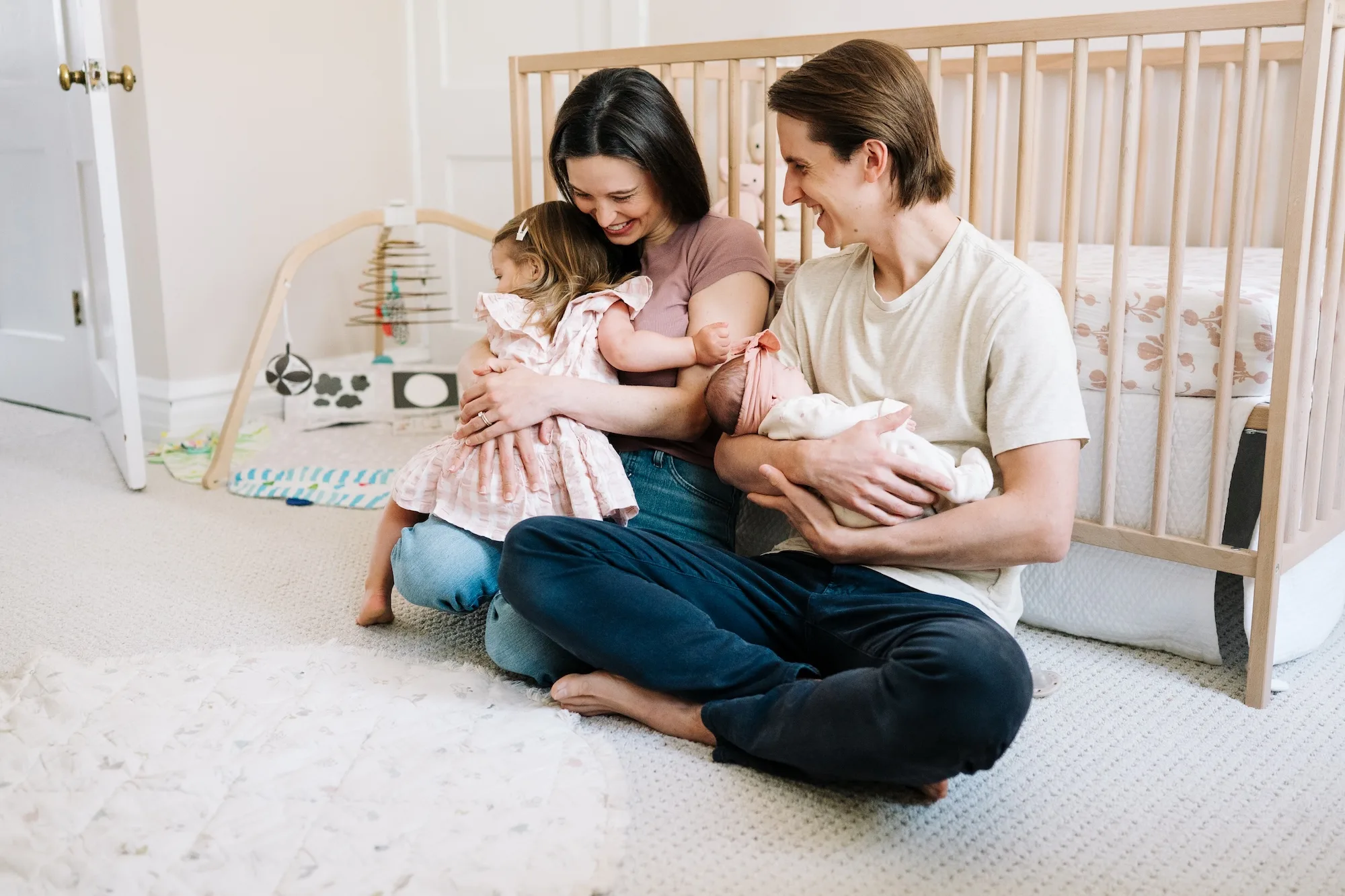
Throughout Erker’s second fourth trimester after having her daughter Lillian, she’s learned to slow down in a way that promotes her own wellbeing—and inspires her to help other moms do the same. From the vaginal healing to the exhaustion, Erker wants her clients to know that she’s navigating it all alongside them and that she hardly has all the answers. “Our bodies just took nine months to grow a baby—it’s gonna take time for it to heal, too,” she says. “The things that you were doing physically before aren’t going to feel quite as easy postpartum. That includes things like lifting up the car seat or going on a long walk right away. All of those things, we really need to ease back into.”
Erker has put personal wellness at the forefront in her own postpartum journey with Lillian by giving herself grace and rest during nap windows, being intentional about individual quality moments with each of her children, and setting her phone to “do not disturb” during family time.
“Take care of you,” she advises other moms. “Let the laundry sit there for a little bit. Let the dishes sit there for a little bit when you have a moment. Take care of you first, and then if you still have more moments, then take care of the other things—because there will always be laundry, there will always be dishes, there will always be a mess to clean up, but if you take care of yourself first, you’re much better able to handle those things later.”
The other aspect Erker has emphasized during this time of life has been mental health. Instead of doomscrolling during 3 a.m. feeds, she’s reading books—more than she ever has—and as her mother-in-law advised her, making the middle of the night a point of connection with her youngest. “It’s a mindset shift of ‘both can be true,’” she says. “I can be so in love and obsessed with this baby I’m holding, and I can be so tired and exhausted and drained at the same time. I can want to hold her but also want to sleep. Holding those emotions at the same time has been something that has really helped me.”
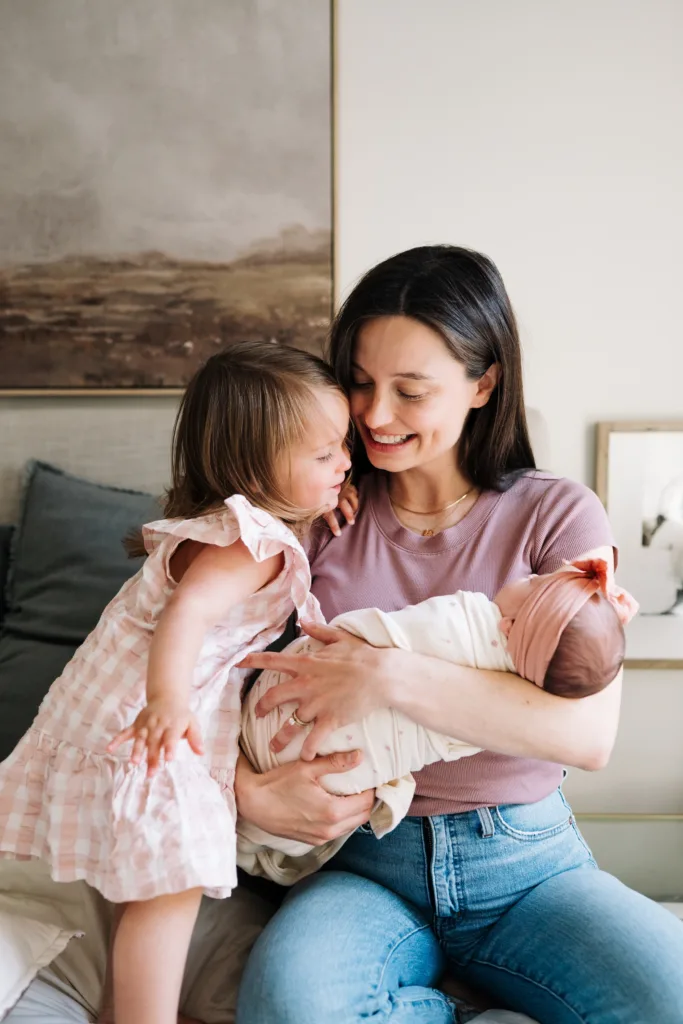
She’s also learned, through the way other women have supported her during both of her postpartum periods, how she wants to be there for others—from dropping off coffee without the expectation of face time to building mom baskets of essentials such as dark-colored pajamas and shower steamers (because “any shower postpartum should feel like a little spa”).
Erker is following her own fourth trimester program this summer, as well as physical lessons she’s picked up along the way. For instance, while baby-wearing has increased for her this postpartum period due to simultaneously having to keep up with a toddler, she’s mindful about the carrier she’s using, its position on her body, not going for walks with the carrier on, and her baby-wearing posture.
“It’s such an argument for reconnecting to your core,” she says. “Some of those less supportive carriers, as baby gets bigger, basically almost act like you’re still pregnant. So it’s pulling the front of your body forward and your lumbar spine into a lot of extension or a big arch back there. That can do a number on your back.”
Still, ever the exercise expert, Erker is a big believer in moving in ways that makes sense postpartum. “There is some good emerging research that physical activity in the postpartum period is extremely helpful with postpartum depression,” she says. “It is not a fix-all—it never will be—and there are so many different circumstances, but we do know that physical movement is really good for our mental health. Apart from that, just finding that 10 minutes where you get to feel in your own body and then also knowing that you have a safe space in these videos…. I’m not talking at all about how your body looks during this time; we’re just talking about how it feels and what it allows you to do.”
Although Erker hopes that her new program helps moms across the board, she also knows there’s no one-size-fits-all solution for anything postpartum.
“We’re not telling people, ‘Here’s what it should look like when you’re six weeks postpartum,’” she says. “We are all on a very different path, and this is about what we can do to support each other.”