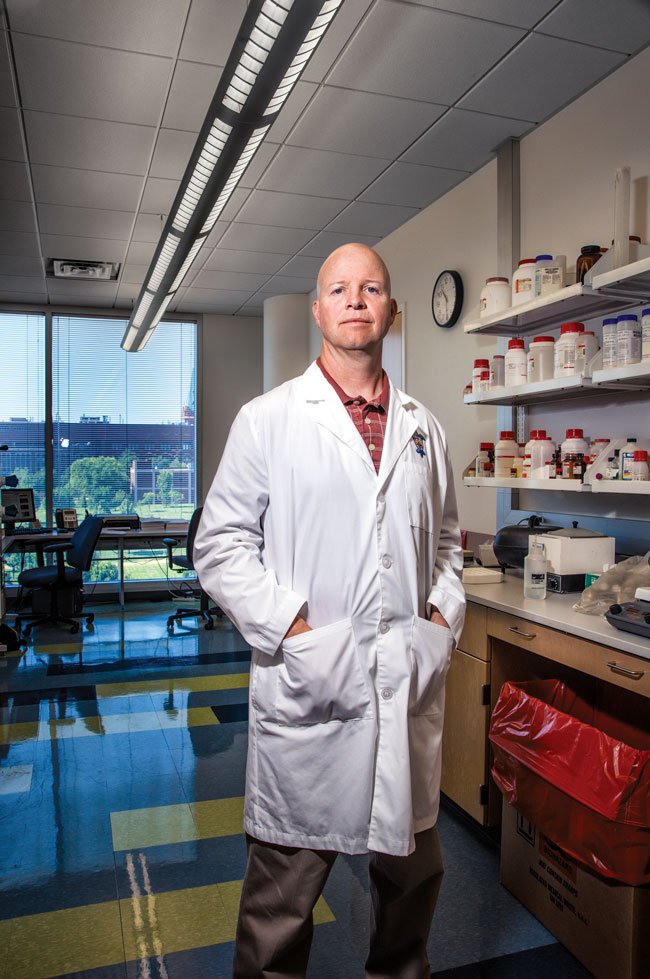
Fran Sverdrup first caught sight of his future wife as they stood at a bus stop just off campus—the University of Pittsburgh, where he was doing graduate work in molecular biology and Marsha Pagnotto was studying genetic counseling.
Marsha had no idea Fran had even noticed her. And neither of them had any idea how crucial their choice of graduate programs would become. (Fran isn’t a big believer in fate—never has been—but people around him keep pointing to examples.)
Your guide to a healthier, happier you
Sign up for the St. Louis Wellness newsletter and get practical tips for a balanced, healthy life in St. Louis.
That evening, he ran into Marsha again at a party. Soon they were seeing each other regularly at beer-and-pizza gatherings. Asking her out on a date, at first a scary prospect, started to feel inevitable.
He and Marsha fell in love. They were both Catholic, but they wanted to be married outside, so they found a minister. When he roared up on a motorcycle, they wondered whether Marsha’s mom could take it. But the ceremony was graceful, and married life proved deeply satisfying. Four years later, when Marsha became pregnant, Fran took “Boot Camp for Dads” at the local hospital. Smart, informed, prepared, they thought they were ready.
When Marsha went into labor six weeks early, her scientist husband told her to go back to sleep; it was probably just Braxton Hicks contractions. She knew better.
“Her water broke at the hospital entrance,” he says ruefully. They had a beautiful baby girl, and everything was radiantly fine until later that day, when she started nursing—and stopped breathing.
A battery of tests followed, and Fran practically lived at the hospital for two weeks with Marsha and their daughter, every beep of the breathing monitor keeping their nerves on edge. The baby had learned, in the first few days, to suck, swallow, and breathe in the proper order, but now they’d noticed a bit of hearing loss, and Marsha suspected a connection. Over the next months, they also noticed a weakness of her facial muscles. Fran was focusing on the hearing loss, hypothesizing that the antibiotics the hospital gave her when she stopped breathing could have caused ototoxicity. Marsha kept rifling through all her genetics books, but she couldn’t find anything that linked her baby’s early breathing problem, hearing loss, and facial weakness.
The little girl was lovely, though, and such fun! A happy go-getter, always in the middle of a party. They fitted her with tiny hearing aids so her speech would develop normally, and she wound up with a vocabulary—and wit—that kept her older cousins laughing.
In those years, the Sverdrups lived in Michigan, and Fran was researching antiviral drugs for Pharmacia & Upjohn. But in 2003, right after the birth of their second daughter, he was transferred to St. Louis. Here, Marsha gave birth to their third daughter, and the family thrived. Seven years later, when Pfizer (which had bought Pharmacia) closed its St. Louis research site, they didn’t want to leave.
Instead, Fran and 11 other displaced scientists joined SLU, forming the core of a new humanitarian project: the Center for World Health and Medicine. Their charge was to discover medicines for rare and neglected diseases—those that Big Pharma ignores as unprofitable. Part of his work there drew on his early training in regulating gene expression, and he acquired expertise in epigenetic regulation, using drugs to trigger the immune system to turn off certain genes.
He still had no idea how important that would be.
By now, the Sverdrups’ firstborn was a serious athlete, playing vigorous basketball and softball, swimming laps in a blur of frothed water. She had an amazing backstroke, Fran realized with a thrill of pride, even with those thin little arms.
Later, he’d remember just how thin they were. But she was skinny all over, in a cute tomboy way, so at the time, nobody paid much attention.
When she turned 9, though, her dad noticed her maneuvering awkwardly when she raised the basketball over her head to shoot. He devised exercises to strengthen her upper arms, and as he isolated different muscles, he discovered a startling weakness in her triceps. She’d been working around it.
He and Marsha took her for a neuromuscular evaluation and received a tentative diagnosis—later confirmed by genetic testing—of facioscapulohumeral muscular dystrophy (FSHD).
Neither of them had ever heard of it.
They read every bit of literature they could find. A rare genetic muscle disorder caused by an inexplicable mutation, FSHD affects maybe one in every 7,500 individuals. One of the most common forms of muscular dystrophy, it starts by weakening muscles in the face, shoulders, and upper arms, then progresses, slowly but often inexorably, to the legs, eventually requiring the use of a wheelchair. Usually FSHD begins in a person’s teens; when it starts in infancy, it sometimes affects hearing and vision as well.
There was no known treatment, and there was no cure.
And epigenetic regulation played a major role in the disease’s progression.
Fran walked into his boss’s office. “My daughter’s been diagnosed with this disease, and I have the background to start doing research in this area, and I’d like to do it,” he said. He waited calmly for the answer. If it was no, he’d find a way to do the research anyway.
“This should be a no-brainer,” Pete Ruminski, the center’s executive director, told him. “Your daughter has a rare disease. Our mission is rare and neglected diseases. You have expertise in coming up with therapies directed at these diseases. And it’s your daughter who has this. Of course you can do it!”
In November 2011, Fran showed up at the FSH Society’s International Research Consortium in Boston. By now he’d made his peace with a father’s lost dreams—perfect health for his daughter, a strong body, varsity teams sailing to victory because of her athletic prowess… Let it go, he told himself. Those dreams are selfish, and they’re childish. Tackle reality.
His questions at the research meeting were naïve; later he’d realize just how impetuous he’d sounded. “Why can’t we just remove the patient’s muscle cells, fix them, and put them back?” he demanded. “We know how to do that!”
Once they knew him better, one of the FSHD researchers teased, “You came in like you were walking into a saloon with both pistols drawn!” There were all sorts of technical impediments. Muscle stem cell technology wasn’t yet advanced enough for the swap he proposed.
They told him that drug screening—his wheelhouse—would be the best approach. So he persuaded Dr. Stephen Tapscott, a neurologist and molecular geneticist at the Fred Hutchinson Cancer Research Center in Seattle, to help him. After years of work, Tapscott was just about to break open the mystery of FSHD by identifying the genes and proteins that damage the muscle cells, as well as the mechanisms that can cause the disease (two genetic changes on chromosome 4 that made a certain protein abnormally active in muscle cells). Tapscott agreed to provide Fran with reagents—cell lines from patients’ muscle cells—that would allow him to screen different drugs, hunting for one that would turn off the toxic gene expression.
“I’m going to figure this out,” he told his daughter, jaw set.
At first, her reaction was eager and trusting: “That’s great, Dad! Can I come see where you work?” Then self-consciousness kicked in, as her father broke his soft-spoken reserve to get some media attention. It mattered; they needed to do a little fundraising to help the research effort. But when reporters started asking for photos and video and interviews with his daughter, that flush of young enthusiasm corkscrewed into a tight “I don’t want to talk about it”—which softened, with another year’s maturity, into “I’m glad you’re doing this and I want to know what you’re learning, but don’t use my name, Dad, OK?”
In 2014, three years after that first FSH Society meeting in Boston, Fran identified a class of compounds that could turn off the toxic gene’s expression.
Sky-high at the first results, he tore home to tell his family. His daughter asked how long a drug would take to be approved. He gulped and said, “Five years, maybe?” That was best-case; it would probably be closer to 10, by the time the clinical trials spiraled their way up to federal approval and labeling. “She couldn’t comprehend that long time frame,” he says, his eyes sad, “and it made her realize her predicament. What bothered her most was that there was nothing anyone could do—and it would be that way for her foreseeable future.”
She’d started to skip phys-ed classes, and she’d decided that she wouldn’t swim the next year. It was becoming awkward just to lift a glass to her face, and eating was an exhausting challenge in coordination. Once happy-go-lucky, she’d developed a mordant wit, trading her role of entertainer for the quiet, sometimes caustic observer. She liked offbeat, edgy, smart humor that not everybody got. She hung with a small, tight circle of friends. When she swore that she never got teased by the other kids, her parents weren’t sure that they believed her.
Fran spent 2015 refining and publishing his results, writing a patent application, and courting drug companies, looking for a partner to move the investigation toward clinical trials. The Center for World Health and Medicine started a “Dance N Donate” campaign to help raise awareness and research funding. The attention made him a little squeamish, and his daughter was mortified. But he couldn’t say no to the opportunity.
“My goal all along was the fairytale ending,” he says. “There’s no other goal. But with drug discovery, you have to be realistic. The best-case scenario is a clinical trial for two or three years. I can’t get her into that, because it won’t be pediatric. But by the time she’s an adult, there will be something nearing the market, so when she’s in her twenties and can still be helped, it will be available.”
He’s determined to keep her out of a wheelchair. As long as the muscle groups are weak but haven’t disappeared altogether, he believes, that will be possible.
Meanwhile, she’s developed an artistic talent that’s outstripped the old athleticism, and she intends to study graphic arts. She keeps her dad current with music. Gets A’s in school. Her moods are evening out. Her usual garb’s a rock ’n’ roll T-shirt and leather jacket. Sophisticated and smart, she’s showing flashes of wisdom.
And her father’s goal is in sight.
This spring, Ultragenyx, a biopharmaceutical company that develops novel products for rare and ultra-rare diseases, agreed to fund Fran’s research team for the next three years. That should be long enough for them to turn his discovery into a drug to treat FSHD, helping not only Fran’s daughter but at least 15,000 others in the U.S. alone. (The FSH Society estimates the total as closer to 40,000.)
Because a therapy for FSHD would be considered an “orphan” drug, medication developed for a rare disease, it could be eligible for expedited reviews and fast-tracked through clinical trials, reaching Fran’s daughter just in time.