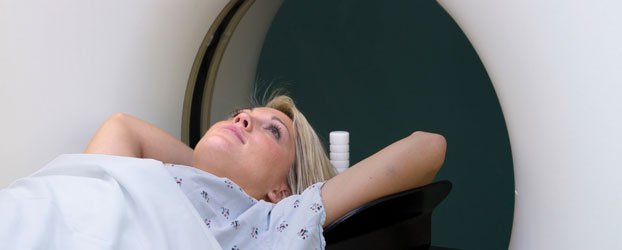
When it comes to cancer, “Early detection is the name of the game,” according to Dr. Dan Luedke, medical oncologist with SSM Cancer Care. To catch the disease in its earliest stages, SSM St. Joseph is now utilizing CT scans to help diagnose lung cancer.
“The easiest way to understand it is that the CT scan is to lung cancer what mammography is to breast cancer,” says Luedke. CT scans of the chest provide a closer look into the lungs, detecting even very small nodules that previously went unseen on chest X-rays, which Dr. Luedke describes as “totally insensitive,” with a five year survival rate of only 15 percent.
Your guide to a healthier, happier you
Sign up for the St. Louis Wellness newsletter and get practical tips for a balanced, healthy life in St. Louis.
Studies performed by the National Cancer Institute and the International Early Lung Cancer Action Program (I-ELCAP), which includes nearly 50 institutions world wide, both encourage CT scans over X-rays, Luedke explains. In November, the National Cancer Institute released findings that there was a 20 percent decrease in lung cancer deaths when using CT scans instead of chest X-rays. These findings corroborated with the results of the I-ELCAP, which had been doing similar studies out of New York’s Cornell University since the 1990’s. I-ELCAP studies, over the course of about 70,000 CT screenings, found that when using CT scans over chest X-rays, 80 percent of lung cancers will be detected in early stages and 90 percent of those patients will be alive in five years.
SSM St. Joseph, a member of I-ELCAP for nearly five years, has screened almost 700 patients using the CT technology. Luedke reports that of these 700, six cases of lung cancer have been found, five of which were found in stage one. All six of the patients have since underwent surgery and are alive and well. This data is all transmitted back to I-ELCAP at Cornell, aiding in the continual study and refinement of CT screening.
“We’re trying to expand our program by August,” says Luedke, looking to also locate the program at SSM St. Clare and then hopefully system-wide by the end of the year.
SSM is still looking for those with an increased risk of lung cancer—specifically those who are over the age of 40 and who are either current or former smokers, with no prior history of cancers—to participate in the study. “Data gathering is what I-ELCAP is about, and we’re participating with them,” Luedke says. “The idea is to continue to accumulate data… accrue data and accrue patients… in order to better interpret what is seen on CT scans.”
The CT screening can benefit non-smokers, as well. “We include people with significant exposure to secondhand smoke,” says Luedke, which can include those who have spent a considerable amount of time working at bars, restaurants, and casinos, or other places where smoking is prevalent. “If someone is concerned, we’ll discuss it with them,” he says, adding, “We can screen off study.”
Currently, the CT scan is not covered by insurance companies and costs about $300. But, “A pack a day of cigarettes per year is a whole lot more than the screening,” says Luedke, adding that if any kind of abnormality is found, insurance usually then begins to foot the bill. There is also a slight exposure to radiation during the screening, “about the same as flying from the east coast to the west coast,” according to Luedke.
And while the CT scan is a screening for patients, it is also part of the learning process for radiologists. “I-ELCAP has a tremendous library of CT scans,” Luedke says, mentioning that screeners are, at first, read by a panel of experts in New York to ensure proper screening and reading of the scans. The constant research and sharing of data is an indefinite process. “We are continually working to improve technique,” says Luedke.