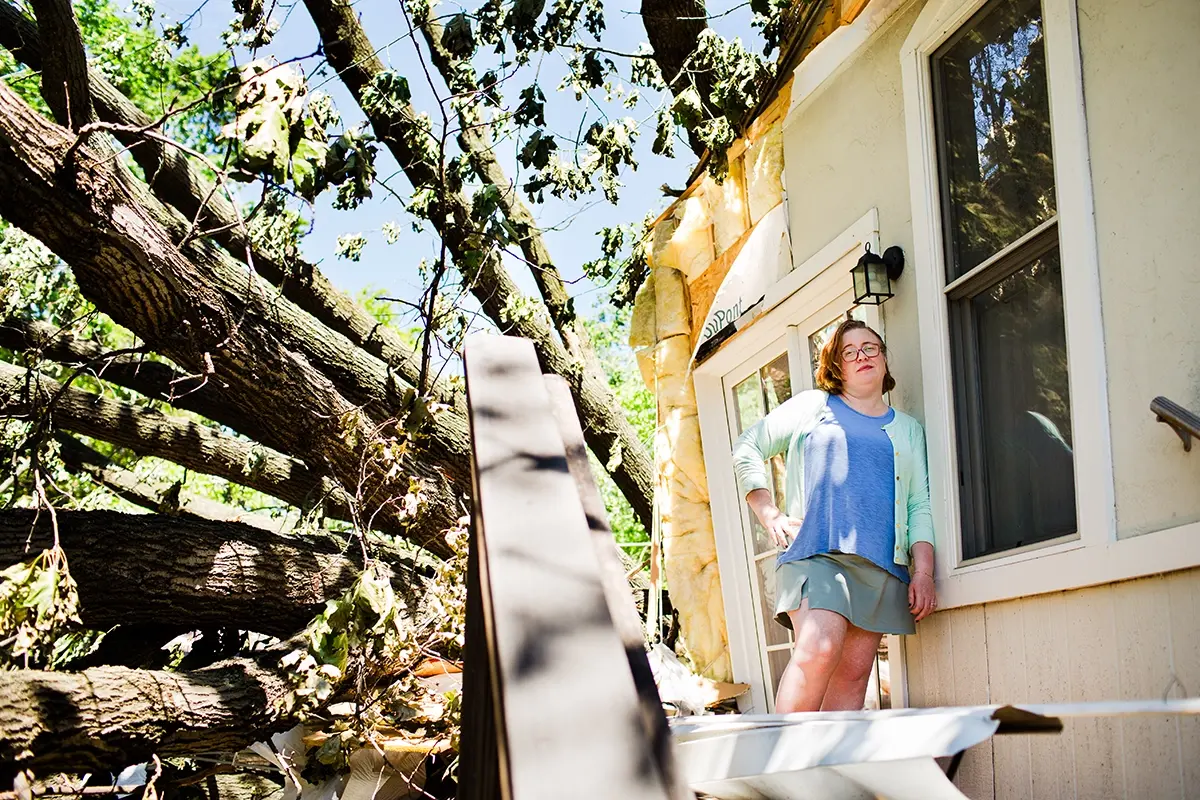
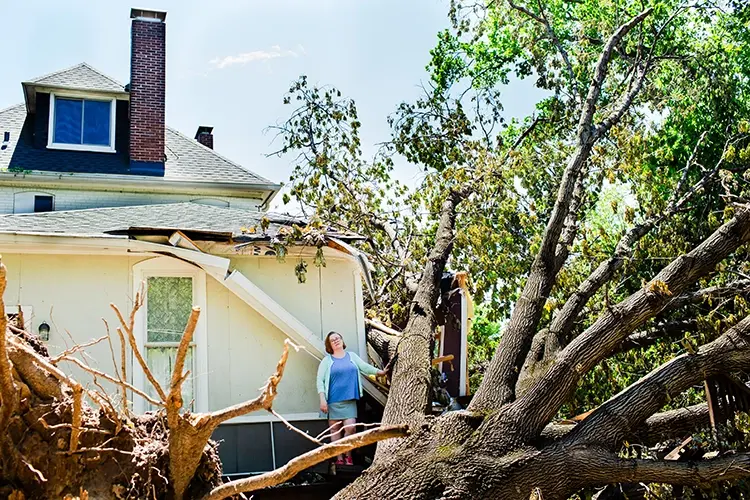
Liz Deken’s Richmond Heights house is a Century home. It has three stories, a double lot that allows for a two-car driveway, a playground across the street, and a peacefully shaded deck that wraps around two sides. Inside, the main-floor laundry made the mom of two swoon when she saw it, and the original brick fireplaces—well, they don’t work, but they’re beautiful, Deken says.
“It was just a really perfect blend of historic with some new updates that made it feel modern and comfortable,” she says. “With all these old trees that I love—well, loved.”
Discover fun things to do with the family
Subscribe to the St. Louis Family newsletter for family-friendly things to do and news for local parents, sent every Monday.
On May 16, Deken received a text from her next-door neighbor when the sirens started going off: “Your oak tree fell on your house.” The oak tree in question was more than 100 years old, more than 50 feet tall, and more than 4 feet in diameter. “My brain just couldn’t actually process that information because that tree couldn’t have fallen over,” she says. “Not that one.”
Then, the cascade of panic hit: Deken’s 14-year-old son Parker was home by himself, in their basement. “I finally get ahold of my kid, and he’s like, ‘Mom, I’m fine. I’m fine,” she recalls. But when Parker sent her a picture showing the oak tree crushing the back corner of her home and backyard, she knew she needed to get to where he was.
So she talked to her boss, Tara Gallina of Take Root Hospitality, who told Deken, the director of events and catering, “Go home, go home.” Deken drove down Delmar to Brentwood, but it was closed. She turned down Skinker, but it was closed. “Every time I would go to a new intersection, I couldn’t go south,” she recalls. “I just couldn’t get south.”
She went to the gas station to fill up her tank—but there was no power. Anxiety spiking as she navigated the roads, Deken also called relentlessly to get through to her 11-year-old son Sebastian’s school in the Maplewood-Richmond Heights School District—but again, the power was down. “I don’t know where my kid is,” she says. “I don’t know if he’s on a bus. I don’t know if he’s walking. I don’t know if they’ve got him hunkered down at the school. So I can’t even identify where my 11-year-old is. All I do know is that my older son was home alone when this tree fell on the house, and I can’t get to either of them.”
As a newly single mom, Deken describes the chain of events as abject terror: “I have never felt so scared.”
The Aftermath
After the City of Richmond Heights deemed Deken’s home uninhabitable due to the damage, it placed a yellow sticker signifying the family could come in only to get their things. Ameren cut her power, due to risk of electric shock. And most of the direct damage—although structural damage has yet to be evaluated—was contained to Deken’s personal bedroom.
So while her kids could thankfully pack their favorite stuffies and clothes to move in to their grandparents’ house in Chesterfield, Deken relied on the generosity of neighbors to lend her the essentials normally kept in her now-demolished dresser. “Literally the same day, three different women showed up,” Deken adds. “Somebody brought me socks; somebody brought me shirts. I was just in tears with gratitude. The way this community pulls together for one of their own is so magical. I know that’s not the most rare thing, but it sure isn’t every community.”
Close friends weren’t the only ones to offer respond to Deken, who made many local connections by volunteering during the height of the COVID-19 pandemic. The kids’ school board and baseball and soccer teams also rallied, she explains. A meal train was set up for the family. The superintendent’s service coordinator even offered to pay for cab rides to get the kids to school from Chesterfield to Richmond Heights and back. “All of the support, this community—it’s made this impossible thing feel possible,” she says.
It’s the day-to-day challenges that Deken, who acknowledges how lucky she is to have a place to go, that are currently plaguing her family. The newly elongated commutes to work, sports, school, and extracurricular activities have presented a scheduling nightmare. Deken describes a constant logistical puzzle of figuring out what makes sense to take with them, to where, and with what—and, heaven forbid, the classic kid move of forgetting a backpack or cleats.
“Do we go back out to Chesterfield then? Do we drive to Earth City to the game? Do we go to a coffee shop? Do we go to a friend’s house? Do we just sit in our front yard, where we’ve got some shade and some lawn furniture but nothing else? Do we eat out again even though that’s getting expensive and not very healthy? It’s not like I can cook anything or heat water for them at our home. Every day, it’s like we don’t know what we’re doing.”
And though Deken describes her work as incredibly supportive during this time, life doesn’t stop, of course, mid-crisis. So as she started navigating her own slate of home repair vendors. Deken also started her day the morning after the storm up at 7 a.m. attempting to connect and reassure bridal vendors for events hosted at Winslow’s Table.
Deken’s real source of strength through this time has been her kids, who held her as she cried when she saw the damage for the first time. “It was one thing having it described to me by my kid,” she recalls. “But coming home, the first thing that I could see is tree branches that are horizontal in my driveway that should be vertical in my backyard. And then, the purple paint from my interior—I could see it outside. I saw that I don’t have a deck anymore; it’s underneath this tree. All of it just kind of registered at once. I just broke down.”
Deken says she can see the toll of being displaced weigh on her kids, with her normally rambunctious boys more quiet than usual. Her older son sits and reads in what she assumes is regulation soothing. The kids don’t want to go in the house by themselves, and they repeat to her that though they do have a place to go, they feel homeless.
“We’re not in our home where I want to be, where they want to be, where they feel at home,” she says. “Especially since [my husband and I are] in the middle of this separation—their lives in many ways had already been uprooted.”
The Future
Just a few days before the scheduled tree removal, Sebastian—an 11-year-old to the core—turned the family’s fallen tree into a jungle gym. His mother warns him to be careful, as two arborists have already told Deken that though the tree looks secure, it’s very risky. “They said, ‘If you even start cutting limbs off, the torque or the tension on this could cause it to roll farther onto your house.’”
As she faces a proverbial storm of logistics, including going back and forth with insurance, Deken wonders if returning to her home will ever be an option.
“I have lived in St. Louis my whole life; I’m certainly familiar with being a tornado alley person,” she says. “But now, having experienced this firsthand, what is crystal clear to me is that when something like this happens to you, you are just totally unprepared for what the next steps are. There are so many people I have to call and so many things I have to coordinate and so many things I don’t know about that I’m relying on these other vendors to explain to me.
“It just kind of puts you in this experience where you’re dealing with all of these things you have no knowledge about but that are very personally urgent to your life,” she adds. “Because your home is destroyed or it’s unlivable, or you’re risking further damage because your roof’s falling off in pieces or water’s coming in the window.”
Among her immediate worries is that draping a tarp over the damage is ineffective because of the size of hole that the tree left and the inability to attach the fasteners. Beyond that, the future looks hazy, as Deken’s parents, who are older, can’t house the family long-term. She’s looking into whether the insurance company can set them up with temporary housing, but without knowing the full scope of the damage or timeline for reconstruction, it might lead her to require alternate housing on a longer-term basis.
All Deken does know, regardless of her floating address, is that St. Louis is home. “I would rather live here than anywhere else because I see it over and over again: When people hit crises, this community comes together in such a beautiful way.”