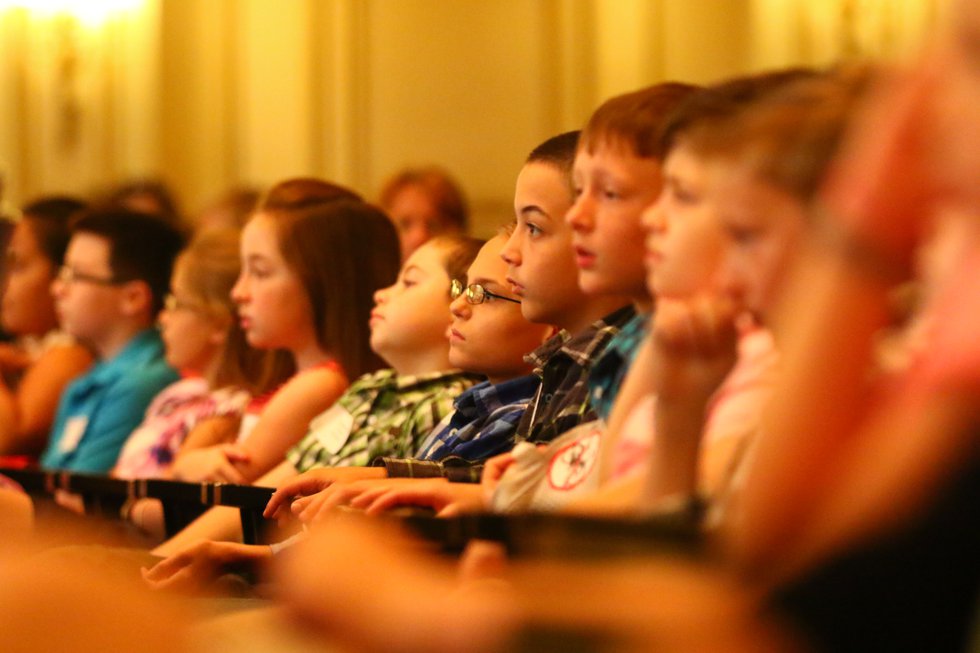
More than 8,000 elementary school students from across the region will travel around the world in a few weeks. The children will make stops in the Balkans, China, France, and West Africa—without leaving downtown St. Louis. With the St. Louis Symphony Orchestra as their guide, these students are embarking on quite the musical journey.
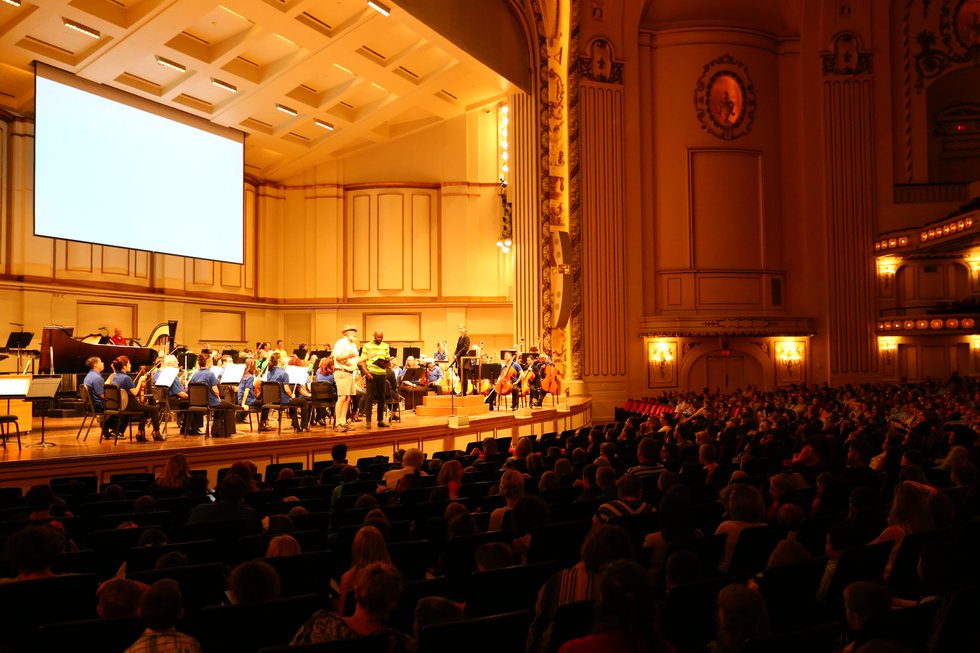
The St. Louis Symphony Orchestra is hosting four Music Without Boundaries education concerts, staging two 45-minute performances daily on February 20 & 21 at Powell Hall. The sold-out shows mark the first time the Symphony has extended its Music Without Boundaries programming into its educational concerts, which are held during the school day and come with detailed teacher resources. Music Without Boundaries concerts ask students to compare the music of different cultures and understand the impact people those cultures had and continue to have on music, says Maureen Byrne, St. Louis Symphony Orchestra’s senior director of education and community partnerships. “It’s a little bit of a social studies lesson through music.”
Discover fun things to do with the family
Subscribe to the St. Louis Family newsletter for family-friendly things to do and news for local parents, sent every Monday.
In addition to expanding student education, Music Without Boundaries provides transportation and admission to special performances throughout the year for new immigrants and refugees. The program also organizes orchestral outreach events to create connections between musicians and the area’s immigrant populations.
Those connections will be on display during the Music Without Boundaries educational concerts, which will feature the University of Missouri–St. Louis Percussion Ensemble under the direction of Matthew Henry as well as Bosnian-born accordionist Amir Salesevic.
For Salesevic, the opportunity to share cultures with the students is possible because of his own path to SLSO. He was planning to attend a conservatory and become a professional accordion player when the Bosnian War broke out. He left his musical aspirations behind as a refugee, eventually settling in St. Louis to begin working in the medical field.
His initial reconnection with music came when he was a member of an advisory council to a collaborative project between the orchestra and Fontbonne University’s Bosnian Memory Project. A casual conversation between Byrne, Salesevic, and others led Salesevic to sit in with the SLSO on Bosnian Journeys performances that stemmed from the Fontbonne collaboration. After years of thought and planning, Salesevic is now devoting himself to music full time again, Byrne says.
“It’s changed the direction of Amir’s life. It’s unbelievable,” she says of his path back to music. “Now he imports specialty accordions into the United States and he plays accordion all around St. Louis, including with us in community concert settings, and he has plans to open an accordion museum here in St. Louis.”
In addition to featuring selections from Bosnia, the Music Without Boundaries concerts offers music from West Africa, Asia, and Latin America to represent a few of the immigrant groups found in St. Louis today. Performances will also include a contribution from French composer Gabriel Fauré as a nod to the city’s French roots, along with selections by American composers Aaron Copland and Scott Joplin, who wrote some of his best-known music while living less than a mile from Powell Hall.
“St. Louis is such an incredibly culturally diverse place that there was no way we could represent every single culture,” Byrne says, “but [with] these pieces we think are going to provide a really satisfying experience for the students because they represent the cultures so well, and they are great pieces of music.”
SLSO will present its last educational concert of the school year, The Orchestra Swings, on May 7–8. The orchestra also offers Family Concerts—its next will be Cinderella, 3 p.m. on February 17—and free community concerts in an effort to make orchestral music accessible to all.