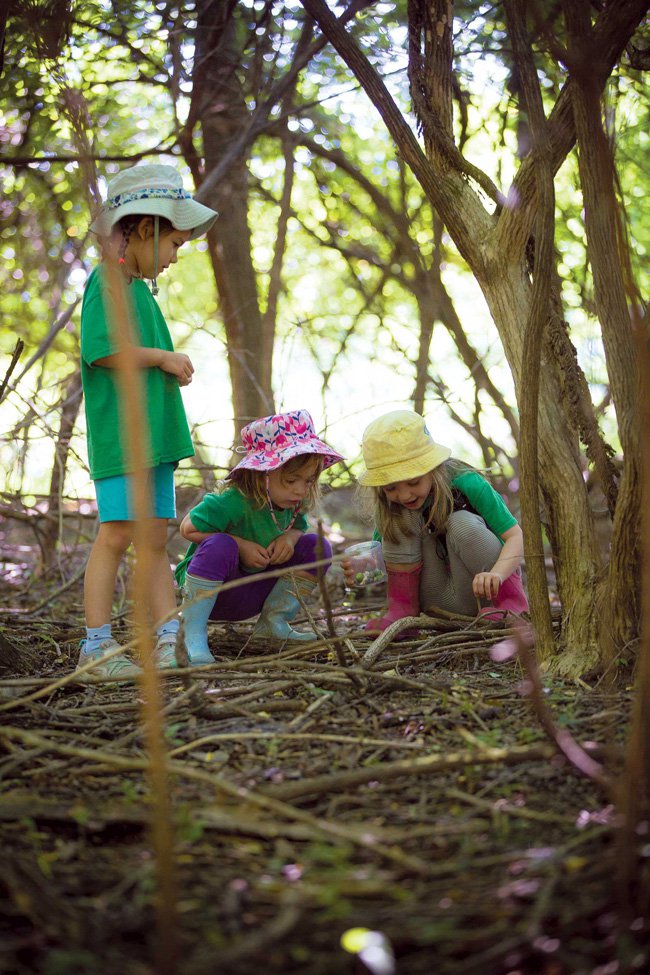
Ahead on the path, five little girls in pastel sun hats crane their necks as they walk, hoping to spot forest fairies.
“Beautiful forest fairies,” stipulates Vivienne.
Discover fun things to do with the family
Subscribe to the St. Louis Family newsletter for family-friendly things to do and news for local parents, sent every Monday.
Her teacher at Raintree School, Emily Gillain, tells me the day will depend “on how the symbolic play is going.” My day usually does, too. But I’m not sure what a 4-year-old’s version of office politics is.
“Symbolic play is very inventive,” Gillain explains. “They may find a log and claim it’s a pirate ship. We’ll start by saying good morning to the wild space and set our intention for the day.”
We scramble over rocks and enter deeper woods. They’re nimble and silent; I’m crashing through like a buffalo, sticks cracking underfoot.
“There’s a better way,” one child sweetly informs me, and Gillain plucks twigs and leaves from my hair. They find a clearing, hang their water bottles from branches, and carefully set down the rocks they’ve gathered.
“Hands up, reach to the sky like a leaf or like a feather,” calls the other teacher, Annie Martin, and they sing good morning to the dear earth, the sun, the beast-ies and the birds. They are, I’ve been warned, especially interested in mini-beasties (a.k.a. bugs) and like to make tiny twiggy huts for them.
Next, each girl comes up with a forest promise. Braids swinging, Mia says, “I promise to use my brains before I do it.” (They’ve been talking about whether something is high risk or low risk and how to think things through.)
Now free to explore, the girls are to say when they’ve found something interesting, and Gillain will dole out a bug-catcher or magnifying glass. “I’m ready!” yells Nora a minute later. I ask what she’s found, and she screws up her face with delight: “I found dirt!”
“I found a groundhog home,” Vivienne calls.
“I just found garlic, but garlic is not blue!” Molly says, puzzled.
Italian videographer Sara Bonaventura crouches next to the girls, camera trained on each little face in turn. She’s been an atelierista (artist-in-residence) for a school in Italy that takes the Reggio Emilia approach to educating little ones, emphasizing experience, discovery, and self-expression. Now she’s filming a documentary about little girls in the forest—having adventures, getting comfortable in wild spaces. Her stars go to a Reggio preschool here, Raintree, the first “forest school” in Missouri. As often as possible, nature is the classroom.
Nora presses a big magnifying glass to her eye. “I just saw fairies! Tree fairies! I see little sparkles!” A minute later (the teachers offer scant direction) she’s figured out how to hold the magnifying glass closer to the plant than to her eye. “Ah, yes!” she says, squatting to examine “an interesting plant!”
To be safe to climb, Molly announces, a tree must be bigger than both your arms next to each other. I take a tree’s measure, then shake my head ruefully, as though disappointed I can’t climb it. If they can find forest fairies, I can fake being a free spirit.
“Everything is super far away,” complains Vivienne, holding a pair of binoculars backward. I slap my hand down, fighting the urge to fix them. She solves her problem by trading them for a bug catcher. But when she asks how to open it, all Gillain says is “Remember, the first step is finding the bug.” Zen in the woods.
Nora comes over: “We don’t know how to find a bug!”
“If you are in school,” Vivienne mutters to herself, “then you can discover.”
“Over here!” someone calls, and they gather to bend over the ground.
“Those are not family,” one of the girls announces. “They are not alive.”
“They could just be pretending,” Martin says.
“Stuff can still be a family if it’s not alive,” Vivienne declares.
A few forest days ago, they came upon bones and wondered aloud whether a coyote ate a deer. The next time, they decided to play in the tall grass, pretending to be coyotes chasing deer. “Death is brought to us in a very natural way,” Gillain says. “They learn compassion.” Pretty soon, they don’t squeal or recoil.
We venture so far into the sunlit, scratchy tallgrass prairie that I lose what little sense of direction I possess. Then Gillain stops the girls, reminding them to make a mental note always of where they are. “Mila, will you lead us back?”
A minute later, Molly’s clear voice rings out: “No, but Mila, we are going the wrong way. We did not walk through this.”
“Uh-oh,” says Mila.
“I can’t go back to the prairie,” Vivienne announces, full drama. She and Molly offer suggestions, Molly second-guessing Viv, and they decide to scan the trees for the hot pink of Viv’s water bottle.
“Oh, Mila, I think I was right!” Molly exclaims a minute later.
“Yes, you are! That’s my water bottle!” Viv calls, and there’s a “Wooohhhh!” of thrilled relief.
“Vivienne, I knew I was wrong about you,” Molly says graciously.
You couldn’t fit all these lessons in a textbook chapter.