In August, the Proceedings of the National Academy of Sciences of the United States published a study that the disparities in the survival rates between Black and white newborns during childbirth. Researchers from George Mason University analyzed the data of 1.8 million hospital births in Florida between 1992 and 2015 and found that when cared for by white doctors, Black newborns are three times more likely to die than white newborns.
“These statistics really shine a light on how deeply rooted racism is in our society,” says Kiah Earl. “We can either allow the behavior to continue by staying silent or [we can] hold white medical professionals accountable for the disparities in the way they treat Black moms and babies by creating awareness.”
Discover fun things to do with the family
Subscribe to the St. Louis Family newsletter for family-friendly things to do and news for local parents, sent every Monday.
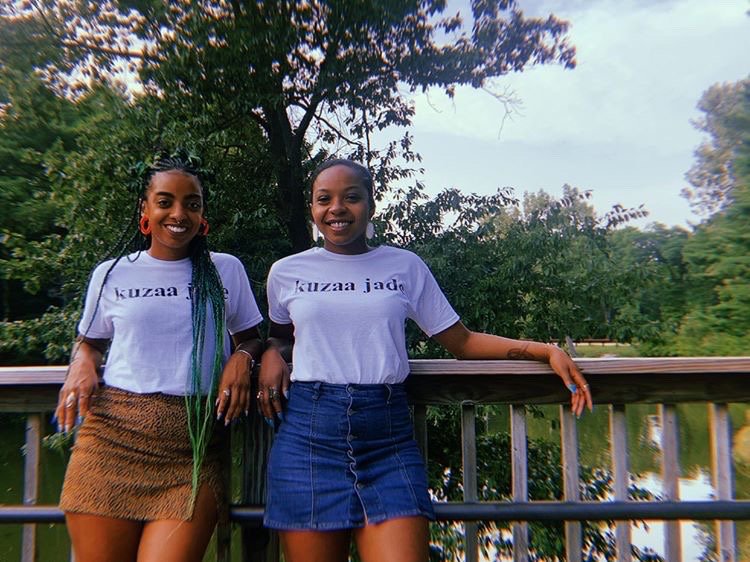
It’s why the 27-year-old and her friend Jessica Tibbs, 24, are currently raising money to fund their doula training and plan to launch their own birthing collective, Kuzaa Jade. (“Kuzaa” means “birth” in Swahili and jade represents love and connection to Earth as well as the power of crystal healing.)
“We came from a time when we were brought into the world by our own people, and we’ve come so far away from that,” says Earl. “It’s almost like [giving birth] is a medical emergency versus a journey, a transition, and a flow, and we want to create that and bring people back to that.”
A doula is a professional pregnancy and labor support person who advocates and provides support through the process of labor and birth. As a health care worker, Tibbs previously assisted patients with fertility issues and wants to make the birthing experience even more compassionate for mothers. Earl saw firsthand the impact a doula can have. “I have an 8-year-old, and when I was pregnant I had a doula,” Earl says. “I feel very lucky because my mom worked very intentionally to make sure I had people around me—my OB/GYN was Black, I had a Black doula, so there was never a time that I didn’t feel heard or supported.” She also had the opportunity to sit in on doula circles and hear experiences from other pregnant women.
Earl and Tibbs define a doula and what they do by four main pillars of support: physical, emotional, informational, and advocacy-based. Women who have the help of a doula during pregnancy benefit from the birth workers’ presence and encouragement, information about the labor process, using the power of touch and massage to reduce stress, and facilitating communication between mothers and medical professionals.
With the support of a doula, studies have found a high number of positive birth outcomes. According to the American Pregnancy Association, women with doulas were less likely to take pain-relief medications and have a cesarean birth. Research shows that having a doula present decreases the overall C-section birth rate by 50 percent, the length of labor decreases by 25 percent, the request for an epidural decreases by 60.2 percent, and the use of oxytocin decreases by 40 percent.
But Earl and Tibbs note it’s not just about the health of the baby—Black women are 3.3. times more likely to suffer a pregnancy related death than white women, and involve complications like severe bleeding, high blood pressure, heart disease, and strokes.
“Advocacy, education, and support are huge for bridging those gaps and helping [pregnant women] feel like it’s okay to ask questions if you don’t know the answer and it’s okay to do something other than what the doctor is suggesting,” says Tibbs. “Clearly there needs to be some type of connection between the patient and the doctor that has been missing for a very long time.”
“We aspire to be an inclusive doula collective,” says Tibbs, “but our focus, our driving force, and what really started all of this is the Black community, Black families, Black women and Black people that are going through the birthing process.”
According to the Journal of Perinatal Education, funded community-based doula support offered to low-income communities can potentially reduce disparities by not only focusing on the needs of the women but by offering community-based programs and having access to doulas who can provide culturally sensitive care.
With Earl’s experience in fund development, the goal is to begin writing grants and getting donor support to fund doula care for women who cannot afford to pay. The collective will either provide some sort of payment sliding scale or free services. “There are different doula agencies that already provide support—whether it be individual donors or grants—there are a lot of programs and local organizations that support Black birth workers and Black moms,” says Earl. “When we are taking clients 100 percent on our own, we will look for ways to make ourselves accessible to everyone.”