When Amy Buehler, program director of Washington University’s nonprofit management master’s program, was first approached about teaching an online course, she was skeptical.
“Anytime you experience a change with the way things have been going, there is trepidation,” she says, “but I thought it was a terrific opportunity.”
Discover fun things to do with the family
Subscribe to the St. Louis Family newsletter for family-friendly things to do and news for local parents, sent every Monday.
That opportunity has made major waves in St. Louis and nationwide. Washington University’s school for continuing education, University College, offers both fully online and hybrid programs. Saint Louis University’s School for Professional studies is branded “SLU for Busy Adults,” a nod to online education’s target demographic.
Today, Buehler is an enthusiastic advocate of the online approach. For one thing, it offers flexibility—a benefit that resonates strongly with students trying to hold down a career while pursuing a degree.
Emily Bland, a student in Buehler’s class, began her graduate studies with a mix of online and in-person classes. When her job at a nonprofit offered her a promotion that required a move to Philadelphia, her program allowed her to shift exclusively to online coursework. “I didn’t have to choose between finishing school or taking this new job opportunity,” she says.
Yet beneath the flexibility is a rigor that proponents say rivals that of traditional classes. “You think online classes are easier or not as prestigious, but professors still have the same expectations,” says Bland. “‘Put in the work, work hard, turn things in on time.’”
In a 2014 study, David Pritchard, a professor of physics at the Massachusetts Institute of Technology, found that achievement gains made online exceeded those made in the traditional classroom.
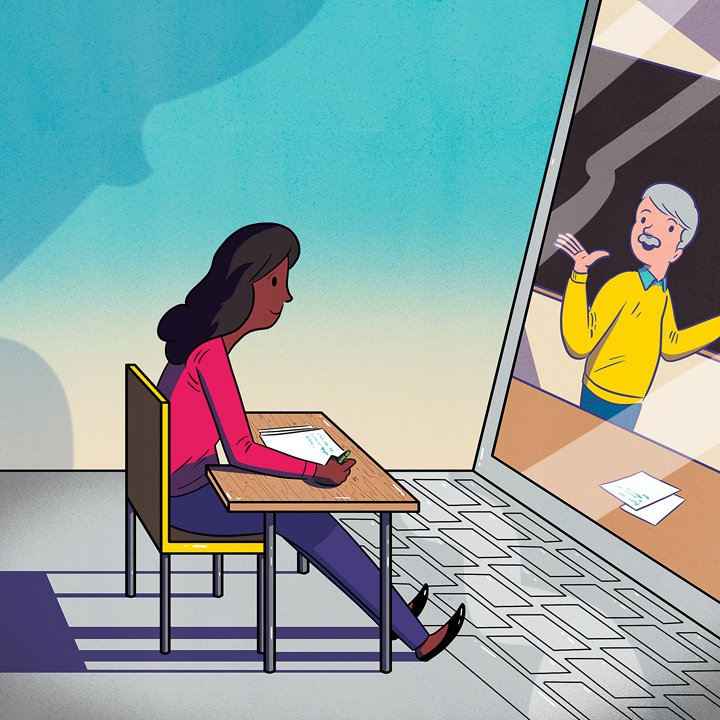
Though her online classroom lacks face-to-face interaction, Buehler says the online setting demands engagement. Discussions are asynchronous, meaning that students can weigh in throughout the week; participation is required. “On the ground, you can fall asleep in class, and I don’t know what you got out of it until I make you write a paper,” she says. “In this classroom, when someone isn’t following along, you can tell immediately.”
Buehler and Bland point to an unexpected intimacy in the online classroom. An educator can customize discussion threads to have group or one-on-one conversations with students. Both say the online environment nurtures more thoughtful, honest, and inclusive discussions. “You have to think out your responses instead of firing off something for participation points,” Bland says.
In the Saint Louis University School of Nursing, the online program uses what’s called the “unfolding case presentation,” a step-by-step approach to holistic learning. “Students have to be aware that this is going to take more time than in-class work,” says Joanne Thanavaro, associate dean of graduate education for the program, who echoes what Bland and Buehler say about the quality of discussions: “It takes more time to post a response that has to be articulate, that has to have citations, than it does to say something in class spontaneously.”
If there is a high level of student accountability in the online classroom, this can be partly attributed to greater maturity among students. Studies show that online students are, on average, older than their traditional classroom counterparts, and they are typically better educated.
Yet the impact of online education transcends age and experience. In a 2014 study, David Pritchard, a professor of physics at the Massachusetts Institute of Technology, found that achievement gains made online exceeded those made in the traditional classroom. “Right now, in general, online education seems to be at least as good as classroom education,” he says.
Yet he isn’t abandoning the traditional classroom in favor of the online classroom. He’s championing blended education—specifically, he says, the “flipped classroom,” which moves the lecture part of the course online and pulls the strategic-thinking components into the classroom.
This means that students can learn online at their own pace, and it shifts the burden of time for professors: less time spent preparing and giving lectures, more time for interacting with students offline and facilitating a higher level of thinking.
“Classroom education has been pretty much unchanged for 100 years,” Pritchard says. “It isn’t going to get better very fast all by itself. Online education presents a golden opportunity to actually improve what you’re doing.”
And for Bland and other students like her, it’s expanding opportunities rather than restricting them.
“I still love traditional learning, and I do sometimes miss that face-to-face interaction,” she says, “but online classes are working really well for me right now.”