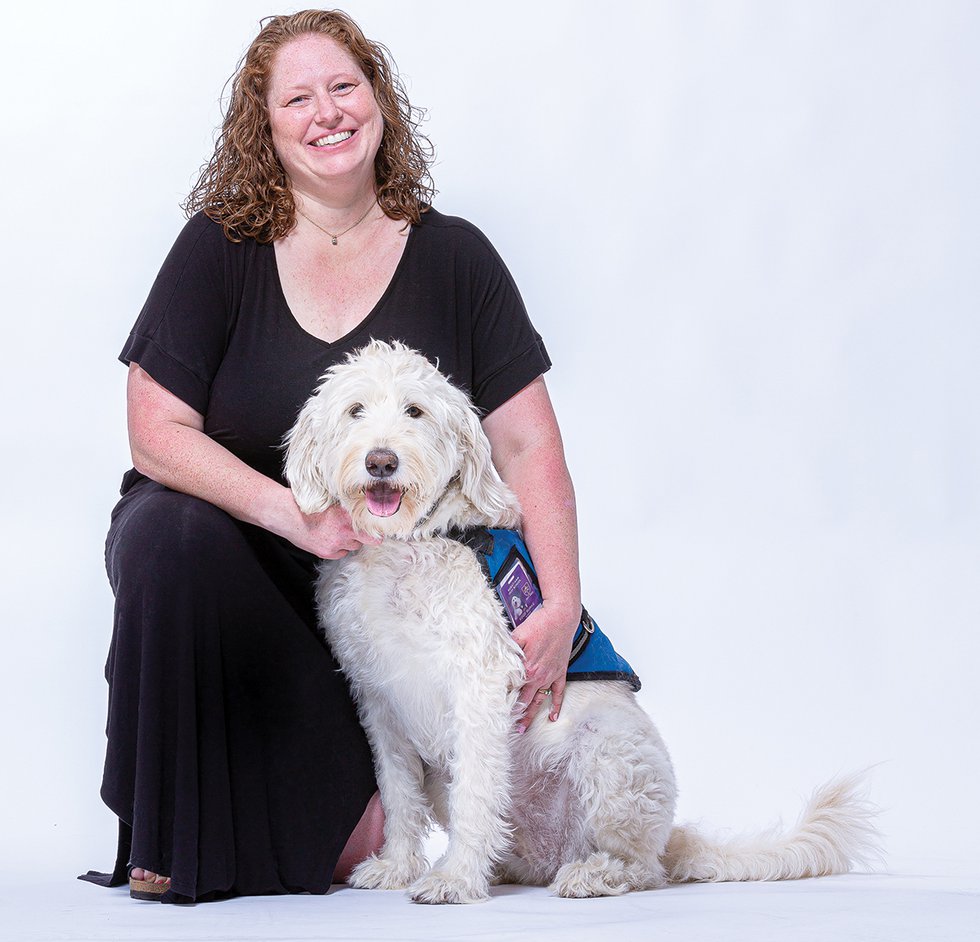
The dog’s name is Edge. She’s a 3-year-old labradoodle who was named after an SUV in Ford Motor Co.’s fleet of vehicles, just like the rest of the pups in her litter. When Jamie Burke, Rosati-Kain High School’s director of counseling, adopted Edge as the school’s therapy dog two years ago, she didn’t have the heart to rename her. Besides, the name fits. Sort of. “We joke that she takes the edge off of our intense feelings,” Burke says with a laugh.
The use of a certified therapy dog like Edge is just one of the many creative ways schools in the St. Louis region are striving to help students navigate the youth mental health crisis that has gripped the nation in the wake of the COVID-19 pandemic. From the introduction of new clubs to the addition of staffers—human and canine alike—schools are working overtime to make sure kids at all grade levels have the help and support they need to carry on.
Discover fun things to do with the family
Subscribe to the St. Louis Family newsletter for family-friendly things to do and news for local parents, sent every Monday.
After the pandemic forced children into isolation, redefined norms, and added a layer of stress to everything they did, there’s mounting evidence that kids need more help now than ever before. According to the Centers for Disease Control and Prevention, nearly one in five kids in the United States have a mental, emotional, or behavioral disorder. What’s even more worrisome, only 20 percent of children are getting the professional help they require. U.S. Surgeon General Dr. Vivek Murthy began sounding the alarm last year, issuing a national public health advisory that underscored the need for action. At the local level, schools and education providers are heeding the call. In some cases, even students themselves are taking action.
That’s the case at Saint Louis University High School, where seniors Freddy Laux and Jackson Slusser recently launched a new club, the SLUH Center for Mindfulness. In the wake of the pandemic, Laux and Slusser not only wanted to help their peers heal from the COVID-influenced upheaval of recent years, but they also wanted to create opportunities for classmates and faculty to practice mindfulness techniques, along with guided breathing exercises to manage stress and promote body-mind wellness. Last year, the group held regular meetings and encouraged campus community members of all kinds to attend.
“It’s become a very intergenerational thing, where administrators, staff members, and students are all a part of it,” says SLUH counselor Kate Kindbom. “It’s really neat how the kids have made gourmet lemonade out of these lemons from what have obviously been a tough couple of years.”
In response to the toll taken by the pandemic, John Burroughs School began adding to its traditional student health days with workshops focused on mental health. Seniors and juniors, for example, completed specialized half- and full-day courses that taught them such skills as coping with stress and practicing self-compassion. “Once we went back to in-person, it was clear to us that we really needed to focus on these things,” says Jennifer Jones, director of counseling and wellness at Burroughs. “We said to each other, ‘We have to make sure we’re taking care of our kids’ mental health.’”
Jones is also excited to have extra help on hand. Beginning this school year, Burroughs has a third counselor on campus to help kids navigate their high school experiences. For Jones and her fellow counselors, that means they’ll be covering only two grade levels, as opposed to three, which facilitates more personal care. “We’re going to be able to do our jobs so much more efficiently and effectively, and just be present for kids and families,” Jones says. “It’ll also allow us to really beef up our programming.”
Ginny Fendell, director of health and wellness at Whitfield School, can relate. Fendell believes that one of the benefits students realize from attending Whitfield is the small class sizes that allow for more individualized attention, and an emphasis on prevention. “It’s hard to fall through the cracks,” Fendell says. “With our advisory program, every student has a relationship with a teacher. We also have other structures in place, like weekly teacher meetings and maintaining open relationships with our parent body. If there’s any issue with a student, or a concern, we’re able to notice that early on.”
After the past couple of years, it’s basically all hands on deck. Schools now know that their students’ emotional experiences are as important as what they learn in the classroom. Options that schools might have deemed unconventional are now encouraged, like having a dog in school.
In the case of Edge, the therapy dog at Rosati-Kain, she’s not only cute, fun, and pettable, but she also serves a needed function. Burke notes that Edge’s mere presence during one-on-one meetings in her office has helped students open up and talk about their feelings more freely.
“I make the joke that I’m totally invisible now,” Burke says. “When I’m walking down the hallway with her, I hear, ‘Oh my gosh! I love you!’ She’s like a celebrity. She brings students comfort in her own way.”