When Vasit Sagan talks about St. Louis’ longstanding role in geospatial technology, he goes back—way back. Sagan is the deputy director of the Taylor Geospatial Institute and associate vice president for geospatial science at Saint Louis University. Unpacking the past, he starts with the Mississippians of Cahokia, pivots to the Lewis and Clark expeditions, then moves on to the region’s role in establishing what would become the National Geospatial-Intelligence Agency. Finally, he arrives at the metro area’s recent positioning as the nation’s epicenter of geospatial innovation. This history, he believes, is key to understanding what he and his colleagues are helping create with the Taylor Geospatial Institute, and it speaks to St. Louis’ role as a leader in the sector.
“We see this as a new wave of economic opportunity for St. Louis,” Sagan says. “We see this as another opportunity for something like the Donald Danforth Plant Science Center when it was established 25 years ago. We see the repetition of that history, of the region’s history, when NGA [National Geospatial-Intelligence Agency] decided to locate its headquarters here.”
Discover fun things to do with the family
Subscribe to the St. Louis Family newsletter for family-friendly things to do and news for local parents, sent every Monday.
Sagan isn’t alone in envisioning a way that education can drive economic development. Other institutions are developing programs with a similar goal.
In 2023, St. Louis Community College broke ground on the Advanced Manufacturing Center at its Florissant Valley campus in North County. The center is poised to not only have an impact on the college but also on the local economy.
“Our region is constrained by how to make sure there are good jobs out there that are available for our young people, so they will stay in St. Louis,” says STLCC chief operating officer Hart Nelson. “For our region to be competitive, keep young folks, and attract more, we need to provide competitive jobs. We are a small piece of that, but to be able to tell people to come to St. Louis Community College, get through this education program, and get a good job in a field where you are looking to the future and using the latest and greatest technology is exciting.”
STLCC’s Advanced Manufacturing Center is part of the larger Advanced Manufacturing Innovation Center, an innovation hub created by the National Association of Manufacturers, which aims to position the region as a leader in the sector’s future. As Nelson explains, the idea is for the college to ready the workforce that will help make this
vision possible. In addition to STLCC, several other area institutions, including SLU, the University of Missouri–St. Louis, Washington University, Southern Illinois University Edwardsville, Missouri University of Science & Technology, Harris-Stowe State University, and Ranken Technical College, have partnered with AMICSTL in its workforce development efforts, which will help ensure the region’s long-term success in this vital industry.
“For every Ph.D. you have working in the facility, you need seven to 10 folks doing the lab work,” Nelson says. “Those Ph.D.s will be trying out new ways to manufacture goods, but what we also need are people who do the manufacturing and people who know how to use the new technology and have learned side by side with those developing it, so they can be the ones who are doing the prototyping.”
AMICSTL aims to be a catalyst for the region in much the same way that the Taylor Geospatial Institute and SLU support the region’s geospatial sector. Sagan points to SLU’s commitment to growing its geospatial faculty members and creating a robust program that will provide St. Louis with both the research capacity and a trained workforce to fuel the area’s geospatial ecosystem. “The vision is to be a national leader and drive St. Louis’ development as a center for geospatial excellence,” Sagan says.
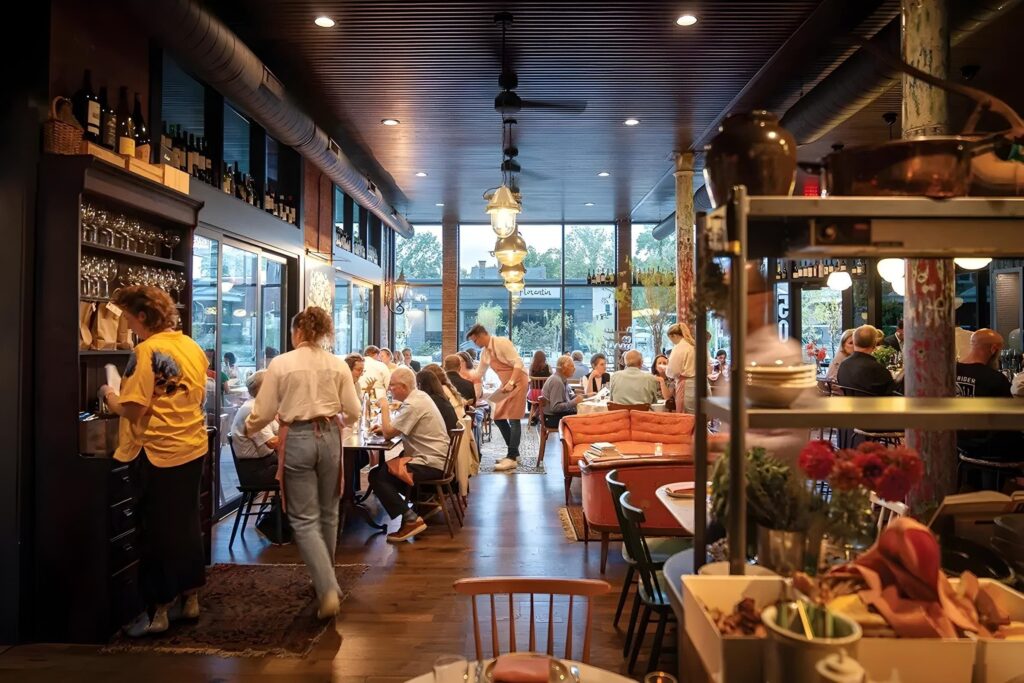
At the same time, Washington University is supporting local businesses in a new way. In 2023, the university’s dining program partnered with five local restaurants, which now have an ongoing presence on campus. The opportunity came about as the university was transitioning between its larger dining providers and decided to try a new approach. The move not only has a significant economic impact, but it also helps connect students with the surrounding community.
“This pushes resources into the region, gives business to local businesses, and puts money into the local economy,” says Jason McClellan, assistant vice chancellor for university services. “It provides work for our team members in the community, which provides livelihoods. The more that we can invest in the community, the stronger the community and the university will be in the long run.”