They met at a high-school speech meet. Bob Leifeld and a buddy were doing a Neil Simon duet, and the priest who coached speech at St. Henry Seminary—a boarding school in Belleville, Ill., that has since closed—had them really ham it up. Angela Ohms was just a freshman, shy and pretty, with long brown hair. She agreed to write to him; his gang at St. Henry solicited as many heart-inscribed, lipstick-kissed pink envelopes as possible, to torment the dean who handed out the mail.
They wrote on and off for the next three years. Angela asked him to take her to prom, but by then he was a college man, studying at the Illinois Institute of Technology in Chicago, and they made fun of the guys who dated high-school girls.
Discover fun things to do with the family
Subscribe to the St. Louis Family newsletter for family-friendly things to do and news for local parents, sent every Monday.
Once he’d “partied my way out of that fine institution of higher education,” though, he ran into her again. He and his buddies had followed the band Sergeant Carter down to Carbondale, Ill., where Angela was studying. She met them at a bar, wearing a skirt, and she was 19 now, and she looked, he had to admit, pretty darn cute.
When she came home to Waterloo, Ill., for the summer, he asked her out—and brought his friend Jim on the date. Every night after work, they practiced throwing boomerangs, and any girl he dated would have to be OK with that. So before dinner, they went to throw boomerangs under the Arch. And she was OK with that. She was even OK with him running out of gas on the sloped cobblestones of the levee…and with dating him for the next five years because he didn’t have enough money to propose.
Bob fell in love with her family, too. Angela’s parents had five kids; then they adopted two more from Korea. Voted Illinois Family of the Year in 1998, the Ohmses were quite a contrast to his own small family, which didn’t have much of a center of gravity, let alone such easy warmth. At the Ohmses’, nobody fought, everybody knew they were loved, and there was always room for the kids’ friends at the dinner table.
Finally, Angela’s dad said, “If you guys will just get married, I’ll pay for it.” Bam. They picked a date. Bob started squirreling away money for a really gorgeous engagement ring and wedding band. He wanted to officially propose at his family’s farm in Old Mines, so he tucked the ring into a picnic basket and put champagne in a cooler and…slid his car into a ditch crossing a muddy pasture. They had to walk back to the farmhouse, get boards, pry the car out, then schlep the rest of their stuff to the creek, where he knelt, sweaty and muddy, in the shallows, and proposed.
She said yes like he’d flown her to Paris.
******
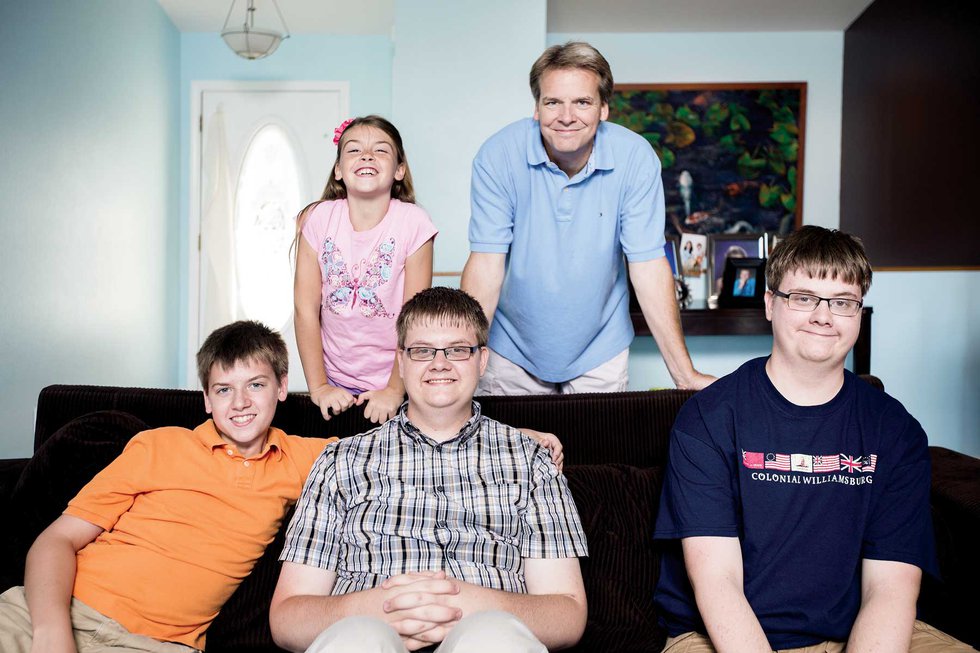
They had twins, Spencer and Mitchell, who turned out to be geniuses with Asperger syndrome. The boys needed lock-step routine and parents who could predict and plan for the slightest change in schedule. Angela and Bob worked hard to stay attuned to two brilliant, easily derailed minds very different from their own. Then came Evan, fun-loving, a lot like Bob, and Madeline, a charmer with a vivid imagination.
Bob went back to school after the twins were born—this time earning a 4.0 GPA—so he could get a nine-to-five job, instead of bartending, and be home with Angela and the kids on evenings and weekends. He developed his own parenting style, unflappable and amused. He’d put a Cheerio on each baby’s nose, and they’d stare at each other in their twin high chairs and giggle while he studied.
Angela taught full-time—fifth-graders, and sometimes the gifted program. She and Bob made firm rules for their own kids: no caffeine, video games only on weekends, bedtime at 8 p.m. After the house fell quiet, she and Bob watched TV or talked. If he’d brought his IT work home from Boeing, she’d leave him in peace for a few hours, then gently urge him to leave it and come to bed; the work would still be there tomorrow.
They loved the outdoors, so in June 2010, they took a family vacation to the Southwest, hiking and mountain climbing and white-water rafting. Angela fell on the rocks a couple of times; Bob teased her relentlessly about wearing sandals instead of her hiking boots.
When they came back, her left hand felt funny, so she went to her chiropractor. He sent her to a physician, who sent her to a neurologist. Every test came back fine, which should have been good news—but wasn’t.
On Friday, August 13, 2010, a nurse showed them straight into the neurologist’s office. They waited there for him, Bob shifting restlessly in a leather armchair, Angela staring at the big mahogany desk and framed certificates. This is the movie scene, thought Bob, where they give you the bad news.
Angela had ALS (amyotrophic lateral sclerosis), also known as Lou Gehrig’s disease.
There was no treatment.
******
Bill and Lucille Ohms were there, watching the kids, when Angela and Bob came home. One look at their faces, and everybody sat down in the living room. Angela spoke first. “I have ALS” was all she managed to get out before she started sobbing. Mitchell went to look up ALS in a medical dictionary. Evan asked his mom, “Are you going to be here for Christmas?”
She gulped back the tears and said, “Yeah, sure! I’ll probably be here next year, too.”
She was determined to finish out the year teaching, but by late October, she was having trouble walking. Bob borrowed a wheelchair from one of the churches in Waterloo so she could go trick-or-treating with the kids. She ordered everybody’s Christmas presents online—so many that Bob threatened to take the charge card away. “I’ve got it memorized,” she told him. “Even the little number on the back.”
They did all the research, but the disease cut through Angela’s nervous system like a scythe. They were always a stage behind, Bob just mastering ways to make her comfortable in a wheelchair when she lost the use of her hands; just learning how to put lotion on her ears and under her arms, anywhere that might itch, when she lost the ability to speak and couldn’t even tell him where she needed him to scratch. He rigged up a wireless doorbell chime, putting it between soft leather coasters so she could easily press it, and he’d carry the chime box around with him while he tended to the kids and house. When she was alone in the bedroom, she’d panic and press the button every few minutes.
When Evan would come home from school, he’d curl up with her. Madeline made her pictures, all glitter and hearts and “I love Mom!” The twins just toughed it out, strangers coming in and out of their house with casseroles, friends stopping by to do their laundry at odd hours, every cherished routine smashed to bits.
She stayed strong until March, then spent most of April in the hospital. When she came home, Bob hung big signs all over the room. He’d point to things she might want, and she’d blink or give a slight, jerky nod when he reached the right one.
She died on Saturday, May 14, 2011, just nine months after the diagnosis.
******
While Bob’s telling the story, Bill and Lucille come over, bringing a big bag of fried chicken. “I was just talking about how I’d pull up at your house in my stripped-down Mercury Zephyr,” Bob teases them. “The trunk and the hood were both bungeed down. I probably wasn’t at the top of your list for your oldest daughter.”
Bill smiles. “Um… We went by Angela.”
“Angela had good standards,” Lucille adds. “We knew you could live up to them.”
Bob remembers groaning the first time he and Angela drove from the Ohms family Christmas to his. “It’s like going from the Bradys to the Bundys,” he told her. Now he admits how much it meant to him, the chance to be part of such a great family: “It was something that was missing for me; I’d never really had it. You feel welcome. There’s somebody there you can count on.”
He needs that now, more than ever. On weekdays, he gets up at 4:45 a.m. and leaves for Boeing by 5:30, so he can head home at 3 p.m. to make dinner and help with homework. Lucille comes over every morning and makes sure the kids get off to school.
Madeline’s now 9 years old, and after a few quiet years, she’s talking more again, self-possessed and full of ideas. “Christmas presents shouldn’t say ‘Made in China,’” she informs her father. “That’s not very Santa-y. They should say ‘Made in the North Pole.’”
“Everybody’s outsourcing,” he says.
She’s standing on a step stool at the kitchen counter, her back princess-straight, stirring Kool-Aid with an air of supreme competence. Bob remarks how different all the kids are, how he and Evan get goofy, how the twins want daily newspaper subscriptions and know every fact in the world.
“I’m with you, Dad,” Madeline says over her shoulder. “Half the time I don’t know what they’re saying.”
She reaches for a bag of Goldfish.
“I bought the rainbow-colored ones for you,” Bob says. Evan comes out and stands at the counter. “She won’t give me any,” he grumbles and stalks off. Lucille whispers to Madeline, “Make him a bowl.” Madeline’s smile goes wide as she nods. She pours her brother a bowl of Goldfish and carries it to him in the living room.
Bob keeps a list taped to the refrigerator: reasonably healthy stuff he can make and the kids will eat. Angela was the cook in the family. “I make a mean ham and rice,” he offers. “And I love to grill. Twelve months of the year—I’ll fire it up in the snow. Last week, a bad storm blew through, and I had the grill cover on me like a cape. I was trying to be efficient, so I just carried six slices of cheese out, and the wind blew them right off the burgers!”
He’s efficient about groceries, too: “I just load up my canvas bags and roll down the aisle once every two weeks. My goal’s one cart, one hour, $100.” He grins. “I’ve never made it. Usually, it’s $250.”
He looks out the window, silent for a moment. Then he shakes his head. “When we were married, it took both of us all our time to keep it going.” He’s kind of amazed he’s pulling it off alone, even with his in-laws’ constant help. On the first anniversary of Angela’s death, Bob and the kids went out to dinner and, as Spencer later put it to his teacher, celebrated that they’d made it one year without her.
What’s hardest still is the quiet end of each evening, after the kids have gone to bed. Bob saves tasks like balancing the checkbook or catching up on work for those times. But there’s nobody to say, “Come to bed. It’ll be there in the morning.”