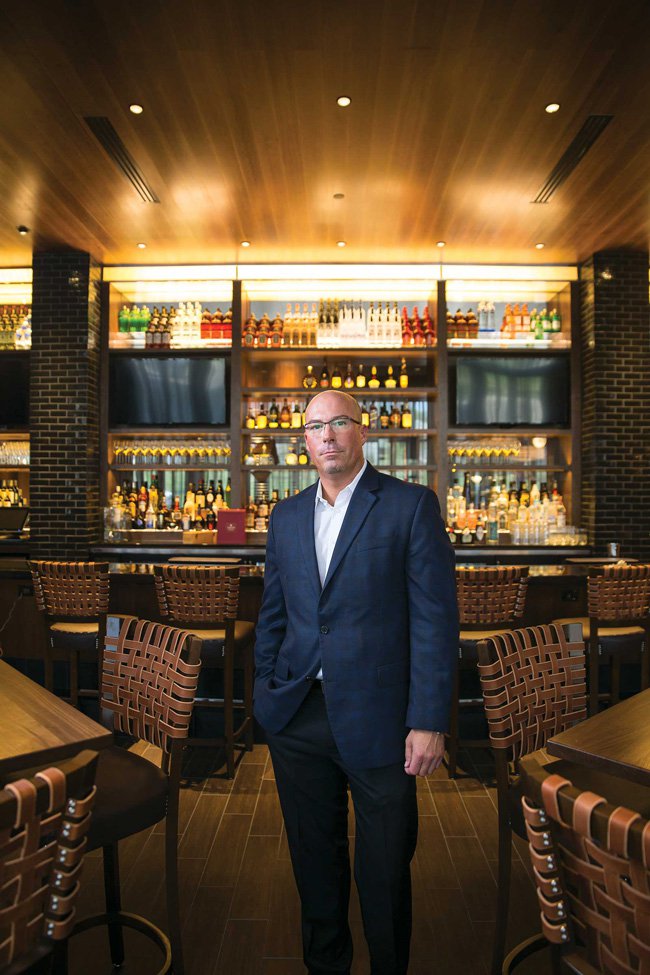
When he realized how differently upscale restaurants treated his father, Vernon Dill (“They made him feel like a big deal, no pun intended”), Geoff Dill fell in love with fine dining. He worked for Morton’s, Ruth’s Chris, 801 Chophouse, and Scape before being recruited by the acclaimed Capital Grille, which opened last month in Clayton. Now he’s the big deal.
Did you ever consider another career? I was a DJ in college—until it occurred to me there weren’t too many 65-year-old DJs around.
Find the best food in St. Louis
Subscribe to the St. Louis Dining In and Dining Out newsletters to stay up-to-date on the local restaurant and culinary scene.
How did you get into the steakhouse business?
After college, I moved to New York City to take a job at Morton’s. I started there in October 2001, right after 9/11. It was really sad and the closer we got to the holidays, the worse it got.
I’m sure you had some memorable customers there. A guy came in every Tuesday night dressed very casually, always wearing a gold necklace with a boxing glove on it. I never thought anything of it, but I always engaged with him. I remember him saying, “You are the epitome of why I come here. You have zero idea of who I am, and you treat me like the people all dressed up celebrating something.” It ends up he was the president of Everlast. It was then I realized you never know who you’re dealing with. Soon thereafter, they moved me to Philly, which was the biggest culture shock of my life.
How so? In New York, customers would say everything’s awesome to your face and later we’d find out—via email or Yelp—that occasionally it wasn’t. There was no direct confrontation. What I like about Philadelphians is that they prefer to settle an issue in the moment. They’d call me aside and say, “Excuse me. There’s a problem here, and you and I need to iron this out.” They’d speak their mind, I’d fix whatever it was, and the loyalty and respect was never forgotten—on both sides.
How about a short synopsis of all the places you’ve worked? Morton’s was old-school fine dining that catered to a predominantly male clientele. At Ruth’s Chris, everybody is on board with Ruth Fertel’s kind ways and Southern hospitality. At 801 Chophouse, I was actually hired to open the 801 Fish here.
Talk about Scape. I went to Scape because I was working six-plus days a week and losing who I was. I think I was becoming a mean person. My kids, who are very engaged in my life, told me I wasn’t nice anymore. They said, “What are you doing this for? Because you’re not teaching us anything.”
Except not to be you. Right. So Scape was a good experience, especially since I’d never run a true mom and pop before. We changed a lot of things and a lot of them got changed right back. But I wasn’t disenchanted at Scape. Besides Capital Grille, there wasn’t another organization that could have lured me away.
How did that happen? It’s funny. I met their recruiter way back when I was in Philly. When I told him I’d like to eventually like to move back to St. Louis, he told me they’d never come here. At the time, they were focusing on larger markets.
What took The Capital Grille so long to open in St. Louis? There were a lot of things that needed to happen here. In the past year, we had great success in Raleigh and Lyndhurst, smaller market towns. Clayton is exploding. The right location became available there. Now is the right time.
How are the steaks different? All of the beef is dry-aged in house. A 40-pound strip loin trims out 18 to 24 days later to 20 pounds, so it’s an expensive commitment.
Dry-aging takes time and there are no short cuts. What if there’s an unexpected run on strip steaks? We have sophisticated metrics in place to ensure that doesn’t happen, but of course it can. And while it’s not the call I’d want to place to my boss, if we need to get additional steaks to our specs, we can get them. Remember: There are 57 Capital Grilles.
Discuss your corporate training in KC versus what you might get at an independent restaurant. From the Kansas City-themed gift basket in my hotel room until I completed the program four months later, my training has been validated. The agenda and expectations were clear and defined, from day one at 10 a.m. to the last day of transition. Capital Grille is part of Darden [Restaurants], which is the largest restaurant company in the world. Yet it’s relationship-driven, rather than investor-driven, which is refreshing.
Exactly what does that mean? It starts with how we treat our employees. I don’t know how we can expect them to take care of people if we don’t take care of them. Diners just want to be appreciated. That starts at the employee level.
How extensive is the employee training? It starts with an online 20- to 25-question assessment to see if they’re the right fit. We interviewed 1,000 people to get the 99 we need. After hiring, testing is ongoing, both online and in the restaurant—for everybody. If the host gets a call asking about the porcini rub, they have to know how to explain it. If we hire 100 people, we expect everyone to know that information. You can’t be charging a premium and have the staffer say, “I don’t know.” People expect us to be masters of the craft. The guest doesn’t care who’s in charge of what; they just want to know.
How’s the menu different than at other steakhouses? I hate to use the words “incredibly approachable,” so I’ll say it’s more well-rounded, with plenty of straight-down-the-fairway items but also adventurous things like foie gras crème brulee. We have an onsite butcher who oversees the dry-aging process. A chef makes fresh mozzarella by hand every 90 minutes. And the price points are not as steep as some people think. For example, we have a bone-in filet for $59 that’s $90 at other places.
Are side dishes humongous, similar to other steakhouses? They are, but we won’t oversell you. If a party of six wants four orders of mac and cheese, we tell them two will suffice.
What are your favorite items? Lobster and crab cakes, because they contain a lot of both. The lobster mac and cheese is my favorite item on the menu, because it’s loaded with claw meat. The signature steak is a porcini-rubbed bone-in ribeye glazed with a 15-year aged balsamic [vinegar]. And the bone-in Kona coffee–crusted dry-aged strip with shallot butter is the best thing I’ve ever had in my life.
How much fish will The Capital Grille sell in Clayton? Will it be 5 percent of sales? My guess is that it will be a little more than that and more in summer than in winter.
Describe the décor. Softer and more modern than the older Grilles, with more nickel, less copper and gold. I won’t say that other Capital Grilles aren’t sexy, but this one definitely is. A lot of thought went into the floor plan. The room feels broken up, even though it’s one long throw. The booths were designed for convenience; every one of them can be accessed from either side. Several of the tables for six are oval-shaped and placed so that conversation doesn’t intrude on the table next door.
The unusual ceiling also helps dampen sound. The ceiling is high and opens in spots to a hidden catwalk above. Noise just dies up there.
Talk about the artwork. The last thing we wanted was a restaurant that felt like it belonged somewhere else, so the iron sculptures and paintings were selected to represent local tastes in art. Plus, there are clocks featuring five major world cities—Paris, Los Angeles, Tokyo, New York City—and right in the middle of them is one that says “Clayton.”
The bar seems to have multiple personalities. When the window drapes are closed, it looks mysterious and serene. But when the drapes are pulled, we can open the windows, screens drop down, and passersby can get a better feel of what’s going on inside.
Is there a patio? No, but it wouldn’t surprise me if outside tables were added at a later date.
The Capital Grille has its own app. Our concierge app gives people an inside look at everything we’re doing. You can see what’s going on in any restaurant, choose a wine from your wine locker, add a wine to your wine locker, gift a wine to someone, and see what pairings are recommended with whatever we’re serving tonight. You can even request a server.
Talk about the wine lockers. Those with lockers get preferential treatment with reservations. They get the first shot at any allocated wines that we make available and invites to special vault tastings every 90 days.
How does St. Louis rate as a wine town? The wine market is robust here, evidenced by the number of somms. It feels like Oprah came to town and handed out somm certificates. Partly as a result, the city likes interesting and unusual wines, which you normally only see in bigger cities.
How formal is the service? Everything we do, we do in teams. Four of us will serve food to a table of four and we’ll also clear as a group, but not until everyone is finished. There is a lot of value in what’s called swarm service.
Do you have any personal training secrets? One day in orientation, on the count of three, I had everyone yell no. Then again, as loud as they could. I said, “Good, because that’s the last time you’ll use that word again here.” I wasn’t kidding.
Beer has become more popular as a meal pairing beverage. Is that true at The Capital Grille? While the beer market is certainly something that we respect and identify, the restaurant has become known for its award-winning wine list. And even though St. Louis is a beer town and we have 20 to 25 bottled beers, I suspect beer will still represent a very small percentage of beverage sales.
Throw out some numbers. We added 3,000 square feet on to the J. Buck’s space, so it’s now at 8,800 and seats 250, including the private dining rooms. At lunch, several items are $20 or less. That’s the sleeper.
Somebody had some fun naming the private rooms. In front, the 18-seat J. Buck Room is an homage to the prior restaurant and the Buck family. Off the main room is the Lewis Room and the Clark Room, which both seat 24. Those rooms can be combined, if necessary.
What do you tell people who say fine dining is dead? People still want to be pampered. They just don’t want the snooty and the drama. We are a relationship brand—an upscale Cheers—and that’s what’s dying. Fine dining is far from dead. If anything, it’s about to explode again.