When Schlafly introduced Shorty’s Small IPA last June, it was positioned as an experiment, a 3.0% ABV beer that had quietly moved from the brewery’s research and development pilot system to the Tap Room.
“We’ve been working on various small beers on our R&D pilot system, and Shorty’s Small IPA is the first to make the jump to our Tap Room brewery system,” head brewer Jared Williamson said at the time. “It’s been really well-received.”
Find the best food in St. Louis
Subscribe to the St. Louis Dining In and Dining Out newsletters to stay up-to-date on the local restaurant and culinary scene.
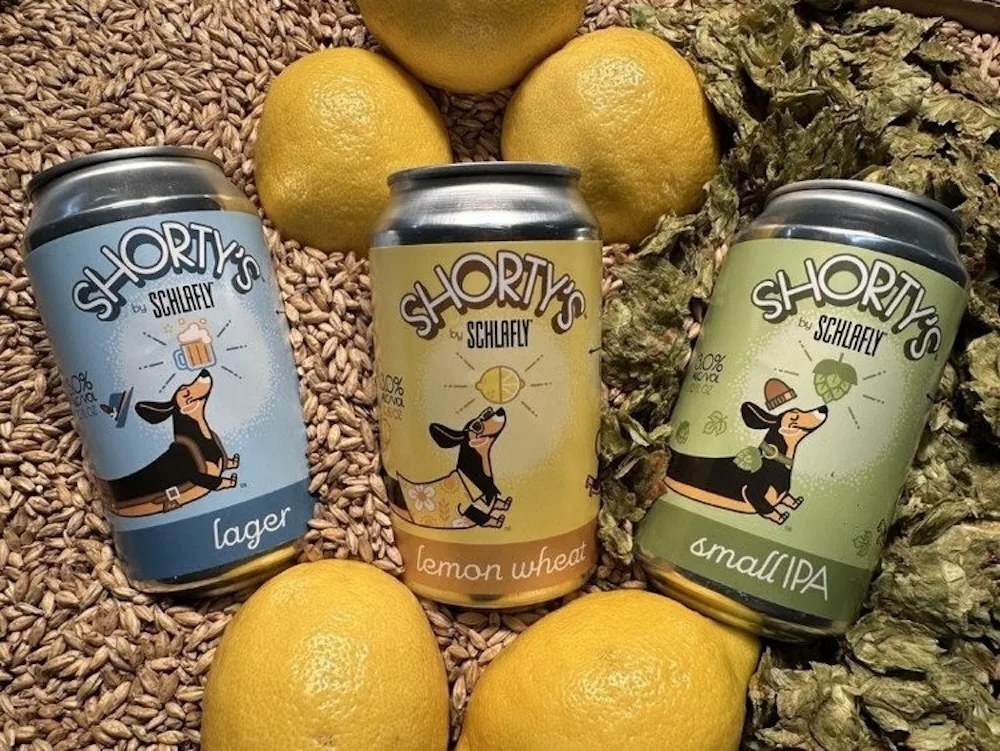
That reception appears to have paid off. Shorty’s has now grown from a single draft offering to a full-fledged, year-round lineup, including Shorty’s Lager, Shorty’s Lemon Wheat, and the original Shorty’s Small IPA. All three clock in at 3.0% ABV and are available in six-pack 12-ounce cans, as well as on draft at Schlafly Tap Room and Bottleworks.
The Beers
Shorty’s Lemon Wheat: Inspired by radlers and shandies, lemon wheat is fermented with real lemon purée. Built on pale and white wheat malts, it delivers bright citrus over a soft, subtly sweet base. At 5 IBUs and 107 calories per 12-ounce serving, it leans refreshing without sacrificing structure, meaning it isn’t weak or watered down.
Shorty’s Lager: Rather than chasing the ultra-light category, the lager layers Pilsner and Munich malts with German Magnum and Tradition hops for a clean, bread-like backbone. At 15 IBUs and 112 calories, it drinks like a fuller-bodied lager, despite its 3.0% ABV.
Small IPA: Dry-hopped with Citra, Galaxy, and Strata, it delivers tropical aromatics, pineapple, citrus, and melon in a mid-strength frame. With 20 IBUs and 103 calories, it provides presence without being heavy.
The Background
The name “Shorty’s” is a nod to Williamson’s senior rescue dachshund, “a big personality in a small package,” he said. The beers follow the same logic.
From the beginning, Williamson made clear that the goal wasn’t to water down beer or rely on post-fermentation dealcoholization. Instead, the brewery committed to brewing intentionally to strength, carefully adjusting grain bills, mash temperatures, and fermentation profiles to maintain body and aromatics without ramping up alcohol.
“Our aim is to enter the low-alcohol segment with full-flavored beers,” Williamson said in June. “Most of the offerings in this category tend to be ‘lights’ or ‘ultras’ that don’t pack much flavor. We think you can have both.”
Unlike the wave of low-ABV hard seltzers and alternative beverages that have surfaced in recent years, intentionally brewed low-strength beer remains a narrower lane. “Consumers continue to want more options that allow them to enjoy flavorful beers while being considerate of their alcohol consumption,” said Williamson.