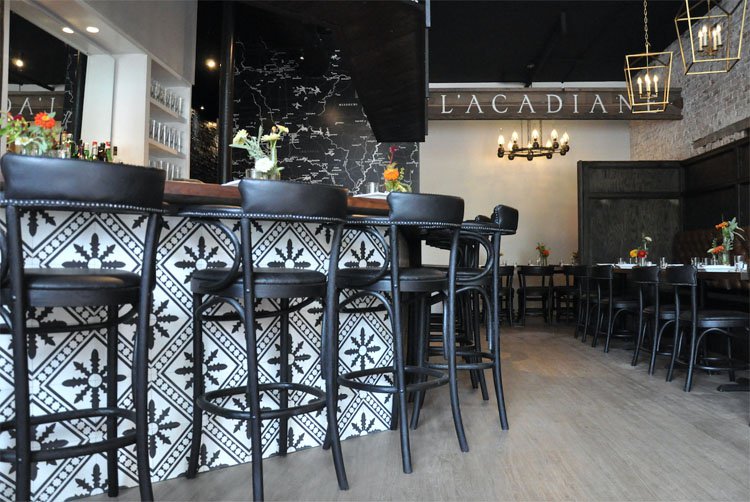
Restaurateur Dave Bailey’s latest venture, L’Acadiane, opens today in Lafayette Square. Located in the former Baileys’ Chocolate Bar space, it serves Cajun and Creole fare, a nod to our city’s ties to France and our tethered connection to New Orleans via the Mississippi.
From outside, the restaurant positively glows at night. Light spills from tall windows and pools onto the brick sidewalk. A small, discreet sign brackets the words ‘L’Acadiane,’ and wrought-iron accents hang above the door.
Find the best food in St. Louis
Subscribe to the St. Louis Dining In and Dining Out newsletters to stay up-to-date on the local restaurant and culinary scene.
Inside, L’Acadiane at first appears small, though the space discloses itself in stages. A sweeping bar is clad with a design of black chicory leaves on white tiles (pictured above), harking to a French provincial design of the 1890s and echoing the blue-and-white tiles commissioned by Monet for his kitchen in Giverny. At the far end of the bar, a detailed map depicts how the river connects and divides us. A civilized line of bistro tables runs along the opposite wall, and a small alcove in back provides semi-private seating for up to eight. Farther back, a larger dining room, not visible from the bar, seats groups in the next room and opens to the back patio. (The second floor houses a pared-down version of Bailey’s Chocolate Bar.)
The menu also offers pleasant surprises, including inventive variations on Louisiana favorites. The crab-stuffed Missouri catfish is served with poblano grits and garlic dressing, a local groove on a NOLA-style dish.
Shareable plates include a hot chicken and waffles (pictured above), smoked pork ribs and Southern-style watermelon pickles. A lump crabcake is paired with avocado, bright orange supremes, and piquant remoulade. Hominy hush puppies are served with cucumber ranch, and hot-link corn dogs with cajun ketchup. A house-made aioli and French bread rounds accompanies the blackened shrimp.
The po’ boy playbook includes a fried green tomato number paired with plum tomato jam, arugula, and cucumber slaw; and fried chicken (both pictured above). Purists can order pulled pork, house hot links, shrimp, or blackened Acadian redfish po’ boys, each with specially selected condiments.
Among the sides: brabant potatoes, cornbread waffles, and dirty rice. Naturally, the soup and salad options include gumbo and a crawfish bisque, as well as a frisee salad with poached egg, lardons, chives, and herb de jardin dressing.
For dessert, the Baked Alaska is actually a rich bread pudding with whiskey, caramel, tart cherries soaked in whiskey, and chopped pecans—all topped with a scoop of ice cream and house-made toasted marshmallow cream. The beignets are sprinkled with bacon sugar dust and come with a delicious raspberry sauce.
A well-chosen wine list is composed entirely of French varieties, including a terracaë malbec from Cahors, grown there continuously for 800 years; it’s said to have been served at the wedding feast of Henry II and Eleanor of Aquitaine in 1151.
There’s a sly urbanity in the cocktails, in both the presentation and play on words in the names. Consider the Sazerac Ménage a Trois, which begins with a triple dose of absinthe: 1. The glass is rinsed in absinthe, 2. the drink’s served with absinthe ice, and 3. a house-made absinthe rock candy sugar sweetens the sazerac. (Hint: Eat the rock candy that you don’t put in the drink.) The frothy Chicory Milk Punch gets its oomph from cognac and a house-made chicory liqueur, with vanilla, sugar, and milk providing the sweet side. Perhaps the most memorable cocktail, however, is the Wise Blood, a port wine drink with a celery-fennel root infusion and a generous squeeze of lime, garnished with fennel fronds and grapes. The name brought back memories of Southern writer Flannery O’Connor’s hauntingly beautiful work.
L’Acadiane works on so many levels, not just in the attention paid to developing delicious dishes, but also in the space’s nuanced beauty, with visual and thematic references that illustrate St. Louis’ French and Creole roots.