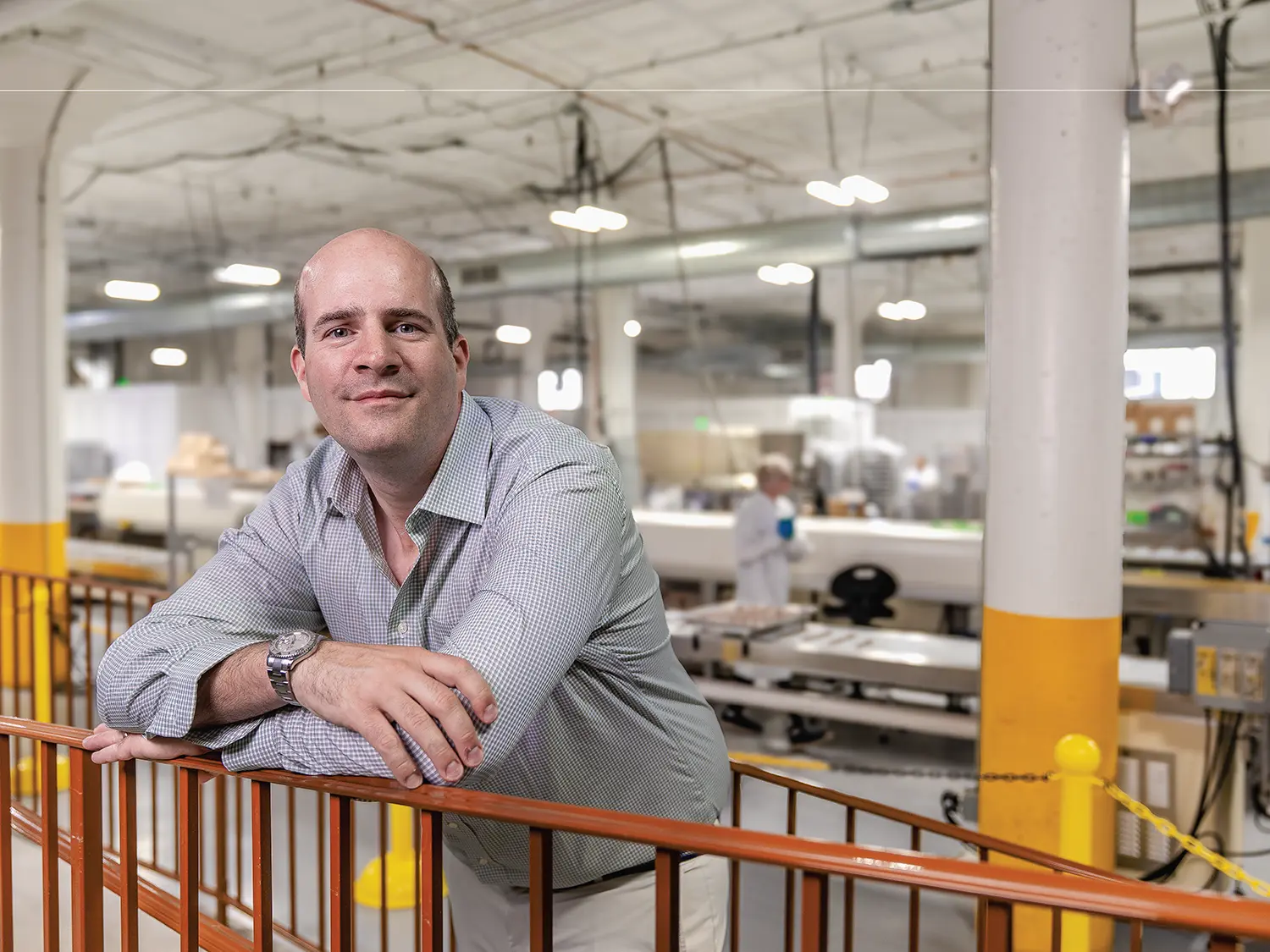
Since its founding in 1981, Chocolate Chocolate Chocolate has seen dramatic growth, and 2025 is proving to be an especially exciting year for the company. With a newly expanded production facility and forthcoming café and speakeasy on The Hill, the local chocolatier is making its first foray into the hospitality business, something that, according to co-owner Dan Abel, is a natural extension of the company’s commitment to giving its customers the highest-quality experience.
Editor’s note: Since press time, Abel has announced that Bissinger’s Handcrafted Chocolatier, the 350-year-old legacy brand which Chocolate Chocolate Chocolate acquired in 2019, is opening a luxury boutique in Palm Beach in September 2025 and additional shops are planned.
Did you always know you would go into the family business? My parents started Chocolate Chocolate Chocolate in 1981, and my brother, sister, and I were all born after that. I’ve never known anything else. We grew up going to the store on Saturdays to visit my dad when he was working, and we were always talking about the business during dinner. All of us are involved, and I always knew it would go this way. I do love technology and computers, so in high school I also worked for a computer company, and I went away to college for four years. Getting out of St. Louis for a while was good, but this is always what I was going to do. We get approached all the time about selling the business—which we will never do, but my brother, sister, and I joke that if we ever did, we’d have to move out of St. Louis, because we couldn’t watch someone else run it. The business is our baby; it is our life.
Find the best food in St. Louis
Subscribe to the St. Louis Dining In and Dining Out newsletters to stay up-to-date on the local restaurant and culinary scene.
How did Chocolate Chocolate Chocolate come to be? My dad was in Ohio for college, and he was looking for a part-time job while he was in school. He knew somebody whose family owned a big candy company, and she told him they were always looking for help in the warehouse. He started out doing this part-time on weekends and when he wasn’t in class, and then he came on full-time after college and it morphed into a career. He became vice president and stayed in Ohio, but there was one issue: It wasn’t St. Louis. As an entrepreneur would do, he threw that away and said, “No, I am going to do my own thing.” He gave up his guaranteed paycheck and risked it all. His company was gracious to him and helped him set up operations in St. Louis, but they told him to be careful because Bissinger’s and Mavrakos own St. Louis. Now, we own both of them, so it’s a funny history.
Chocolate Chocolate Chocolate has grown a lot since you came on board in 2008, but you were a small operation in those early days. What was that like? I started straight out of college, in 2008, and wanted to grow the business. My dad said that he made a good living, but he was not going to give me the salary I thought I deserved; he started [my brother, my sister, and I] at $10 an hour and told us that if we wanted more, we had to go out and build a business. That was enough motivation for me. I traveled everywhere, did trade shows, knocked on doors—now, they call that bootstrapping, but I didn’t even know there was a term for it. We had no outside investors, and we grew everything that we could. The first trade show I ever did, I designed the banner and signage in Photoshop myself, shipped the booth, assembled the booth, worked it, took it down, wrote sample requests, and shipped them myself. There was no team. Our first wholesale accounts would call me up, I’d key in the order, and ship it with my sister.
The company really grew when you bought Lake Forest. Walk us through those changes. When the Lake Forest deal happened, they had such a great team, and we had a nice kitchen that we thought we could use for three to five years. After two years, we were bursting at the seams. At the time, we were debt-free and had low overhead, but we found a building and decided to take the leap, even though we knew that could kill us. In 2012, we had our grand opening at our current space; we thought it would be a good idea to start doing tours, not knowing if anyone would show up. I remember the first day we opened: It was me and my dad doing the tours, and we had one retail employee. Eight hundred people showed up for tours. The next day, 900 people showed up. The first three months were us trying to hire and train a staff in real time. It all came so quickly.
You say that 2016 was a big milestone year for you, because of your investment into a special chocolate manufacturing line. That was the year when everything changed. We bought this expensive equipment from Switzerland to make chocolate bars; everyone told us it was a bad idea, but that was our first realization that we should do the opposite of what everyone says to do. I don’t know where those instincts come from, but I think that when you live on the production floor, you just see things. After that was successful, I told my dad that I was thinking about doing a molding line with equipment that was three times as expensive as the bar one. I told my dad that we would make truffles on it, but I didn’t know how to do it, and I didn’t even have a recipe for them. He said, “So it’s triple the cost, you don’t know exactly what you’re going to make on it, you don’t have recipes, and you say you can figure it out in a year.” I told him, yes, and it ended up being the most successful line we have; now we have four of them, and 80 percent of our plant volume comes from these lines. It could have been the stupidest mistake I ever made, but my dad taught us well. He was so much harder to sell to than the bank; if the bank needed 10 points of information, he needed 20. My sister, brother, and I have learned that if we are going to make a big decision like that, we need to know it forward and backward.
Buying Bissinger’s in 2019 was a huge moment for Chocolate Chocolate Chocolate. How did that come about? The first thing to know is that when you work in the same field as someone, even if they are a rival, there is a connection you have with them. That was us with Bissinger’s; we were all candy makers, and lived and breathed it. Because of that, we became friends. At one point, we talked about merging, but we didn’t want a partner or investor. Then, in 2019, we were at a trade show and Bissinger’s didn’t show up, which we thought was odd. We figured it was because of a snow storm that had prevented flights from getting out of St. Louis, but we started to hear rumors on the show floor that Bissinger’s had been sold. We called the owner, who said that it hadn’t been sold but that it was for sale… That was January, and in March of that year, I met with them, made my pitch, and told them we wanted to buy everything but the building. The deal closed in June 2019; there were six months of chaos on the back end, but in January 2020, I stood in front of our staff and said, “This is going to be our year.” I now joke that I was the reason there was a worldwide pandemic.
What has acquiring Bissinger’s meant for Chocolate Chocolate Chocolate? What I love about it is that Bissinger’s and Chocolate Chocolate Chocolate are cut from the same cloth. We both believe in handmade over automation, precision details, and using extremely good and sustainable ingredients. But Bissinger’s brand story is unlike anything else. They were founded in 1668 as the king’s chocolatier. It’s a powerful story. We’ve always had premium ingredients, handmade artisanal chocolates and great packaging, but the extraordinary brand history is something special. It would take generations to do what they have done, so they are a great addition.
Bissinger’s allowed you to get into the direct-to-consumer business, which has been hugely successful. Now that you have that going, what is next for Chocolate Chocolate Chocolate? Again, we got to the point where our infrastructure was no longer big enough; we needed more people, equipment, and space, and we were starting to get nervous that we had to leave. A while ago, I called our neighbor, which was an old tool and dye shop, and asked if they’d be interested in selling. They said no, so we started looking for a space and eventually made one more attempt. This time, they said yes because they’d been acquired by another company, so we bought the building, tore down the whole thing and drew up what we needed for the space we’d been missing.
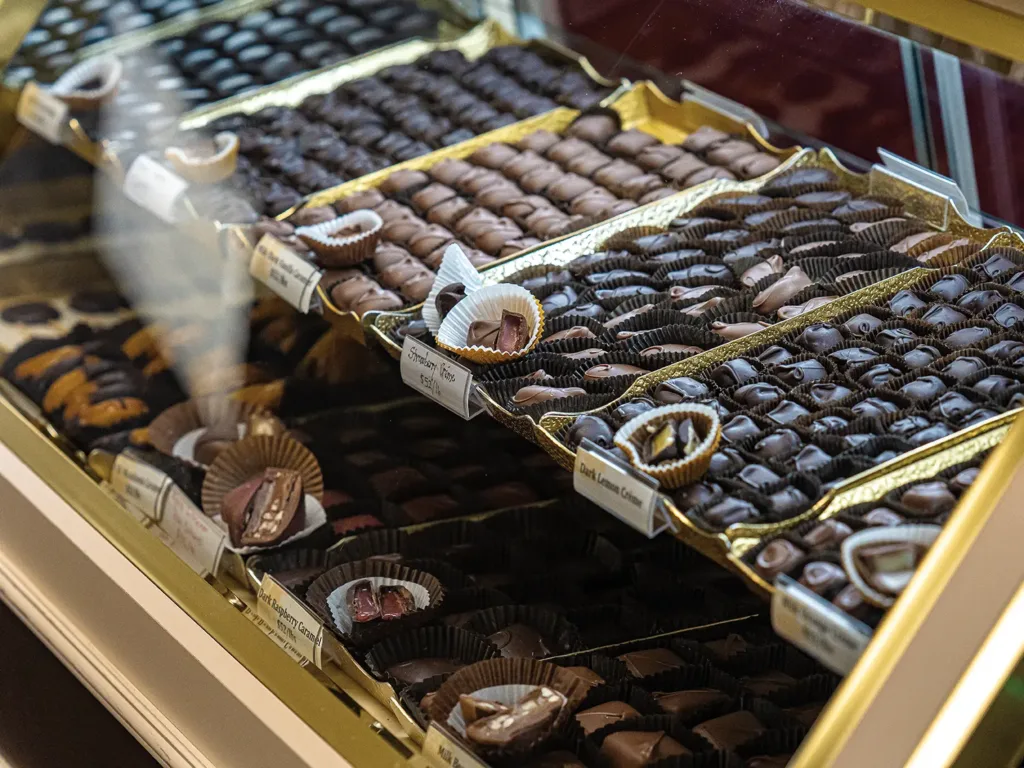
You have big plans for your newly expanded space, slated to open in August. What’s in store? Our family all agrees that tourism is so important to us and that our brand needs that part of our business to be more extensive. We don’t want to be a restaurant, but we want to be a place where people can meet over beverages like espresso, coffee, and iced tea. We started talking about that and then went to wine and beer. It was a slippery slope, and now we have a full liquor license, which means we are going to open a bar, too.
Tell us about the café component. Kaldi’s will do all the coffee; we already have a custom blend that they created for us. There will be espresso and iced tea and coffee and lemonade. Beer and wine will be available in the café, too. We are not bakers, so we are partnering with Companion for fresh breads and pastries. We also want it to be an emporium of amazing St. Louis food establishments like Volpi. We really want local foodie brands to be a part of the experience.
What about the bar? It’s going to be a true speakeasy with a hidden entrance. You can’t tell where it is just by looking for it; we’ve done a really good job of disguising the room. As for the concept, we want the experience to be unique to chocolate, so its name ties into the brand history. Some of the cocktails will have a chocolate component, like a chocolate martini, an espresso martini, and a chocolate Manhattan. We have a half-dipped orange we want to be the garnish on our Old Fashioned. It’s a crafted chocolate–themed menu, but we also want a classic menu for those who just want a gin and tonic. We worked with a winemaker in Napa, and in conjunction with the café opening, we will be launching a Bissinger’s cabernet sauvignon that we will sell by the glass and the bottle. [The bar] will have a darker feel and, like a true speakeasy, should feel like controlled chaos with different tables and chairs. There will be red leather bar stools but green or brown leather chairs, dark curtains—we’re going for a Gatsby design style. This is one of the most hands-on projects we have done, and we’ve really liked challenging ourselves with this new venture.
What keeps you grounded and focused during all of this growth? Our passion for handmaking and crafting confections is the most important thing to us; it’s our ultimate purpose. The level of handwork and craft that goes into what we do is the utmost important thing for us. There was a time in 2016 or 2017 when we got our big Swiss equipment and had taken on two huge wholesale customers. At the time, we thought we’d made it; it’s what everything we’d been doing was leading up to. And we hated it. It’s the only time when I felt like what we were doing was so generic and stale, but we felt stuck because we spent millions on the equipment and gave our wholesale customers our word. When [the pandemic] happened, they stopped producing with us, and we decided to do only handcrafted artisan chocolates from then on. It was a big risk because that volume was a lot of revenue, but it felt inauthentic. To walk away from that is risky, but every day since then has felt more authentic and purposeful. I’ve never felt as passionate about what I do as I do today.