Well before Herbie’s owner Aaron Teitelbaum decided to reopen his Clayton restaurant for dine-in service on May 20, he knew he’d need to alter operations and sanitization in response to the COVID-19 virus. Like so many restaurant owners reopening during the pandemic, he hoped to make the dining experience as enjoyable and normal as possible for guests while still implementing strict measures to protect employees and customers.
As fate would have it, not long before Herbie’s reopened, an acquaintance, Ken Redman, approached Teitelbaum about a sanitizing system that is non-toxic, chemical-free, and safe on skin, eyes, and clothing: 2.5 pH medical-grade, electrolyzed water. Redman and his wife, Shannon, operate a local company aptly named Medical Grade Water, which sells the eco-friendly, natural product that destroys bacteria and viral pathogens.
Find the best food in St. Louis
Subscribe to the St. Louis Dining In and Dining Out newsletters to stay up-to-date on the local restaurant and culinary scene.
Commonly known as EO water, the product is made by activating an electrical current into salted water. The science of EO water stretches back some 150 years and is fairly simple: The electric current converts sodium ions into sodium hydroxide, while chloride ions are converted into hypochlorous acid. Together, sodium hydroxide and hypochlorous acid form an alkalized water that has been used in restaurants, hotels, and even meat-processing plants in the U.S. and around the world.
“There is no other ingredient in the water—it’s just been altered by an electrical charge is all,” Ken says. “It’s used widely on cruise lines worldwide, and there are thousands upon thousands of restaurants in America use it, but it doesn’t seem like people know about it.”
Medical Grade Water sells restaurants such as Herbie’s the sanitation machines required to convert salt water into electrolyzed water, which can be calibrated to various pH levels.
“When we make 2.5 water, we do that by simply pushing a button and turning on the tap water,” Ken says. “The water goes into the machine, it’s purified through a filter, and then it enters an electrical chamber, whether it’s a positive and a negative charge. Depending on the button we push is the type of water that comes out of the machine.”
Colorless, odorless, and alcohol-free, the water can be used to clean countertops and dining tables or sprayed directly onto customers’ hands.
“Obviously sanitation has become a key factor to everything that we’re doing,” Teitelbaum says. “These systems were originally built for higher pH, alkaline-level drinking water. If somebody tried to sell me that, I would have laughed them out of the restaurant. But when we started to get close to opening back up, [Redman] approached me about his machine that takes water and reduces its pH to make an effective sanitizer that’s all natural…no chemicals, no odor, nothing.”
The Redmans believe that Herbie’s is one of the first, if not the first, restaurant in the St. Louis area to implement EO water across the restaurant. For Teitelbaum, sanitizing water is a preferable alternative to harsh chemical disinfectants that leave his dining rooms with an antiseptic sting in the air and on customers’ hands.
“When you use hand sanitizer and you’re eating, you smell the hand sanitizer,” Teitelbaum says. “So we decided to institute this in all of our restaurants for cleaning tables. We offer to spray our guests’ hands, if they would like, and we use it on our hands, we use it to clean our menus, we use it to clean everything that we possibly can. And then there’s another higher level water, an 11.5, that we use to clean our vegetables.”
At Herbie’s, as well as at the two locations of its sister restaurant, Kingside Diner, electrolyzed water is used to clean the kitchen and dining room, and hosts at the restaurant ask guests if they can spray their hands with it upon arrival. Other new safety measures on-site at Herbie’s include asking customers to remain at least 6 feet apart from other guests (the restaurant is currently only seating groups of 10 or less) and face masks are required when customers are not seated at tables. (Face masks are provided for customers who don’t arrive with them in tow.)
Both restaurants are also keeping contact tracing records for every party seated and plexiglass partitions have been installed at the bars. “We’ve spent tens of thousands of dollars to prepare our restaurants for this,” Teitelbaum says. “For a period of time that is not going to be forever, but that so that we could make it through.”
Since reopening the dining rooms at Herbie’s and Kingside, Teitelbaum says his staff has had to relearn the service industry and has stepped up to make the experience as orderly and safe as possible for diners. They’re still learning new best practices, Teitelbaum adds, and appreciates how understanding most customers have been during the transition.
As the front-of-house navigates a new normal during the pandemic, transition has been taking place in the kitchen at Herbie’s as well. Earlier this year, before the COVID-19 virus forced restaurants across town to close, Bill Cawthon was named executive chef at Herbie’s. Formerly the chef-owner of local favorite Frankly Sausages, Cawthon hadn’t fully put his stamp on the Herbie’s menu when dine-in service temporarily ended in March. In the past two months, as Teitelbaum has reworked dining room operations at Herbie’s, Cawthon has developed an entirely new menu.
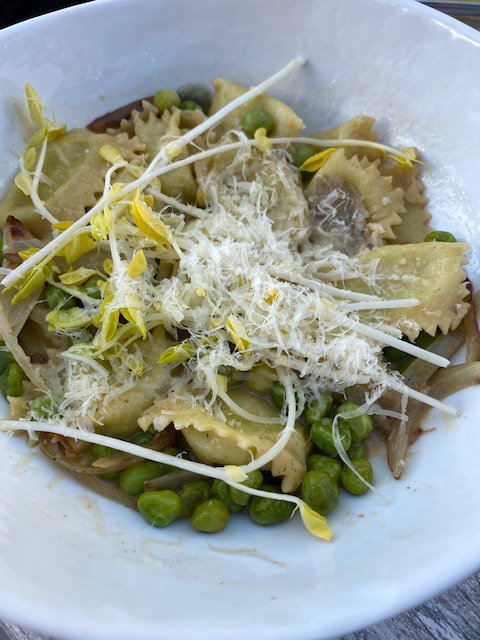
“The biggest blessing of all this is [Cawthon] had two and a half months to build the kitchen himself, and the menu and the team right now is the best I’ve seen in Herbie’s in years,” Teitelbaum says. “I’m so thrilled about it; from the housemade pastas and agnolottis to just the details of each dish and new components, it’s all spectacular. He has a spring pea agnolotti that I’m hearing a lot of good things about, and it’s one I’m particularly fond of.”
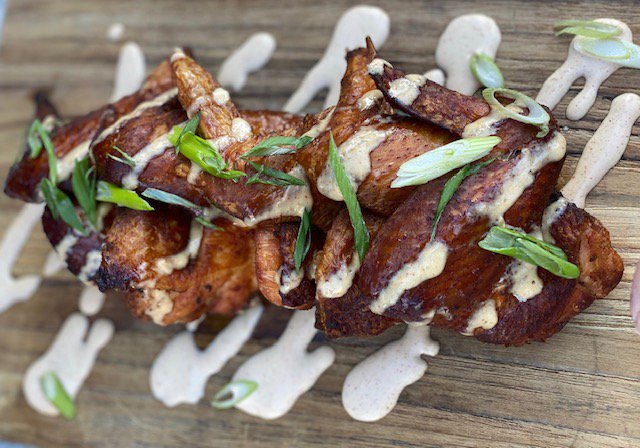
Among other new menu highlights, Teitelbaum also notes that Cawthon’s house-smoked chicken wings as well as the chef’s housemade biscuits and breads for sandwiches and soups and chicken and waffles, which is on the brunch menu that launched in March.
“I never thought Herbie’s would be in the chicken wing business, but people love it,” Teitelbaum says with a laugh. “The kitchen has been blowing through them. We can’t make them fast enough. The menu has just really been special.”
Teitelbaum is thrilled to finally share the new Herbie’s under Cawthon’s leadership and navigate this new era of dining out in general. Between the improvements to the dining rooms and a new, chemical-free sanitizing system, he feels confident about the steps he’s taken to transform his restaurants, and he’s ready to share them with diners.
“My staff is working hard, as hard as they possibly can,” Teitelbaum says. “This is all new territory.”