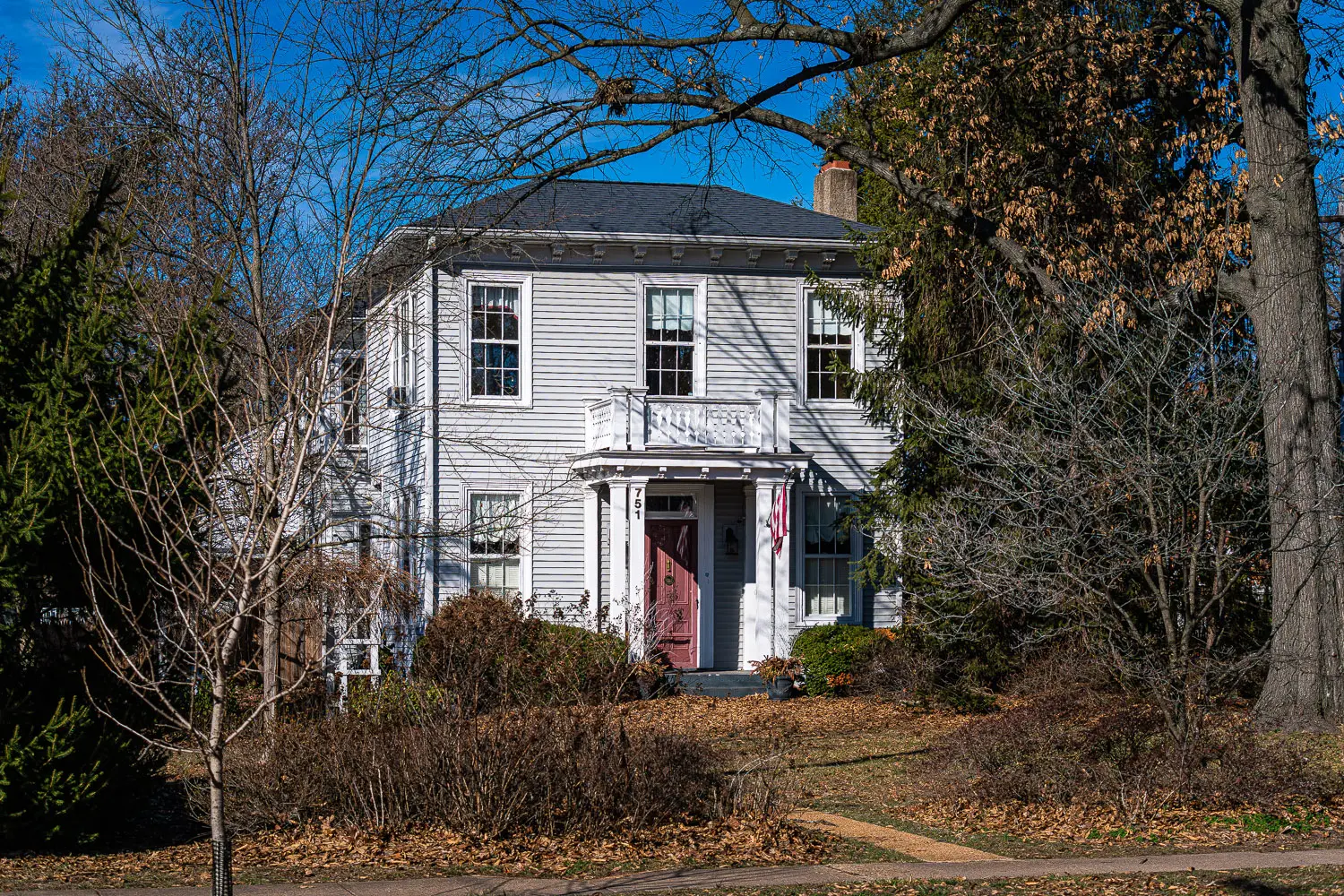
Editor’s Note: On Mon., Feb. 23, a group of Kirkwood residents filed suit to halt demolition of the house at 751 N. Taylor Avenue. Jay Burns, attorney for the group of residents, says a setting with a Kirkwood judge is scheduled for tomorrow at 3 p.m. In Burns’ view, the City of Kirkwood is authorized to deny demolition permits under state and federal historic preservation laws.
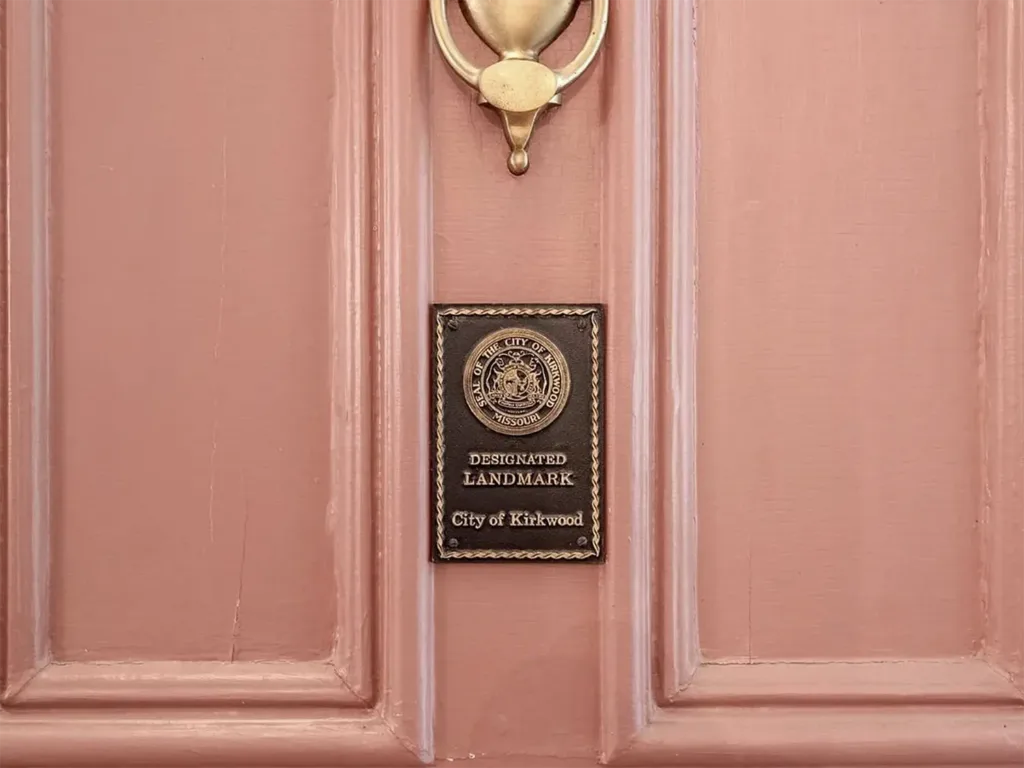
The third photo in the Zillow listing for 751 N. Taylor in Kirkwood displays a placard on the home’s front door declaring it a “Designated Landmark.”
Get a weekly dose of home and style inspiration
Subscribe to the St. Louis Design+Home newsletter to explore the latest stories from the local interior design, fashion, and retail scene.
Located in the North Taylor Historic District, the house was built in 1858, just five years after the City of Kirkwood was established as the first planned residential commuter suburb west of the Mississippi. The home is one of only 85 designated landmarks in the city.
By this time next week, the memory of that placard and the home may be all that remains.
On Mon., Feb. 23, a nine-month demolition stay on the house will expire, allowing the homeowners to raze it, unless the city’s Landmark Commission denies the homeowners’ request.
The house is the latest example of a historic property slated for demolition to spark conversation about what can or should be preserved in the St. Louis area’s built environment. In March 2025, the Creve Coeur City Council voted to demolish the Lake School House, a one-room school built in 1897. Last month, the Wildwood City Council passed a temporary moratorium on issuing demolition permits following a years-long effort to save the Marycliff Residence, a 150-year-plus home that was torn down in 2025.
“People will often try to claim that historic preservationists try to save every building; we acknowledge that you can’t save every building,” says Stuart Keating, executive director of Landmarks Association of Saint Louis. “But what that means is that the buildings that are worth saving are that much more important, right?”
“We’re watching it slip away”
The home at 751 N. Taylor is known as the Marquitz-Garesche House, named for former homeowners William Marquitz, who purchased the property in 1876 and sold it in 1910, and Charles A. Garesche, who purchased it in 1915 and lived there until his death in 1931. In Garesche’s obituary, printed in the long-defunct The St. Louis Star-Times, he was described as a “member of a pioneer St. Louis family.”
The home was purchased in February 2025 by Harlan “Harlee” Sorkin. The Sorkins aren’t strangers to large-scale home renovations: In a 2017 story published in Ladue News titled “We Love Our Neighborhoods,” Harlee and Annelle Sorkin shared how they had completed a gut rehab of their Town and Country home, which was built by Harlee’s grandparents. At the time of publication, Harlee and Annelle’s three children were the fourth generation to grow up in the family home.
Yet a renovation doesn’t appear to be on the table. On May 29, 2025, Harlee Sorkin submitted an application to the Kirkwood Landmarks Commission and Architectural Board for a demolition permit of the property. Less than two weeks later, Sorkin appeared at the commission’s monthly meeting to discuss demoing the home.
At that meeting, Sorkin shared a number of concerns, including that multiple additions made to the home over time have created “challenges in updating the home to modern safety and living standards.” A month later, at the commission meeting on July 9, 2025, Sorkin listed more detailed concerns, ranging from a tiny bathroom and an outdated kitchen to issues with the electric system, lead water pipes, lead paint, and the possibility of asbestos in the vermiculite insulation underneath the attic floor and walls—though Sorkin said he had not collected bids on replacing the water line or testing the insulation.
In Kirkwood, when the owner of a landmark property or a property in a historic district submits a demolition application, the city’s Landmarks Commission can ultimately issue a 270-day demolition stay. After those 270 days expire, unless the commission denies the request, there is no way for the city council or any other governing or preservation body to halt demolition. The nine-month demolition stay for 751 N. Taylor ends on Feb. 23.
“Philosophically speaking, there’s no good reason to demolish this house,” says Keating at the Landmarks Association. “It’s livable. Someone spent decades renovating it. It’s an asset to the neighborhood. Houses like this are the reason people try to move to Kirkwood in the first place.”
Three weeks ago, in an effort to appeal to the Kirkwood City Council and the community about saving the home, a two-story Italianate at 751 N. Taylor, resident Erin Mariscal started a petition on Change.org. As of this writing, the petition has more than 1,450 signatures.
“I lived in Washington, Missouri, from the time I was 10, in the downtown historic area where you can walk everywhere, and we wanted to raise our kids that way,” Mariscal says. “I feel like we came here because there was something special that very few places have, and we’re watching it slip away.”
Although the Kirkwood City Council doesn’t currently have the authority to halt the demolition, the petition has yielded responses from two council members.
“I also believe the likely imminent demolition of the historic architectural gem is extremely unfortunate,” said Kirkwood City Council member Nancy Luetzow in a comment on the petition. “The current owner appears intent on demolishing this lovely, well-maintained landmark home. I appreciate citizens speaking out against the owner’s decision. It is my hope this outcry may convince the owner to consider alternatives to erasing this beautiful piece of Kirkwood history.”
Mariscal has also launched a GoFundMe campaign to raise funds to cover legal fees needed to help protect this and other historic Kirkwood buildings. The campaign states that the money raised will be used to: “…help me clarify whether the city is acting lawfully and, if necessary, file an injunction to halt the demolition. My goal is not only to save this home, but also to strengthen our local codes so that this doesn’t happen again.”
This isn’t Mariscal’s first time advocating for a home on North Taylor. In 2011, she and a group of other residents launched “Save 750 North Taylor,” a campaign to preserve the house once located directly across the street from the Sorkin home. Out of that campaign, the North Taylor Historic District was created, which Mariscal believed would protect landmark homes like 751 N. Taylor.
“When I heard this house was being torn down, I thought, ‘That’s not true; that can’t be. We put restrictions on our own homes—we can’t even change the roofing material by agreeing to that historic zoning—but they can go knock down their house?” Mariscal says. “The outrage is not over ‘this house,’ it’s over Kirkwood not being honest with us. No one knew that we can’t paint our front door without approval, but you can still tear a house down.”
Ultimately the home at 750 N. Taylor was torn down in 2013. The property sat empty for over five years, changing hands multiple times, before two new homes were built on the lot.
“I’m not against people tearing down houses,” Mariscal says. “We [no longer live in the North Taylor] historic district, we live right past the border. There is a house literally going up across the street from me; the house they tore down was built in 1880 or something. It was the oldest house on the street. Terrible shape. We had a block party when they tore it down. I am not against progress. We’re not zoned historic. The house was in total disrepair. [Sorkin] could have moved two blocks away and done this and no one would have cared. Why there?”
“The worst house he’d ever seen”
Steve Bell and Maryann LoPiccolo Reese spent two years house hunting in Kirkwood. They knew they wanted to live within walking distance of the city’s charming downtown, home to small businesses, local restaurants, and community events—and, as a result, where the real estate market is highly competitive.
They were eating burgers at a Kirkwood restaurant when Reese saw a home in the Jefferson-Argonne Historic District, near the Kirkwood Farmers’ Market, listed for sale. It was a prime location, one Bell and Reese knew well, and yet they couldn’t picture the house.
“I thought we knew every street and every house [in Kirkwood],” Bell says. “So we drive by here, we’re like, ‘I didn’t know there was a house there.’”
Bell and Reese recall seeing overgrown trees, one sloping close to the home, which was positioned near the back of the lot, somewhat shrouded from view. They purchased the house knowing it would require significant renovation if salvageable.
“We got a structural engineer to look at it to see if we could remodel it,” Reese says. “It had roots growing into the basement.”
Bell continues: “Floor joists were bad. There was a place that you could fall through [the floor]. We’re talking about structural things that needed to be changed in the house.”
After reviewing the report from the structural engineer and consulting with an architect, Bell and Reese decided to submit a request for demolition to the Kirkwood Landmarks Commission. They asked their structural engineer to attend their first commission meeting to share his conclusions. “He said it’s the worst house he’d ever seen,” Bell recalls.
The couple anticipated receiving questions from the commission, but they didn’t get much feedback from neighbors or the community. The commission ended up extending the demolition stay for Bell and Reese’s home to the maximum 270 days, at which point the couple could raze the property.
“You know, at first there was no house there — it was just land,” Reese says. “It was nothing. And so life does go on. We become more modern and we want modern amenities, but nostalgia is what’s hard to give up.”
After the original house was demoed, Reese and Bell worked closely with architect Nick Adams of Mademan Design to build a transitional-style home that paid homage to the original house’s architecture and character, especially from the curb.
The couple knew they wanted modern amenities in the home, including a sunken golf simulator in the lower-level and an elevator for aging in place, yet from the sidewalk, they wanted the house to feature some of the original dwelling’s character. Stone on the exterior of the home was selected to match neighboring Eliot Chapel, and details such as a two-story front porch, with a cantilevered overhang, mirror the original house design. The elevation of the new home was also constructed to be reverent to the original house.
Today, if you know where you look, you’ll find two placards on the home’s exterior dedicated to its history. Both placards are mounted on bricks salvaged from the original home, offset from others on the exterior, with one reading “Leffingwell 1853” and the other “Schopp 1880.” The first is a nod to Hiram W. Leffingwell, a land owner and developer in Kirkwood dating back to the 1850s. At one point, Leffingwell owned the property Bell and Reese own today. The second brick pays tribute to the man who, in 1880, built the original house on Bell and Reese’s land.
“I’m nuts about this history stuff,” Bell says. “I know all these houses and I feel like we’re kind of on sacred ground here.”
Reese agrees. She notes that the couple have opened their new home to the community for gatherings and events, including a caroling event last December. The couple take great pride in their home and neighborhood, including its history, and enjoy being active community members.
“Everything has a useful life. I don’t mean to be disrespectful, but everything has a useful life,” Reese says. “And when the useful life is up and no one has kept it up so that it’s useful life can be longer, then it’s really sad. But I think that we have done something really good for Kirkwood. This is our corner of the world, but it’s also the gateway, I think, to Kirkwood, too, because we’re in such a good spot. And so it feels good to have built a house that fits in with the neighborhood, fits in with our lifestyle on the inside.”
When asked about the house at 751 N. Taylor, Bell and Reese both say they’d like to see the house stay, though they don’t agree that local government officials should step in. “We’d like to see all these houses stay,” Bell says.
If they can’t all stay, however, Reese would like to see more involvement from the city in what takes their place.
“I would love to see this process improved because there are so many things that could make it better,” Reese says. “And, no, maybe we can’t save every house. But maybe we can make sure that we build houses that are appropriate for the neighborhood, because that’s not happening right now.”
“We’re here to help”
In response to the debate about 751 N. Taylor, Kirkwood Mayor Liz Gibbons recently told the St. Louis Post-Dispatch that the city council could consider changing the city laws to address concerns over historic home demolition.
Before such steps are taken, however, Keating, the executive director of the Landmarks Association of St. Louis (who is also an attorney), says the Kirkwood Landmarks Commission could deny Sorkin’s request for demolition.
“The way that this ordinance is written, it states that the commission may approve, which, speaking as an attorney, implies that they have the ability to deny,” Keating says. “But if you have a commission that has operated with this belief that they can’t deny anything, then that sort of becomes a self-serving fact. And they do have the power to deny. If you have a historic district and people are coming in and bulldozing the houses, what’s the point of having that historic district? And it’s not like this is a building that there’s not a viable use for it. So my instinct is to suggest that the commission test out the limits of the ordinance, deny the permit, and see what happens.”
Rules and regulations for demolishing historic homes vary from municipality to municipality. In the City of St. Louis, for example, if a homeowner requests a permit to alter or demolish their home in one of the city’s 18 local historic districts, it is evaluated by the Cultural Resources Office. If a permit is denied, then there’s an appeals process in place.
“I like to make sure that I’m trying to uphold the spirit of what these neighborhoods want us to do and try to protect the historic resources, but also help homeowners through a process,” says Bob Bettis, Cultural Resources Director for the City of St. Louis. “I like to help them get to a ‘yes’ versus just being ‘no.’ That sounds kind of trite, I’m sure, but it’s true—I just want to be helpful and help out these residents.”
Renovation and design standards vary in each of the city’s historic districts.
“You have Lafayette Square, and their rules [are], if you want to build new, you need to find a house in the neighborhood and replicate it,” Bettis says. “That’s Lafayette Square’s rules for new construction. You go elsewhere, it’s about compatibility—you need to make sure that what you build is contextual with the streetscape. So there’s varying regulations and requirements, neighborhood to neighborhood, and from the beginning, that comes from the neighborhood. Something we often hear is that there’s no consistency [with rules from neighborhood to neighborhood]; well, that’s kind of by design, because it’s ownership of those regulations of their own neighborhood. Like HOAs, when an HOA is established, those rules are crafted by people who built the neighborhood, essentially. So it’s kind of the same thing [in these historic districts].”
A few months ago, in the Central West End historic district, a Greek Revival-style home was razed. Built in 1905, the home sustained large-scale damage during the EF3 tornado that devastated the city on May 16, 2025. The house sustained too much damage to save, and due to local ordinances in the district, specific rules now govern new construction on the property.
“If the lot in question was empty prior to the storm and they wanted to build new, it would still be expected to meet the design guidelines for new construction in the Central West End,” Bettis says. “And that’s still the same now; nothing changed [after] the storm in terms of proposed new construction.”
In St. Louis County, there is no preservation ordinance or laws protecting historic buildings in unincorporated areas. “So we rely heavily on the municipalities to put in place preservation ordinances and have preservation commissions that review demolition permits,” says Guinn Hinman, the county’s historic and cultural sites manager.
Hinman says she’s seen “a lot of loss” of historic buildings across the county and in local municipalities despite the work of preservationists, but she’s also seen great examples of adaptive reuse of historic structures, which qualify for tax credits. She points to projects like the Hawthorne School Apartments developed by WashU, which converted the former Nathaniel Hawthorne Elementary School in University City into 37 apartments and 10 townhomes.
“It’s not all doom and gloom,” Hinman says with a laugh. “There are a lot of success stories. In regard to saving historic buildings, we really advocate for people to find other uses—get creative with it. I think a lot of folks think that a school needs to be torn down because we’re no longer using it for a school, when it could become a lot of different things.”
Hinman, like Keating at the Landmarks Association and Mariscal, who launched the petition to save 751 N. Taylor in Kirkwood, recognizes that not every building can be saved.
“But once it’s gone, it’s gone,” Hinman says. “Some of our most interesting and architecturally significant neighborhoods have all of these wonderful historic buildings and if we start tearing them down, it will certainly affect the community, how folks feel about their community, and their home. Research has proven over and over again that people want to live near historic buildings. Those are always desirable neighborhoods, and the investment made into historic preservation is always of great benefit. It attracts businesses. It attracts younger workers, students. So when you start chipping away at that fabric of the community, where does that end? And, what’s next?”
Multiple calls and interview requests to the City of Kirkwood were not returned. Harlee Sorkin could not be reached for comment.