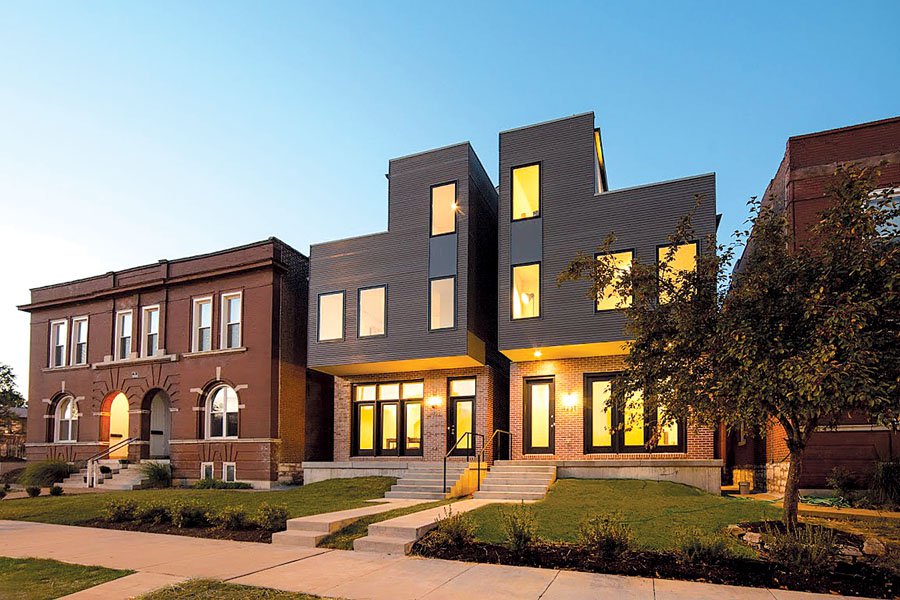
Husband-and-wife architects Brent Crittenden and Sarah Gibson studied, lived in, and explored the modern-built environments of Rotterdam, London, and New York City for 10 years before moving to St. Louis in 2005.
That same year, they launched Urban Investment Company with the purchase of a 110-year-old abandoned building on Cherokee Street, transforming the once-faded lady into a beauty holding condominiums and retail space. Eleven years later, they’ve helped renovate other neighborhoods as architects and developers, through their design-and-build capabilities, and with management services.
Get a weekly dose of home and style inspiration
Subscribe to the St. Louis Design+Home newsletter to explore the latest stories from the local interior design, fashion, and retail scene.
Crittenden, a native of Granite City, met Gibson when the two studied architecture at Kansas State University. “New York City and London are great cities, but the speed in those cities… We wanted to raise a family and start a business,” says Crittenden. “We could do that in St. Louis.”
The two have parlayed successful ventures in urban St. Louis neighborhoods into a credible body of work.
“Midwestern cities have been hard hit,” Crittenden says, “but cities are resilient things, increasingly attractive to homeowners today. People are interested in urban neighborhoods despite 60 to 70 years of disinvestment. We believe the future of cities will be radically different—for the good.”
Crittenden and Gibson moved into the Botanical Heights neighborhood when they designed and built City Garden Montessori School. The charter school serves as a solid anchor for families and a touchstone for future development.
At the same time, they worked with restaurateur Ben Poremba to pull two unique buildings—one a stately home, the other a former filling station—off the state of Missouri’s demolition list. The home became Elaia, and the former 1930s Standard filling station is now Olio. The two restaurants have come to define the corner of McCree and Tower Grove.
Poremba’s inspired cooking drew new people into the neighborhood when both restaurants opened in early 2013. Some bought houses and even built custom homes with UIC. Today, the residential streetscape is a living thing, a mix of old homes, new construction, apartments, and imaginative renovations.
Other UIC projects in Botanical Heights include renovations occupied by favorite St. Louis destinations, including La Pâtisserie Chouquette, Old Standard Fried Chicken, Union Loafers Café and Bread Bakery, and Union Studio.
“We use the analogy of grafting when we approach neighborhoods,” Crittenden says. Just as an arborist unites living buds from one tree with other trees to produce new varieties, UIC blends new buildings and renovations into an existing neighborhood.
“You have to understand the stock, who lives there, identify their needs,” says Crittenden. “Then you act.”