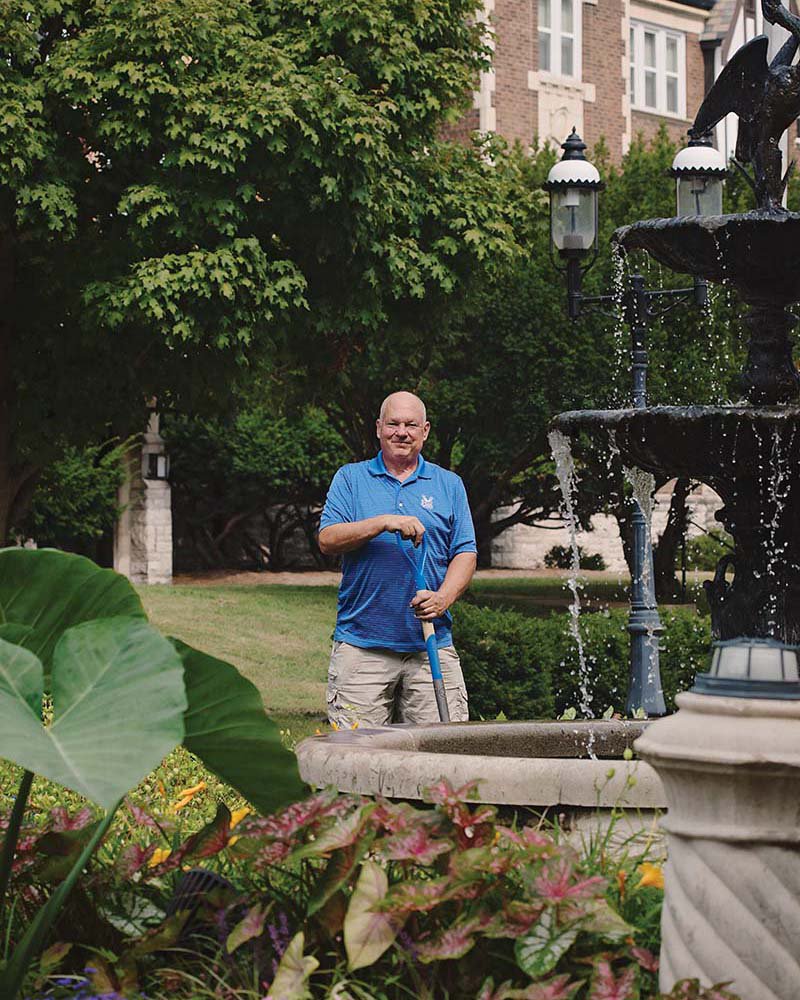
The three blocks of Waterman from Kingshighway to Union in the Central West End stand apart from the others. A roundabout, centered on a garden decorated seasonally with flowers and plants surrounding a large iron fountain, serves to slow traffic. Beautifully designed planters, brimming with canna and marigold mark street corners. These pretty tableaux are the handiwork of retired attorney Tom Brackman, who’s made it his mission to beautify this stretch of Waterman for more than 30 years. Why does he do it? Brackman says it’s out of love for the neighborhood and a personal desire to see it improved.
You’ve been referred to as the Mayor of Waterman. How did that nickname come to be? That term came from a West End Word article in the ’90s. They did an article about the neighborhood because we had just formed the Waterman-Lake Special Business District. As part of the business district, we did a big public improvement project with the aim of slowing down traffic on the street. We put in the circle where the fountain is and a few bump-outs in the 5100 block where there are now planters. The project was done in 1995–96. At the time, I was the chairman of the district and chairman of the Waterman Association.
Get a weekly dose of home and style inspiration
Subscribe to the St. Louis Design+Home newsletter to explore the latest stories from the local interior design, fashion, and retail scene.
What’s the scope of your duties? I’m in charge of planning and maintaining the flower beds and planters on our street. I do it along with my assistant, Lisa Wells. She is really the one who does the manual labor—planting the beds and watering them—so [she] deserves a lot of recognition as well.
What do you enjoy most about living in the CWE? I just love the city living and the diversity of the people on the street. We have townhomes, apartments, million-dollar single-family homes, group homes, and condominiums. We have St. Louis natives and a lot of international residents. We are also fortunate to have the First Unitarian Church, Central Reform Congregation, and New City School all on this stretch of Waterman. Together, those draw [people] from more than 30 ZIP codes. I also always like the old houses and historic buildings and of course the proximity to Forest Park.
Your work is done on a volunteer basis. Why do you do what you do? I love the neighborhood, and I genuinely enjoy the work—but then again, I also have financial reasons to do what I do. I own seven buildings on this street, and at the end of the day, the nicer the street is, the more people that want to move in. It’s funny—when I first moved to this street, in 1985, people were reluctant to move in because they weren’t sure if this was a safe neighborhood. Now, when people come to see an apartment, they say “I’ve always wanted to live here.” The perception of our neighborhood has changed, I think in part because of the improvements we made.
What is life like in the West End during the Pandemic? People are much more social. Everyone is home. Whenever we’re outside eating, people stop to talk. COVID doubled the amount of people who were walking on the street during the day. The appreciation for the beauty we’ve created on Waterman has doubled, too.
In your experience, what makes a good neighbor? I think a good neighbor is someone who always has a smile on their face, someone who wants to volunteer to make the neighborhood better—and a good neighbor is someone who maintains a good attitude, especially in times like these.