When Kathy and Bryan Nicholson were ready to renovate the 1950s Colonial in Ladue they had lived in for five years, Kathy knew that the dated, dark- floral wallpaper in the dining room had to go—she just wasn’t sure what she’d put in its place. An art history major, Kathy has always loved painted, architectural wallpapers, but she thought she could achieve a similar, but singular, look with a mural. Searching for inspiration, she discovered artist Peter Engelsmann’s website, and was captivated by his elegant mural of Forest Park, filled with pretty pastoral scenes. In that moment, Kathy knew that Engelsmann could fulfill her vision of a mural depicting the St. Louis 1904 World’s Fair in her own home.
“Bryan and I were both raised here and have wonderful memories of Bryan’s mom telling us stories about her great-grandmother sneaking out at night to meet friends at the Fair,” Kathy says.
Get a weekly dose of home and style inspiration
Subscribe to the St. Louis Design+Home newsletter to explore the latest stories from the local interior design, fashion, and retail scene.
The Nicholsons and Engelsmann planned to show specific scenes from the Fair, and the family approved the artist’s initial sketch on paper. But as Engelsmann delved further into research—poring over reference materials, vintage images, and maps—he decided that he wanted to paint the scene with historical accuracy, placing each building precisely where it would have been in 1904.
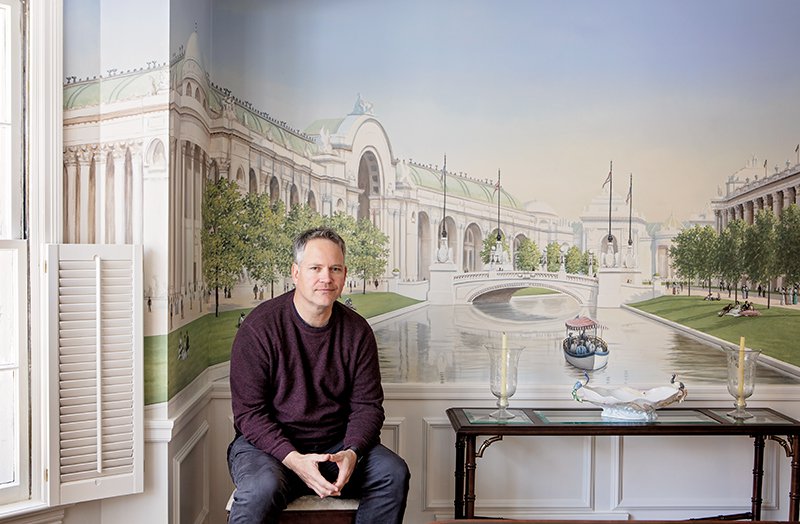
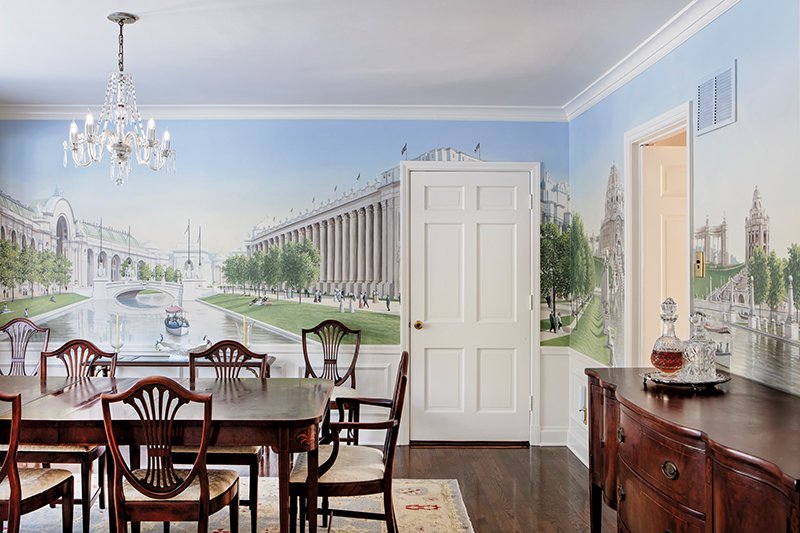
“The grandeur and scope of the Fair were mind-boggling—the engineering and ingenuity that went into it—these were enormous, majestic 15-by-20-foot structures made from plaster of Paris,” says Engelsmann. He sketched the main architectural elements—the Palace of Manufactures, the Observation Wheel, and the Palace of Education and Social Economy, among many others—in pencil on the four dining room walls in a loosely Impressionistic style, allowing him to see how realistically the planned optics would work. The perspective, says the artist, is designed to give someone seated at the table the optimal viewpoint. Engelsmann recalls the challenge of creating an inverted vanishing point “where the nearest corner of the Palace of Varied Industries sits at a corner of the room where two walls meet.” It’s yielded an optical illusion in which the “closest” element of the painting is actually the point in the room farthest from the viewer.
Using fast-drying acrylics, Engelsmann began painting the background, starting with the sky and horizon and working his way to the foreground, which he populated with such detailed elements as boats, elephants, and people in period dress. The artist mixed shades of ultramarine and burnt umber with water to create a transparent wash of gray and brown: “I brushed this on to suggest all of the architectural details and from there slowly built up the mural with more washes of color. In some cases, like with the trees, I used a very opaque treatment.” Much of the sky is just one coat, but the foreground comprises as many as 10 layers of paint. The finished mural’s palette of antiqued pastel blues and greens was Kathy’s vision. “I wanted coloring reminiscent of what you would see on a postcard or in a souvenir book from the Fair, where everything was hand-painted and idealized,” she says.
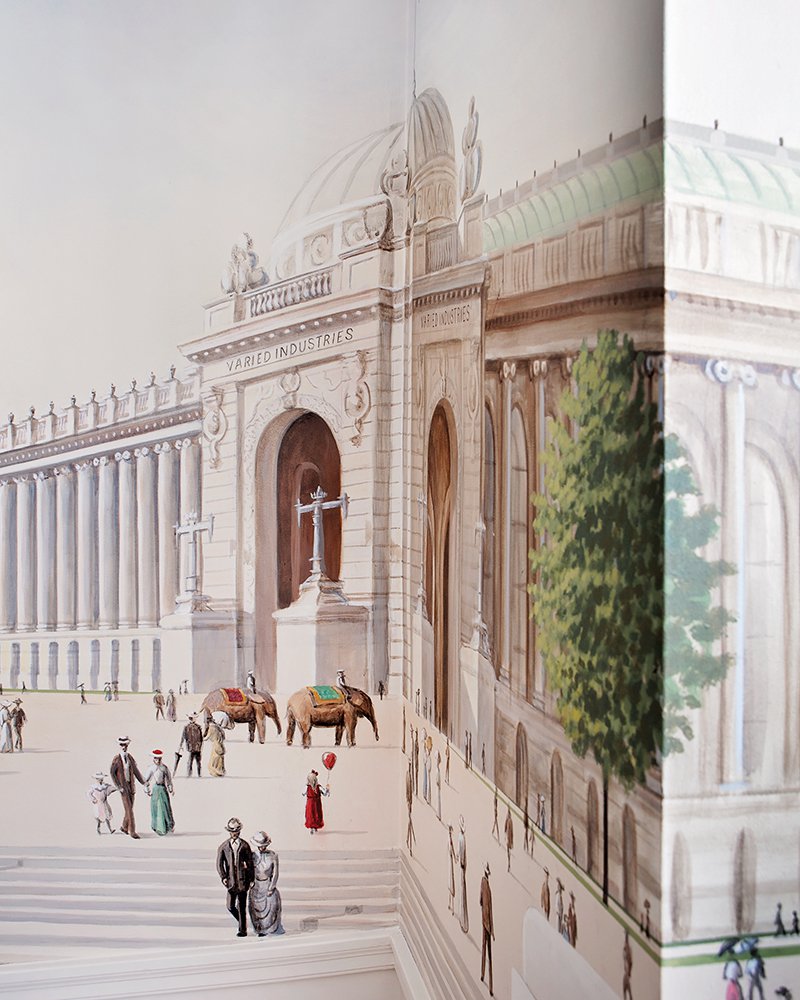
To personalize the mural, Engelsmann painted five figures representing the Nicholson family; in a separate location, a little girl in a red dress, holding a red balloon, memorializes Bryan’s great-grandmother.
Both client and artist are proud of the work, which took three months to complete and transformed the dining room into a one-of-a-kind space. “I was inspired by how beautiful everything was, the complexity of the work, and the industriousness that went into the World’s Fair,” says Engelsmann. “I felt compelled to represent it accurately and hope viewers will appreciate the Fair in a new way.”
The Nicholsons certainly appreciate the artist’s dedication to making the mural both accurate and stunning and are looking forward to family celebrations in the space. “The mural has opened up the room,” Kathy says. “It now looks twice as big and so much more inviting.”