Soft and sophisticated, velvet is beloved, but its appeal is hardly new. The fabric—the product of a weaving technique that creates a dense plush pile over a base cloth—dates back to at least 7th century Asia, where velvet was first woven of silk. Eventually, velvet was brought to Europe, most notably Italy, becoming popular in the 15th and 16th centuries. “At the time, velvet was mostly used for clothing and ceremonial textiles by the nobility and the church because of its expense,” says Genny Cortinovis, the Andrew W. Mellon Foundation Assistant Curator of Decorative Arts and Design at the Saint Louis Art Museum, “but enhanced weaving technology in the 17th and 18th centuries helped usher in a new phase for the fabric, lowering its production cost and making it more accessible to the general population.”
Prized for its warmth and durability, velvet as a home goods textile was first seen in Europe in the 17th century. “Today, designers reach for it again and again because it conveys luxury while being cozy,” says Catherine Croner, design director at Cowtan & Tout.
Get a weekly dose of home and style inspiration
Subscribe to the St. Louis Design+Home newsletter to explore the latest stories from the local interior design, fashion, and retail scene.
“The nice thing about velvet is that it introduces a texture without having a big voice,” says Jimmy Jamieson of Jamieson Design. Jamieson recently completed a project for a California couple in which he incorporated yards of orange cotton velvet into draperies destined for a blue-and-white bedroom. “The orange curtains were the only accent color,” he says. “It was stunning.”
Jamieson turns to velvet for its aesthetic allure but also for its practical applications. He chooses a thick-pile velvet when he wants to dampen sound: “The denser the velvet and the more of it you use, the less resonance you will have, making velvet really great in a screening room or a bedroom, where you want to absorb sound.”
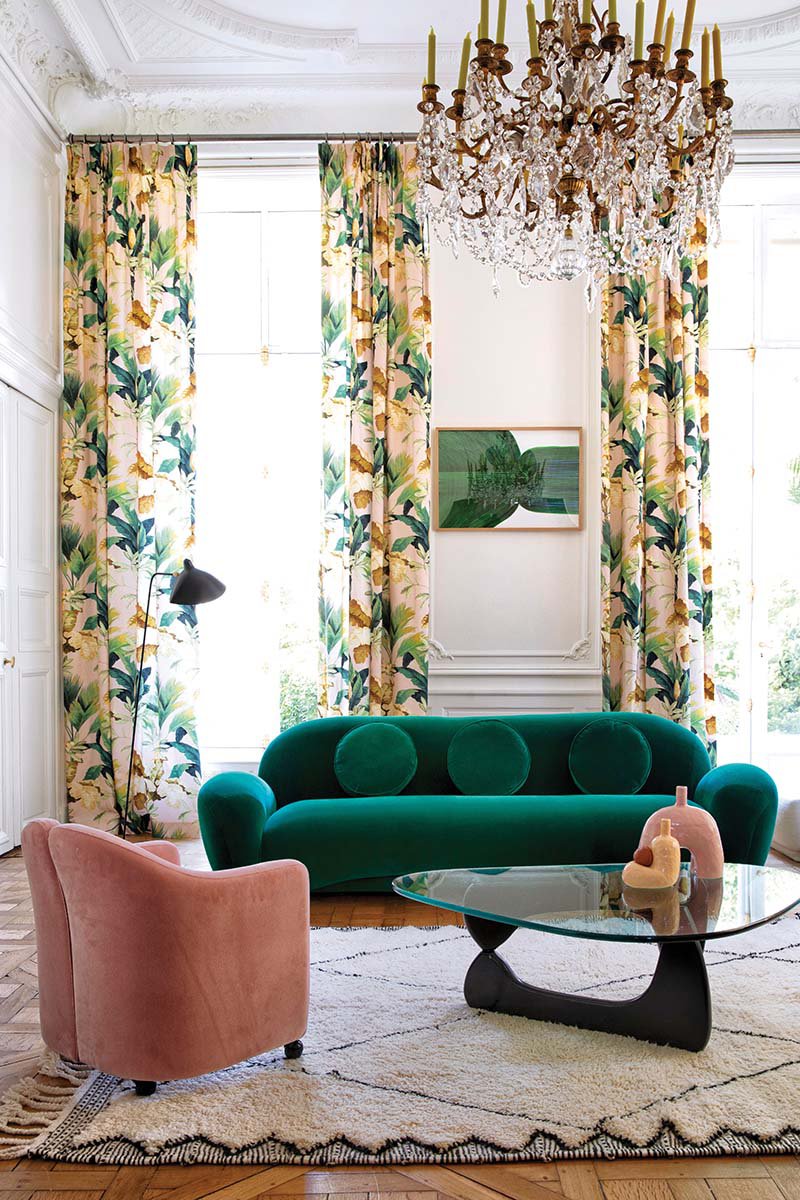
Solid velvets tend to be used on large upholstered pieces and as window treatments, but patterned velvets on, say, accent or club chairs are having a moment, says Kim Caldwell, a textile representative at KDR Designer Showrooms. Cowtan & Tout’s bestselling velvets, their signature Ocelot and Rajah animal prints, are designer favorites because they function as nonsolid solids. “We think of these styles as velvet adaptations of a jacquard,” says Croner.
The various fibers of which it can be woven—silk, cotton, mohair, even polyester—make velvet suitable to a range of settings, from sitting rooms to performance theaters, from headboards to walls.
“Cotton velvets lend themselves to a more matte finish and are least resistant to pressure marks,” says Caldwell. On the opposite end of the spectrum are viscose velvets, which have a high sheen, are reminiscent of a silk velvet, and susceptible to seat and other pressure marks. How noticeable such marks are varies with fiber content, as well as the fabric’s pile length and density. Pressure marks don’t necessarily denote a lack of expense or quality, and shoppers should take their preferences into account. “Do homeowners want their sofa to look perfect, or are they okay having it distress and age?” asks Caldwell. “If you want it to age, linen velvet is fabulous, because it will show everything.”
Regardless of how or where it’s used, velvet is resistant to cycles in trends. As fabric manufacturers continue to innovate, new polyester velvets are made for stain-repelling performance. Velvet, once the domain of royals, can be used in child- and pet-friendly spaces.
Velvets belong everywhere, says Cowtan & Tout’s Croner: “As a fabric, velvet transcends styles and trends. Their sheen makes them ideal for glamorous rooms, but they’re equally ideal in modern or relaxed spaces.”