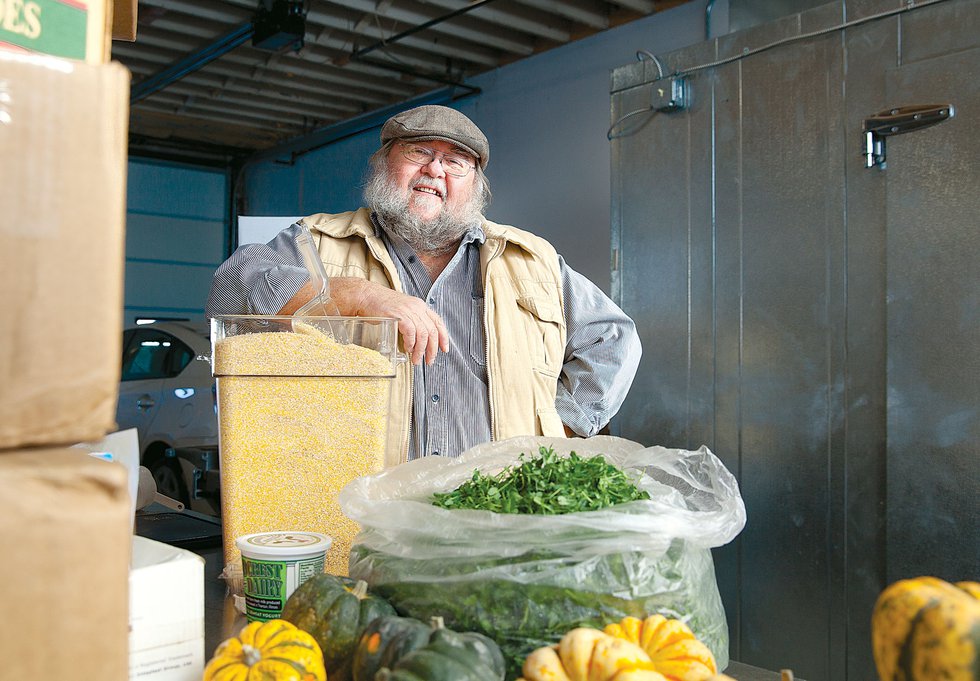
One of St. Louis’ most endearing restaurants, Riddles Penultimate Café & Wine Bar, became the perfect springboard for owner Andy Ayers’ second career running Eat Here St. Louis (314-518-6074, eatherestl.com), which serves as a liaison between local farmers and the local chefs clamoring for their products. And we’re all beneficiaries—the fruits of Ayers’ labor are seen every night on the plates of the better restaurants in town.
I can’t tell you how much I learned about various foods and local farmers just by reading the menus at Riddles.
Get a weekly dose of home and style inspiration
Subscribe to the St. Louis Design+Home newsletter to explore the latest stories from the local interior design, fashion, and retail scene.
A lot of people made fun of that. Still, I’m pretty sure I was the first to have that be a focus of the menu. People would say, “Andy, it takes sooo long to read your menu… We don’t care who grew your broccoli.” But the practice seemed to catch on, now, didn’t it?
I’d say so. So Eat Here St. Louis had its beginnings in how you did things at Riddles?
After 27 years in the business, I already knew a lot of chefs and restaurateurs, plus had developed a reasonably large circle of growers. I really enjoyed that part of the busines—finding local sources for food—and thought, “Why not turn this into my job?” And I didn’t have to hire and fire any dishwashers…
It’s the perfect second career for a restaurant guy.
Yep, that’s been my goal my entire life—to make my hobbies tax-deductible.
Food distribution is almost as old as food.
And all I’m doing here is recapitulating its historical development. There was a time where everyone grew their own food or swapped for it from the person who did grow it. Then there was truck farming. My grandfather was one in Pine Lawn, when Pine Lawn was out in the sticks. He and my dad would drive produce into the city, sell their stuff on the street corner, then load the truck with free manure and haul it back to the fields in Pine Lawn. It was an embryonic farmers’ market.
Truck drivers love it when they have cargo moving both ways. So your grandfather had the deadheading part figured out, too.
That part was brilliant. So all this distribution stuff—minus the manure—is in my blood. Still, every time I heard that story, I wondered how well they cleaned out that wagon…
Distribution stayed simple for a while.
Initially, there were jobbers, middlemen like my grandfather who’d gather the goods and get them to market. Now layers of middlemen gather goods from all over the world and distribute them to chain stores all over, which obviously has its downside. All I wanted to do was get the process back to the way it started. Programs like Eat Here—and farmers’ markets, and chefs who believe in buying products from close by—are how a city develops a local agricultural economy.
How did you start the company?
I started with a walk-in cooler in my back yard—it was illegal and I knew it. I figured the worst-case scenario was to fill it up with beer and have giant barbecue parties all summer long. It didn’t take me long to go legit, though, and rent some warehouse space on North Broadway.
This increased interest in locavorism seems like it has to translate to more business for Eat Here.
There are more sources of supply because of increased demand. Local farmers haven’t changed: Just buy their stuff, and they’ll plant even more next year.
How many local growers did you deal with initially, and how many do you work with now?
A handful to start and about 60 now, but it’s a continuum across the growing season. Take my strawberry guy—I see him only for a few weeks in the spring.
Talk to me about hoop houses. How big a deal are they in Missouri?
Greenhouses and hoop houses—their less permanent, plastic-covered cousins—have been a boon to wintertime growing. The USDA has helped tremendously here by giving grants to Missouri farmers to start hoop houses. This thing is still in its infancy.
Are hoop houses productive all winter long?
I had homegrown tomatoes—beautiful tomatoes—for sale here in late February. A mild winter is ideal. In a cold winter you have to add heat, be it solar-powered, black plastic, or using row cover [a light, gauzy fabric that insulates while letting light in]. One tomato grower uses free wood chips and a wood-chip burner to heat underground pipes that keep both his house and his hoops warm.
What are we seeing now locally that we haven’t seen before?
Grains, for one thing. Wheat flour, wheat berries… I’m working with a guy who’s growing oats and selling groats, that whole grain. Sorghum flour is now available. Blend that with some oat flour and you’ve got a good base for a 100-percent gluten-free bread.
Are any nontraditional fruits or vegetables gaining ground?
Sunchokes, for sure. No one ever fooled with those before, but they’re in demand. What you see the most, though, are heirloom varieties of fruit
and produce. That’s what all the chefs want.
How difficult is warehousing?
We call it “picking and packing.” I’ve got three employees now and two refrigerated vans. When I started this five years ago, it was one man and a van.
How many chefs currently buy from you?
I have chefs in a panic who just booked their one and only Sierra Club banquet and chefs who call me four times a week, 70 standing accounts in all. But I tell these guys, if you buy local for one party and then go back to Sysco, it’s like being nice to your neighbor at Christmas and then being a jerk to him the rest of the year.