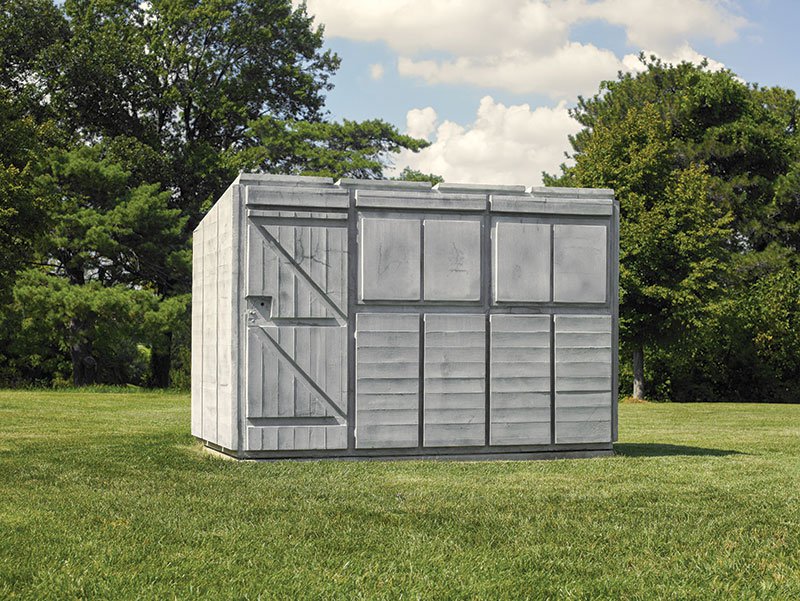
The trail of art, starting on the southwest lawn in the Saint Louis Art Museum’s Grace Taylor Broughton Sculpture Garden, seemingly ends with a large electrical box and a parking lot. If it weren’t for a nameplate placed a few steps away, Detached III—a large concrete casting of a garden shed’s interior by British artist Rachel Whiteread, obtained by SLAM in 2017—might blend in. But soon, more works by Whiteread will populate the museum.
“Rachel Whiteread,” on view starting March 17, features more than 90 pieces by the sculptor, the first woman to win the prestigious Turner Prize. The upcoming visiting exhibit is the first retrospective of Whiteread’s 30-year career. Unlike the other shows, the St. Louis leg is organized chronologically, following Whiteread’s career through ever-so-subtle changes, up to her 2017 papier-mâché project Wall (Apex).
Stay up-to-date with the local arts scene
Subscribe to the weekly St. Louis Arts+Culture newsletter to discover must-attend art exhibits, performances, festivals, and more.
Whiteread has made a name in the art world for “mummifying” the air, as she once put it. Her sculptures are castings of domestic objects—toilet paper rolls, bathtubs, bookshelves—or of the negative space we can’t see, in such materials as rubber, concrete, resin, and dental plaster. “She’s creating these ghostly, uncanny objects from things we encounter every day in our lives,” says assistant curator of modern and contemporary art Hannah Klemm.
This is most visible in her Untitled (Twenty-Five Spaces), large resin blocks in a range of oranges, greens, and reds, presented in a five-by-five square. Whiteread’s artwork is often not what it seems. The blocks are actually castings of the spaces beneath chairs, with the ridges of the seats visible and indentations left by the legs in the corners.
“There’s a moment where you have to think about what something is. Is it a sculpture of, you know, XYZ? Then you start to think about it,” Klemm says. “Oftentimes it’s that she’s cast the air surrounding an object or the interior of something as simple as a toilet paper roll or a cardboard box you’d find in your medicine cabinet.”
Curator of modern and contemporary art at the museum Simon Kelly says works by Whiteread are “very reductive in terms of its forms. It’s very geometrical, but it adds a lot of personal political meaning.” Meaning here is often added through repetition, as in Twenty-Five Spaces, which the museum will house in its own room, intensifying its haunting quality, or with the use of domestic items as metaphors for Whiteread’s life. In Closet, she cast a closet like one she hid in as a child.
“The objects are sort of anthropomorphic,” Klemm says, “but your experience with them is like you’re completing that memory as well as you relate to these bathtubs, tables, and chairs.”
Don’t-miss works at ‘Rachel Whiteread’
Detached III, 2012
Part of a series of concrete sculptures, this casting of a garden shed was obtained by the museum in 2017, resides in the Sculpture Garden on the southwest lawn, and didn’t travel to any of the other museum’s exhibitions.
Line Up, 2007–2008
Inspired by her children’s toys and small-scale objects, Whiteread created these colorful castings of the interiors of toilet paper rolls. “The colored objects are a beautiful moment where technology had changed enough that these really brightly colored resins were so readily available to her,” Klemm says.
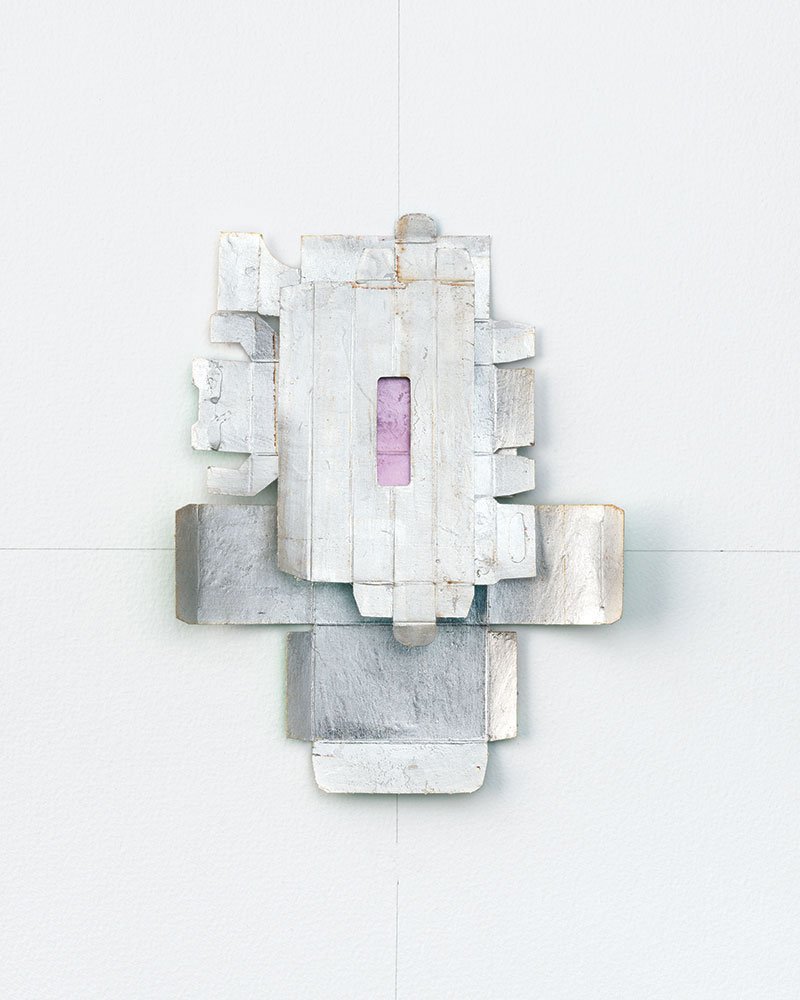
Untitled (Violet), 2012
As the namesuggests, a sliver of violet pops against this work’s metallic background.Comprising silver leaf, cardboard, celluloid, and graphite on paper, this is one of Whiteread’s flat masterpieces and is similar to two other 2012 works—one with a touch of blue, the other green.