Dive into declassified history with the Soldiers Memorial Military Museum’s upcoming exhibition, Ghost Army: The Combat Con Artists of World War II, opening September 25. This free exhibit in the museum’s lower level turns the spotlight on a fascinating piece of World War II history that went unreported for 40 years after the war ended.
“The Ghost Army was kept secret for so long,” says Mark Sundlov, managing director of Soldiers Memorial. “It’s a story that most people have never heard, and it’s an incredibly important story. It can’t be downplayed the importance these men had—not only fooling the Germans but saving countless lives.”
Stay up-to-date with the local arts scene
Subscribe to the weekly St. Louis Arts+Culture newsletter to discover must-attend art exhibits, performances, festivals, and more.
Ghost Army focuses on the 23rd Headquarters Special Troops, a tactical deception unit. This group of approximately 1,100 men was armed with nothing but their creativity and .50-caliber machine guns. With limited resources but limitless ingenuity, they managed to pull off one trick after another on German forces. The troops coordinated a series of 22 large-scale deceptions.
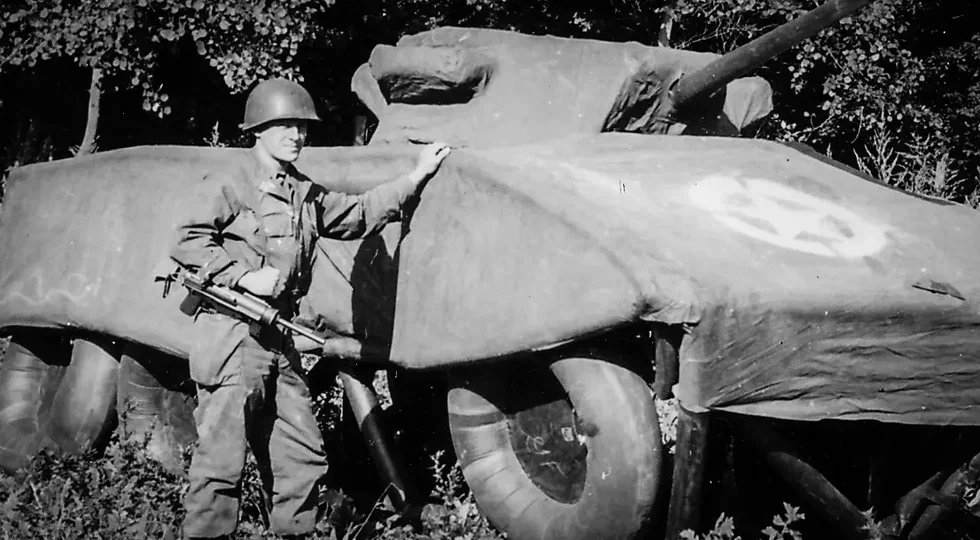
The men—most of them artists—used inflatable tanks and audio recordings to create the illusion of a much larger U.S. force, effectively confusing and paralyzing the Germans. Their work was inventive, improvised, and detail-oriented: One small mistake could mean catastrophe.
“People find it fascinating that these men were primarily artists,” Sundlov says. “When we think of the military, we think of regimented soldiers, but they were very creative and artistic people. It’s a neat story of human creativity.”
The exhibition will feature an inflatable tank and an inflatable howitzer used by the Ghost Army, as well as an interactive audio element where guests can push buttons to hear original audio tracks used to fool Nazi forces.
Visitors can learn more about the men behind the cons and even see some of their original artwork alongside stories of their tactical heroism. The work of Edward Boccia, a private in the Ghost Army who went on to teach fine arts at Washington University, will be among the featured pieces.
“If you think military history isn’t for you, I think this one will prove you wrong,” says Sundlov. “You’ll be pleasantly surprised to find some interesting stories in the military museum.”
Bag of Tricks
A few of the strategies used by the 23rd Headquarters Special Troops
Tanks
The Ghost Army used inflatable tanks to prevent German forces from advancing, but there was more to it than simply blowing up the inflatable and leaving it in a field. To add realism and prevent suspicion from enemy aircraft flying overhead, the unit also used bulldozers to create fake tracks behind the inflatable tanks.
Audio
Huge mobile speakers were mounted on vehicles to fool Nazi troops. These speakers played audio recordings of troop movements, tank sounds, and camp noises.
Messages
The Ghost Army used radio to send fake messages over the airwaves, knowing the Germans were listening in and hoping to lead them astray. This was a difficult task because Germans eventually learned to pick up on the specific style of communication that leading officers used. The unit had to replicate the communication styles exactly so that no one would bat an eye.