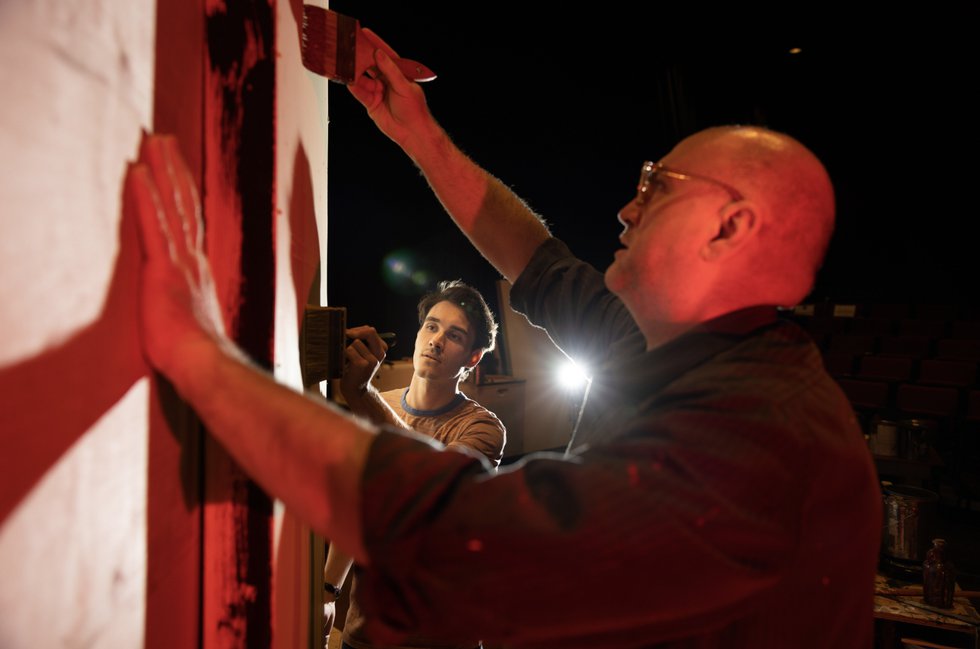
The latest New Jewish Theatre production, Red, is an intimate two-person performance directed by Alan Knoll. The play—inspired by true events from the life of abstract expressionist painter Mark Rothko—tells a profound story of art’s ability to spark critical thinking and transcend human emotion.
Red introduces the audience to Mark Rothko at likely the most defining moments of his life—the few years he spends working on a series of murals commissioned by the prestigious Four Seasons hotel in New York, which were to be displayed in its restaurant.
Stay up-to-date with the local arts scene
Subscribe to the weekly St. Louis Arts+Culture newsletter to discover must-attend art exhibits, performances, festivals, and more.
At the time, the Seagram Murals were the largest commissioned works in modern art history. Following the creation of his famous works and the decision to cancel the contract—never hanging them on the walls of the restaurant—a story of the depths of artistic creation, meaning, and integrity is revealed.
Rothko, portrayed by Christopher Harris, is accompanied by his fictitious assistant, Ken, played by Dustin Petrillo. Ken, a young, stubborn dreamer, is the major catalyst in challenging Rothko’s artistic beliefs and forcing him to the conclusion that his art won’t be appreciated at the Four Seasons in the way he wishes. The two characters possess a kind of father-son relationship.
“Even though Rothko and Ken butt heads, yell, and throw things, I think it’s, deep down, because Rothko cares about him,” Harris says. He’s even experienced a similar teaching dynamic with a former mentor. Petrillo’s life also mimics his character’s—his father was a long-time art teacher, and he remembers learning about art history and techniques at a young age, a parallel to Ken’s apprenticeship and fascination with learning.
The constant push and pull that comes as a result of Rothko’s mentorship of Ken, the challenges the young protégé poses, and their discoveries of deeper meanings in art carry the narrative of the play. Rothko made his art to be all-consuming, to push the viewer to feel and think instead of just see.
“He wanted a lot of engagement and contemplation between the art and the viewer,” Harris says.
Throughout the play, he pushes Ken’s perspective of art-making. Red also brings to light the natural transference of learning. Petrillo believes knowledge can cross generations, and finds that this is the place from which Ken’s frustration with Rothko stems. Even an old master of high-brow thought can be subjected to new lessons by a young student.
“You can be taught at any age from any age. I think this show is a good way to show that we’re just people at the end of the day, and we can communicate and learn from each other,” Petrillo says.
Bask in this dark, introspective story examining art and humanity from July 25 to August 11 at the New Jewish Theatre’s Wood Studio Theatre. Performances run on Thursdays at 7:30 p.m., Saturdays at 4 and 8 p.m., and Sundays at 2 p.m. Tickets can be purchased online or over the phone.
For more information, visit www.jccstl.com.