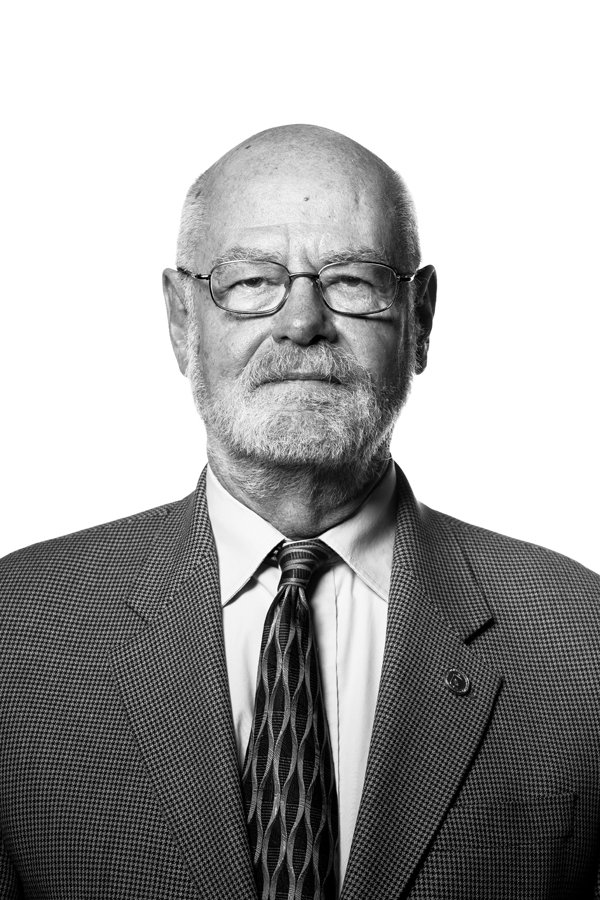
The CIA has existed for 70 years, and Richard Schroeder worked there for more than half that time. When he passed the portraits in Langley’s Directors Gallery, it began to bother him that people had forgotten about Rear Admiral Sidney W. Souers, the quiet St. Louis insurance executive who became the first director of central intelligence, and one of his successors Rear Admiral Roscoe H. Hillenkoetter, who hailed from North St. Louis. Schroeder had heard of St. Louis lawyer Clark Clifford, President Harry Truman’s White House counsel. It was he who slipped the paragraphs creating the Central Intelligence Agency into a Defense Department bill. And then there was the CIA’s first general counsel, Lawrence Houston, who served for three decades, son of a Washington University chancellor. Truman’s early detractors referred to “the Missouri gang” to imply cronyism, but Schroeder borrowed the phrase to write The Foundation of the CIA: Harry Truman, the Missouri Gang, and the Origins of the Cold War. Its foreword was written by yet another native St. Louisan: former CIA Director William Webster.
Before the CIA, did we do much spying? The U.S. was kind of unusual, in the sense that when we weren’t involved in wars and didn’t feel a threat, we really didn’t pay any attention to intelligence. Then, after World War II, Truman dissolved the Office of Strategic Services, saying he wanted no peacetime espionage. He soon realized that as the leader of the free world, we needed spies and analysts as much as ever. He asked for a central organization that would assemble all the intel and give him a morning “newspaper.”
Stay up-to-date with the local arts scene
Subscribe to the weekly St. Louis Arts+Culture newsletter to discover must-attend art exhibits, performances, festivals, and more.
What can you say about your work? At first I thought I wanted to be an analyst—I’m a trained historian—but I didn’t enjoy it as much as I enjoyed the human part, the clandestine operations. I was a clandestine service officer, recruiting foreigners with access to secret information and protecting them, because what they’re doing is treason. Let’s just say I worked in Western Europe. It’s tough to write a résumé after you work for the CIA.
You must have learned all sorts of secrets? You get the secret information, type it up and send it back to Washington. First there were paper documents in diplomatic pouches, then telegrams, and now digital, but they still call the reports cables, and the State Department calls them telegrams. As the recruiter, you see only one tiny piece of the information; the analysts collate it all. This discipline of intelligence analysis is the heart of what the CIA does. It’s a very very difficult business and one where you are more likely to fail than to succeed, because it’s just so darned hard.
What did you learn about human nature? If people in other countries are willing to cooperate with you, they’re doing it for reasons of their own—and their self-interest is not necessarily yours.
Even within our own agencies, there are competing interests. Sometimes your worst enemies are on your own side. The Secret Service and the FBI feuded over who was responsible for capturing German spies in World War I. Truman said that the way the Army and Navy were fighting, you’d think one was the Japanese or the Nazis.
After 9/11, we couldn’t afford to be territorial anymore. I don’t think we ever could. It’s why we created a director of central intelligence in the first place. In ’05, they said, “It’s just too big a job, so we will create a director of national intelligence over all these agencies.” But then the secretary of defense said he’d still be in charge of the National Security Agency, which does the codes, and the National Geospatial Intelligence Agency, which does the satellites, and all the military intelligence…. Eighty-five percent of the people who supposedly worked for the CIA director worked for the secretary of defense, and now the director of national intelligence has the same problem.
What should keep the lines from blurring? Traditionally, there’s been an iron law in American intelligence that you only deal with foreign issues; you don’t have any domestic responsibility, and you don’t have any police powers. You don’t use your intelligence superpowers against your own people.
What would Souers and Hillenkoetter think of today’s CIA? They’d be astonished at its capabilities. Nobody thought the U.S. would be as dominant a superpower as it became. I don’t think they could have imagined the degree of covert action. In a lot of ways, we’ve gone back to our OSS roots, being almost a wartime organization: propaganda, funding foreign political parties or resistance forces, paramilitary activities…
What did you want your book to do? Just explain how intelligence works! But I wound up talking about how the U.S. established a world-class professional intelligence organization, became the leader of the free world, and then used the CIA to win the Cold War.
Some might argue it’s still unwon. When the [Berlin] Wall collapsed, everybody thought the Cold War was over; the Russians would be our friends. Now it looks like the Russian empire never went away: Putin is a former KGB intelligence officer, and they’re using the same methods.
Did your work ever cross over into politics? I used to go with analysts to talk with congressional representatives, and they would say, “Well, what do you think we should do?”—and we would never say. It’s not our job to make policy. The nice thing about the CIA was always its independence. The Secretary of State has his own interests; he’s going to give advice defined at least in part by what his responsibility is. The CIA answers only to the president. The worst thing you can say to a CIA analyst is, “You’re being political. You’re politicizing your analysis.”
I loved the story in your book about Rear Admiral Roscoe H. Hillenkoetter making a stand here in St. Louis. In 1946, he was captain of the USS Missouri, the most famous ship in the world. It’s where the Japanese surrendered. The state of Missouri was going to present a solid silver state seal, and Hillenkoetter brought his sailors to St. Louis for the ceremony. One sailor was black, and the Chase Hotel denied him a room. Hilly pushed back hard. He was way ahead of his time in a lot of social justice issues, which is interesting when you think that he was just this little blue-collar kid from south St. Louis whose dad was a mailman. It would have been very easy in 1946 to have just said to the guy, “Hey, just stay in your hotel room and have lunch.”
I also like his answer when someone congratulated him on his new position as intelligence director. He replied, “It would have been more exact if you had sent condolences. However, we shall try to make the thing work.”