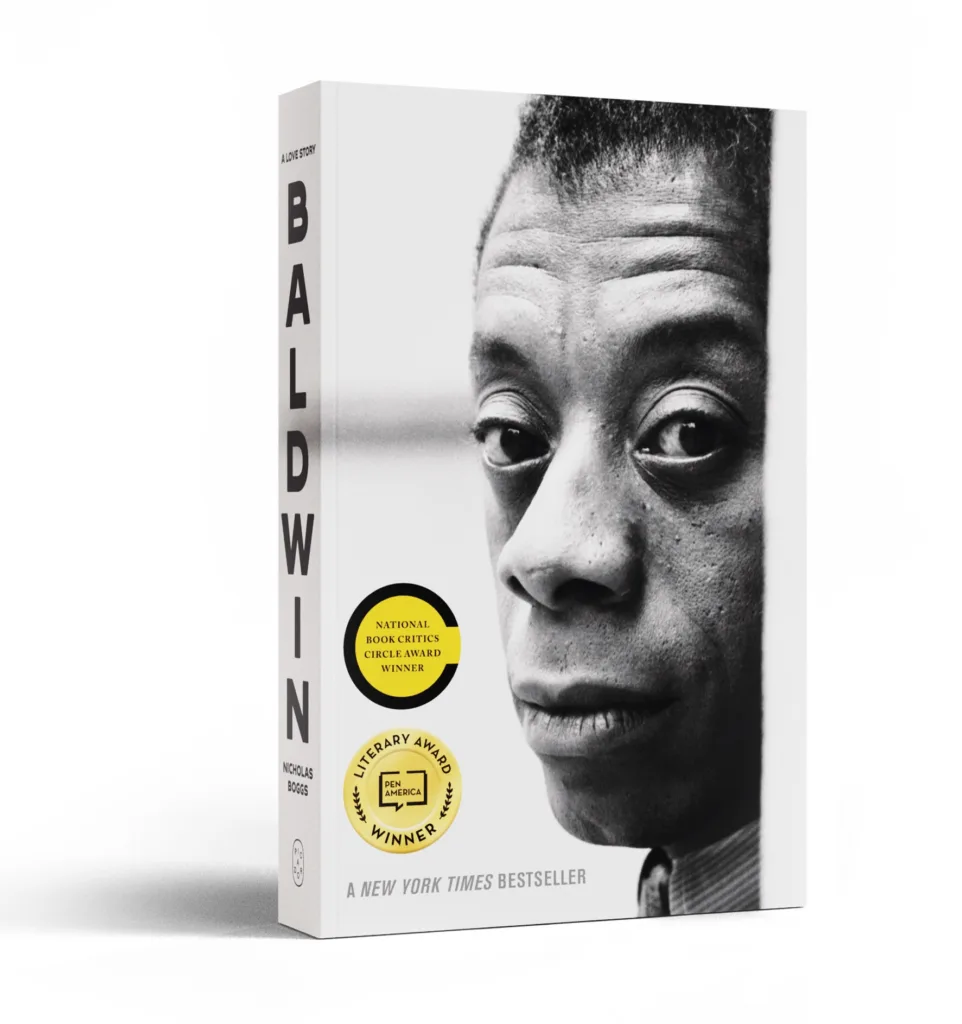
Justin A. Joyce already knew James Baldwin’s story, and in nearly every particular could describe the titan of American letters. But that didn’t prepare him for the end of Nicholas Boggs’s Baldwin: A Love Story—the first major biography of Baldwin in more than three decades which, across more than 600 pages, explores how love, friendship, and artistic collaboration shaped the late writer’s life and work.
Reading the book, says Joyce, a founding co-editor of James Baldwin Review who helped arrange Boggs’s November 13 James Baldwin Lecture at WashU, he found himself dabbing away tears, surprised that a life so familiar to him could still move him that way. “This is going to sound overly sentimental in a way that Baldwin might not like, but I was weepy at the end. And that’s a credit to Boggs’ skill as a biographer.”
Stay up-to-date with the local arts scene
Subscribe to the weekly St. Louis Arts+Culture newsletter to discover must-attend art exhibits, performances, festivals, and more.
For Boggs, whose New York Times bestselling book was shortlisted for this year’s Baillie Gifford Prize and whose audiobook, narrated by Ron Butler, won the Audie Award for History/Biography, telling the story of a life through Baldwin’s four major relationships meant leaving room for readers to make sense of him for themselves. “I really wanted readers to experience the book as a narrative, as a love story,” he says. “And I wanted them to draw their own conclusions.”
Ahead of his WashU lecture, Boggs discussed the long search behind his biography, the possibilities of love in Baldwin’s fiction, and the connections between intimacy and artistic work.
You first encountered Baldwin in eighth grade. What do you remember about that introduction, and how do you think about it now, more than a year after your biography appeared?
I very vividly remember being in eighth grade. Mrs. Miles was this beautiful, brilliant teacher, an African-American woman, and everybody loved her and still does. She had drawings of famous Black people on the wall, and one of them was James Baldwin. I remember seeing this drawing of him and his eyes and just being so taken with him.
I hadn’t seen Mrs. Miles in decades, and then the book came out. We got back in touch, and she’s the one who told me that I came into my public school in a suit and gave a presentation on his whole life. I don’t remember owning a suit. I have absolutely no recollection of this, so I could not tell you what that was like. But I do know that Mrs. Miles is always right, so I am sure that it did happen.I guess that means I spent more than 40 years researching and writing the book, if you go all the way back to eighth grade. Sometimes, to be honest, it really does feel like it was 40 years. I guess I was maybe 13 then, and by the time I was 20, I was in college reading Baldwin. I’d already stolen my twin sister’s copy of Giovanni’s Room when I was maybe 15 or 16.
That’s why I sometimes laugh. When the book came out, some people said, “Baldwin is so hot right now. It’s so smart of you to choose him as your subject.” I’m like, well, actually, he’s been with me for a long time. And for much of that time, Baldwin’s reputation was in decline.
How did that early interest become the research that led to this book—and connect you with Dwight McBride, who’s now at WashU?
At Yale, I took this class on Baldwin, and we read everything by him. Except there was this children’s book that cropped up in David Leeming’s excellent biography, which had just come out. I went to the library and saw the book, and it was so strange and interesting.
I emailed David Leeming to see if he had any more information about [the illustrator] Yoran Cazac. He said he’d never met him, didn’t know anybody still alive who knew him, and thought he was dead. Then I moved to New York, getting my PhD, and decided to email art historians in Paris, leaving my number. Out of the blue, Cazac called me on the phone and said, “I’m alive. Come to Paris. I have many stories to tell you about Jimmy.” That was a moment that really sent me off toward trying to get Little Man, Little Man republished.
I wrote a senior thesis on Little Man, Little Man that ended up getting published in Dwight’s anthology, James Baldwin Now. So I met him right after I graduated from college. James Baldwin Now was such an important anthology because this was 1999, and Baldwin’s reputation still was sort of in decline. This was a huge moment for what became Black queer studies, kind of reclaiming Baldwin. People like Isaac Julien kept him alive in certain avant-garde circles, but I would say that Dwight’s anthology was hugely responsible, I think, for the resurgence of interest in Baldwin in the university. Then, of course, with the rise of Black Lives Matter, he became more visible, too, in important ways.
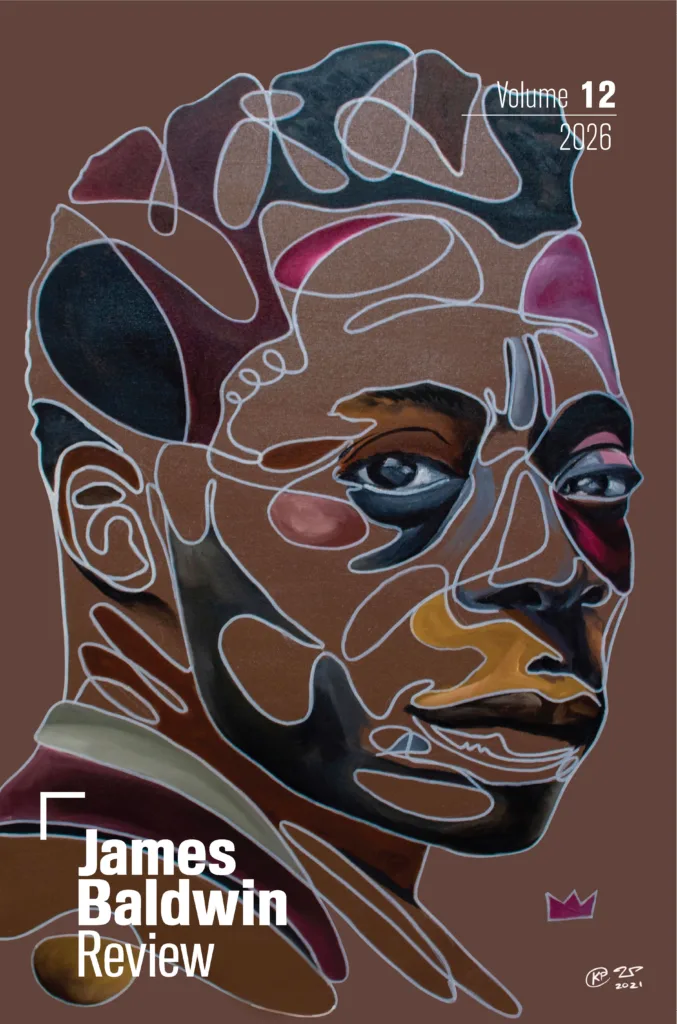
At WashU, I’ve encountered Baldwin in discussions of resistance, from the aftermath of Michael Brown’s killing in 2014 to the pro-Palestinian protests in 2024. Reading the latest James Baldwin Review, I’ve also been thinking about whether “Baldwinism” has lost momentum.
I do think James Baldwin Review is so important. It’s wonderful that it gives an opportunity for seasoned Baldwin scholars like Bill Maxwell and Magdalena Zaborowska and also a whole younger generation. They feature graduate student work, young scholars, postdocs. It’s unusual that way. It’s really special what they’re doing there.
To think about Baldwin’s impact, we’d have to think about the globe. While his popularity or impact might recede for a moment in one place, it surges somewhere else. If there’s, say, an exhibition in Istanbul, when Glenn Ligon goes over there and does something related to Baldwin—he’s such a global phenomenon now that it would take a really complicated graph or calculus to apprehend where and when he’s surging and how these crossings impact each other. I don’t think we’re on the downswing right now. I think Baldwin is going to be with us for a long, long time. Not just because he’s a first-rate artist, but because the issues he was writing about are not going to be solved overnight. We’re going to need him for the next good while.
How did your thinking about Baldwin’s reception, particularly the treatment of his later work, shape your approach to the biography?
It was important to me that my biography come out after the centennial. I thought it was important for the Baldwin family, and for Baldwin himself, to have that huge milestone independent of a major biography coming in and proclaiming this or that.
The question of periodization, when I was working on my biography, was something I was thinking about and also trying not to think about. It really wasn’t until the epilogue that I started to make my own critical opinions more forcefully. As many scholars have also argued—it’s hardly unique to me—the way Baldwin was treated and misapprehended later in his career is so egregious and so systemic that I felt it was necessary in the epilogue to join the chorus of folks who have been reassessing his work. A huge part of my life was spent bringing Little Man, Little Man back into print because I thought the later work needed to be available and reassessed.
Love, of course, is the animating force of your book. What did Baldwin’s fiction help you understand about the kind of love he was asking his readers to embody?
I’m one of those people who was drawn first to Baldwin’s fiction as a young person and then very quickly became incredibly enamored of his nonfiction. Giovanni’s Room was the first novel I read. That novel and Another Country are both about the difficulties and the failure to love. For David, it’s the failure to be able to love himself and therefore love another person. In Another Country, these characters become allegories for the ability of white Americans and Black Americans to see and love each other.
Then he does something remarkable later in his career, starting with Tell Me How Long the Trains Be Gone, with Black Christopher. Somehow, that’s when he was able to realize love fully in his fiction. Think of If Beale Street Could Talk: the love between Tish and Fonny and the hope represented by their child. For me, what was so fascinating, reading the life and the work—not as coextensive, but in relation to each other—was that I was uncovering this hidden love story. If Beale Street Could Talk was dedicated to Yoran Cazac, who he was in love with at the time. It’s a heterosexual Black love story set in Harlem, but it’s modeled emotionally so clearly on an interracial queer relationship in Europe. That is a reminder of how Baldwin was so capacious in his willingness to draw from different aspects of his life and experiences but transmute them into fiction. It’s not a question of “this character equals this character,” but the emotions of it, what he was able to bring from his own life.
Then, in Just Above My Head, he was able to represent Black love and desire, queer desire, in a way that he himself said he wasn’t capable of doing when he was working on Giovanni’s Room. So I think we see him almost realizing in his fiction what he was asking to happen in his nonfiction.
Your book has been optioned by Anonymous Content and Higher Ground, the production company founded by Barack and Michelle Obama. You’re writing the screenplay with your partner, Marlon James. How, if at all, has working with Marlon changed your understanding of the relationship between creative work and intimacy in Baldwin’s life?
I’m not sure about the screenplay, as we are just getting going on that, but I can say that working on our books at the same time—Baldwin: A Love Story and The Disappearers—has been quite an interesting and beautiful journey. As differently as we write, stylistically and process-wise—I need total quiet; he needs music—it was so wonderful to be with a partner who understands the hard work, and joy, that goes into a long-term writing project. And I was delighted that he took up my suggestion to skip ahead in reading my book to the part about Baldwin directing Fortune and Men’s Eyes in Istanbul, to use as the centerpiece play in his own brilliant novel. I know that collaboration and love were so central to Baldwin’s life, and I am grateful to be living my version of this kind of great good fortune.
To hear Boggs’s lecture, visit Emerson Auditorium at WashU on November 13 at 4 p.m., where the author will also be joined in conversation with Justin A. Joyce.