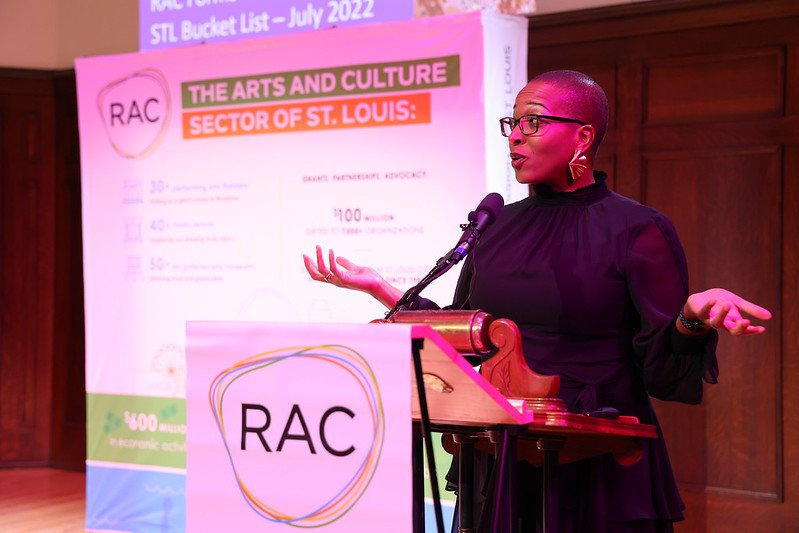
The Regional Arts Commission (RAC) recently hosted its first in-person event since March 2020 to mark the launch of a major upcoming study. The project, presented in partnership with the national nonprofit Americans for the Arts, is titled Arts and Economic Prosperity Study 6 (AEP6). AEP studies are conducted nationwide approximately every five years and report on the economic impact of arts and culture organizations. Region-specific data is slated for release in September 2023 and will help the St. Louis community—including its policymakers—understand how the arts contribute to the city’s fiscal well-being. The full presentation is available online, but here are five quick takeaways from the AEPG launch:
Past studies have demonstrated the economic importance of the arts.
Stay up-to-date with the local arts scene
Subscribe to the weekly St. Louis Arts+Culture newsletter to discover must-attend art exhibits, performances, festivals, and more.
AEP5, the last study of this kind to be conducted, collected data for the year 2015. It revealed that arts and culture nonprofit organizations in St. Louis created 19,129 full-time equivalent jobs, produced $476 million in household income, and resulted in a $57.6 million revenue for the local and state governments that year. Further, more than 86 percent of tourists interviewed for the study reported that their reason for visiting St. Louis was to attend an arts and culture event.
The results of AEP6 will arrive alongside new developments for the RAC.
RAC President and CEO Vanessa Cooksey announced that, when the data for AEP6 is released in 2023, RAC will also be launching a new research and evaluation department. “RAC will be the go-to data hub for all stakeholders who are interested in our arts and culture ecosystem and creative economy,” Cooksey said.
AEP6 surveys are already underway in St. Louis.
RAC began collecting surveys in May, and so far their data represents 14 different zip codes and 48 nonprofit organizations. Study lead MK Stallings recommends that eligible organizations update their contact and financial information in preparation for receiving the survey.
The number of eligible organizations in the St. Louis area has risen by nearly 400 percent since the last study was conducted.
According to initial AEP6 surveys, there are 734 organizations eligible for the study in the St. Louis Metro Area compared to 285 organizations identified in AEP5. Stallings said the change could reflect an improvement in data collection methods as well as an increase in activity within the arts community.
AEP6 will work to reach more communities of color
According to Randy Cohen, vice president of research at Americans for the Arts, past studies have underrepresented BIPOC communities in their scope and data collection methods. A major goal of AEP6, he said, will be to make the survey system more “comprehensive” and “inclusive.”
For more information on the AEP6, visit racstl.org.