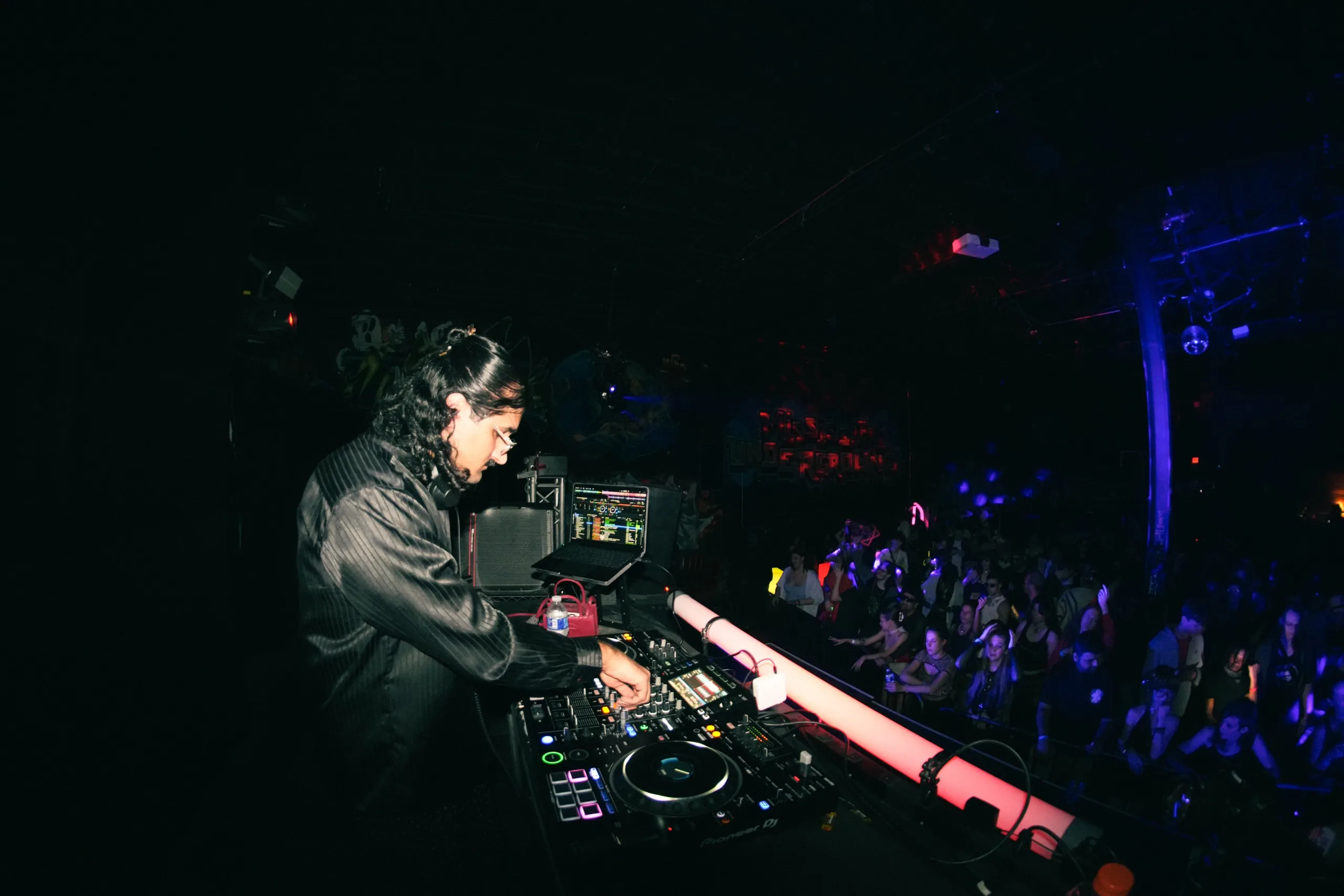
From organizing community events such as Music From a Tent to co-headlining the groundbreaking Materia series every month, St. Louis-native Pajmon Porshahidy has built an unmistakable aura around his brand and moniker Umami. Now the supernova DJ is reminding the world that he’s also a producer with a six-track EP named Pajmon, a callback to the electronic music artist’s Iranian-American roots.
“A lot of people don’t know my real name. They’ve seen me on flyers and know me as Umami. The new EP is a cool way to say, ‘Yeah, but I’m also Pajmon.’ That background comes with a lot of history and culture,” Porshahidy says.
Get a guide to the region’s booming music scene
Subscribe to the St. Louis Music newsletter to discover upcoming concerts, local artists to watch, and more across an eclectic playlist of genres.
While the new release isn’t necessarily rooted in Iranian music, the first single “Djadou” offers a rich range of textures that are influenced by Porshahidy’s identity and his experience as the son of working-class immigrants in America. Online teasers for the track fittingly feature clips from old home movies that he digitally converted as a gift to his family.
“Discovering music was something I was always interested in, even when I was younger and listening to hardcore bands. I’m so thankful that I grew up listening to traditional Persian music and my parents showed me a bunch of stuff. When I play ‘Djadou’ live, the song feels special and I feel really connected to myself,” Porshahidy says.
While he spent four months in Iran as a teenager, Porshahidy is disappointed about the policies that make it difficult for him to return as an adult.
“It’s weird to be tied to a place with so much family and so much inspiration that I can’t even access as a person. Rediscovering my identity through the music without being able to be in Iran has been really cool,” he says.
Although Porshahidy played saxophone in school bands from sixth grade to graduation, he did not consider music as a viable career. Still, being able to jam on sax was handy when Porshahidy moved to Columbia, Missouri, to attend college and lived in a house full of musicians, including friends he had known since elementary school.
“The house was called the Lisa Mona. Music was always happening around me. I was going to Mizzou for psychology and biology and working full-time. Then I was sitting in on sessions and playing sax with friends’ bands,” he says. This period was so influential to Porshahidy that he even has a tattoo of the address modeled after the actual numbers on the building.
“I wanted to make beats for my friends to rap over. That was how it all started,” he says. So Porshahidy paid $200 to fix a broken laptop he received for free and started learning his way around an old version of Ableton Live, a proper digital audio workstation.
“At the time I thought that if I learn how to DJ, I can play my own music out and maybe I can also make some money,” he says. Porshahidy counts Columbia-native DJ Seoul Train as an early mentor who offered advice as well as opportunities to ply his craft in a live setting.
While dropping out of school might look like a setback on paper, Porshahidy’s time at Mizzou was spent playing music, learning production, and starting his journey as a DJ. With three years of classes in the rearview mirror and a new direction forward, he moved back home to St. Louis to study audio engineering at Webster University.
“At first it was hard for me to get gigs in St. Louis to be honest. My weekends back then were driving to Columbia to make money and then coming back for classes,” he says. Ironically, the connections Porshahidy made at Mizzou carried his DJ career at a time when he faced challenges integrating into the river city’s larger music community.
Released in 2018, Umami’s debut EP, No Signal, was a seven-song summation of the young producer’s progression as an engineer and songwriter. From two featured tracks with rapper DaVon Sparkling to an aesthetic blend of hip-hop and house music, this first release offers a glimpse of Porshahidy’s early approach to sound design.
“There were times when I said to myself, what are you doing? My parents worked their butts off to give me a good life here. I had to go and work on this craft or I felt like I wasn’t doing anything in life. If you don’t work on your music every day, no one is going to make you do it,” he says.
Between playing myriad DJ gigs and working with like-minded artists such as Frankie Fingertips, Porshahidy carved out a niche for himself in St. Louis. Umami’s second album, Subtle Kiss, was released in early 2020 alongside a massive party that featured many of his friends and closest collaborators. By transforming his house into a three-story rave, Porshahidy hearkened back to his days in Columbia at the Lisa Mona for one last blowout just weeks before the World Health Organization declared COVID-19 a pandemic.
“Honestly, I got really lucky. I was in a house with five of my best friends and we had nothing to do but make music and hang out. I was doing Twitch streams in the meantime, which was fun,” he says. While he describes this time period as relatively chill on the music front, he started to take on DJ gigs again in spring 2021.
After a chance meeting at HandleBar, Umami was invited to play a house party with drum & bass producer Manapool and Nadyr, who Porshahidy affectionately refers to as “your favorite DJ’s favorite DJ.”
In November 2021, the trio teamed up with rapper Eric Donte and local creative force Sweeet to form Materia, a collective of DJs, producers, and visual artists who deliver aesthetically distinct events that can be compared to raves or dance parties. Porshahidy counts Materia shows as his creative home base.
“I play a bunch of sets throughout the month, but when you go to an Umami set at Materia, that is who I am as an artist at my purest,” he says.
While Porshahidy hasn’t released a solo EP since 2020, he dropped several singles in the past few years including “Orbit” (2023) and “Both of Us” (2024). The prolific producer’s Bandcamp also offers a treasure trove of remixes, including a standout take on Missy Elliott’s “Work It.”
“That’s where my problem lies—knowing when to stop working and appreciate that you can put stuff out in the world. I want things to sound perfect. A lot of my homies pushed me to put my music out there,” he says. With reassurance from his peers, Porshahidy moved beyond singles and remixes to put out his new EP.
Although most of the music for Pajmon was finished by August 2024, Umami spent much of last year doing one-off gigs and residencies around St. Louis along with shows in cities around the country such as San Francisco, Chicago, and Philadelphia. He called on trusted friend and L.A.–based audio engineer Michael Miller to wrap up the new release with a marathon work session.
“[Miller] came into town and sat in my room for like five days and we went through every song,” he says. While most Umami releases feature some kind of collaboration, Pajmon includes two tracks with local vocalist Rachel Bouzier, whose contributions add a distinct flow to the sound.
“If I can listen to something hundreds and hundreds of times and still like it, I’m happy. A big thing with this project is that I needed to put something out that represents who I am now,” he says. With cover art by Porshahidy’s partner Rebekah Shields, Umami’s new release is a deeply personal effort inspired by his Iranian-American upbringing and an adventurous approach to songwriting.
“This is my progression as a person. I’m comfortable with what I’m making because what I’m making sounds authentically me,” Porshahidy says.
Umami will release Pajmon on June 10, just days ahead of his debut performance at Bonnaroo. On Saturday, June 14, Umami will play at Where In The Woods in Outeroo, located at the campgrounds at Bonnaroo. This is a watershed moment for Porshahidy, who started going to the festival back in 2015 and hasn’t missed a year since.
“I dreamed of playing Bonnaroo, now I’m doing it next week. I want St. Louis electronic music to be on the forefront. I’m excited to contribute to that part of our city’s culture.”