Instead of songs, the members of Huht refer to their tracks as “starting points.” But these aren’t jams that unfold into infinity, without a purpose or an end. The three members of Huht—Todd Dillon, Ian Quattrocchi and “Q”—have “extensive notes” on each composition, which have, to this point, only been played out live three times; a fourth gig’s cued up for early February at The Sinkhole. Unrecorded to date, their heavily rehearsed, lightly heard songs are open to spontaneous runs, yet are fully formed, hypnotic and trance-like; they’re numbers that too few have yet experienced, though Huht hopes to change that situation soon.
A band for only half a year, the group’s history is a unique one, in that Dillon and Quattrocchi had/have been playing in an on-hiatus collective called Broom, adding drummer Q (of local the local King Crimson tribute Thrak) after a single session in Quattrocchi’s basement. It was only one session, yes, yet it was exactly the one session that cinched the deal, a moment of appreciation that lead this trio to know they were, in fact, a band.
Get a guide to the region’s booming music scene
Subscribe to the St. Louis Music newsletter to discover upcoming concerts, local artists to watch, and more across an eclectic playlist of genres.
The “Easter egg,” in this case, is as unique as the band’s own sound: Q is Quattrocchi’s father; never prior had they performed in a regular act together. So, yeah, there’s history within this triangle of players.
“I told these guys after a few weeks that there are very few times in working with new musicians, new bands, that it’s working comfortably and that you know it could go somewhere,” Q says. “Honestly, I didn’t think it would with this group. But it did.”
He adds that “it was mid-July of last year, and Thrak doesn’t keep me quite busy enough. Ian’s got drums in the basement and after our first improv together, I saw these two looking at each other, smiling. We knew this was a whole new thing, that we’d caught lightning in a bottle.”
Each member brings a unique insight to not only their instrumentation, but in attempting a definition of what they’re after.
For Q, “it’s like I was saying a while ago, that this is so opposite of what I do with Thrak that it’s got my attention. It’s the opposite of prog-rock, with all those odd time signatures. It’s a whole, new energy flowing within me. I enjoy both. I like both elements.”
“We’re going off of a feeling,” Dillon says. “Each track has someone’s start, then we let it ride and see where it goes. (Myself and Ian) are able to do that as untrained musicians, while he’s the most bad-ass drummer of all-time. We can go into weird places, held down by our drummer, who’s also crushing it in new ways.
“We’ve all got a bag of tricks,” he adds. “We know each others’ powers. If he [nodding to Q] is doing his thing this way, we go that way. We can follow and expand on that point. We find a way and push it.”
It’s a concept that Quattrocchi adds comes in “pressures,” subtle hints that Q lays down throughout the band’s two, nightly sets of 35-to-40 minutes apiece.
Quattrocchi, who also appears in the standout mindbenders of TheOnlyEnsemble, notes that “I’m playing all this percussion over there. My role in that band isn’t a small one; I don’t want to suggest that, at all, but I’m adding color as opposed to painting the picture. There, I’m adding details to something that’s already a painting; I’m just adding the colors. Whereas here, it’s more of a hands-on, creative process. It’s a nice kind of pressure. It’s nice to be in different groups, it just makes you excited compared to playing with one project. It’s less-redundant when you have different projects going on. It’s nice, as with anything else creative, to have different things going, to mix it up a little bit.
“Definitely, for all of us, we’re not nervous,” he says. “We all feel very confident that we’re doing something original. I’m not hearing music that we’re doing, even regionally.”
The very basis of Huht lies establishing a sound that’s unique, with no one in St. Louis approximating what the percussion-heavy outfit’s up to in their first year of creation. Dillon, in writing the group’s bio suggests that Huht’s out “to create free-form, and improvisational-leaning music. Huht’s sound focuses on a hypnotic simplicity that blends heavy percussion with a deeply moody atmosphere. The result is dark and rhythmic excursions with no self-imposed limits. The band flirts with Krautrock, Prog Rock, Noise and Jazz, and is always willing to challenge listeners in unexpected ways.”
Q suggests that the band’s material has been “eerily, almost too easy [to create]. Just about the time we’ll move through our songs, what we’re working on this week, we’ll have three or four new ideas. It’s just been a comfortable mix.”
Dillon adds that “whatever we do’s about the live experience” and as such, audiences “have to be there to feel what we’re doing.”
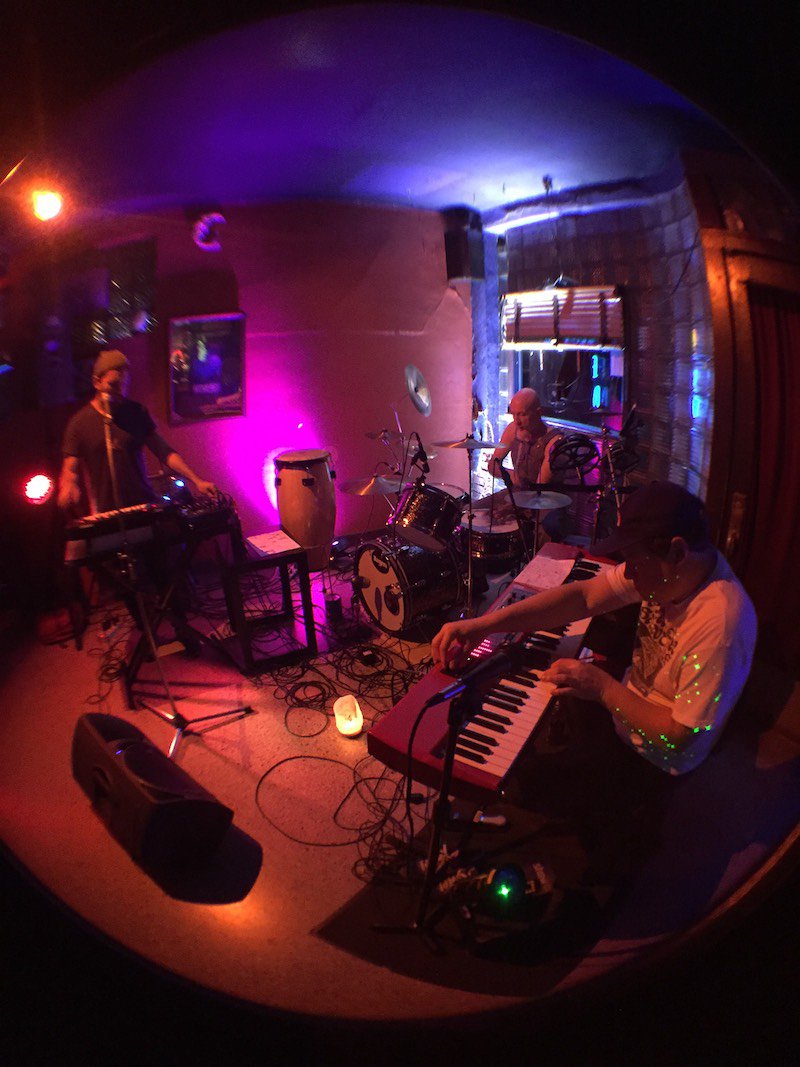
The band’s not opposed to adding a fourth member for recording, if that’s to occur; Quattrocchi, for example, has talked to members of his own TheOnlyEnsemble about exactly that. But if a recording’s to come, it’d likely be a short blast of sound, a three- or four-track EP that highlights the band as raw as possible. As such, it’d feature on Q on a Vintage Rogers drum kit, with only four pieces and a scaled-back cymbal arrangement, rather than his headier, more-expansive Thrak setup; Dillon on a Nord Electro 2 and Ditto loop pedal; and Quattrocchi on natural- and processed-vocals, as well as a Senegalese split (or “tongue”) drum, as well as a Roland JD-Xi keyboard.
The lineup’s one that, Q, active in bands since the 1970s, says is unique, even to him, with no guitars, lots of synth-and-percussion and will to explore the outer ranges of sound.
He says that “with my tribute act, we try to be note-for-note, at least 90 percent of the time. So this is bizarre for me. There’re no guitars! It’s really two, totally different ends of the spectrum.”
Or as his son says, “we’re not a Huht tribute, so the original members aren’t reminding us of our mistakes.”
To date, the band’s got a very light digital footprint. In time, maybe even after the next gig, there’ll be no turning back: they’ll exist online. At this point, Dillon looks as the group’s first video, a full set recorded at CoMo’s Cafe Berlin, as a prehistoric document, of sorts, emblematic of a place that the group’s visited, but has moved on from. The others feel it’s less of an encumbrance, this short history and more of, yes, a starting point. But on one point, everyone agrees: the band that Huht is today is not the band they’ll be in a year.
Dillon says that “moving forward, we want to be a little picky with our shows, to play a lot, but not too much. We want to play at just the right venue, on the right night; we’ll try to put the effort into playing with the right bands or the right DJ, ones that’ll help us dictate the bill and what fits for us.” And as he says this, Q adds that “we’re selfish and always want to play two sets.”
In a couple of weeks, the three members of Huht—connected by either blood or the love of a very particular music created by three St. Louisans in 2018—will be back on a stage, “off the grid” in Carondelet. It’s recommended here that you do see them, early and often, and go to their gigs while listening to mixes of Can and Pylon and Aphrodite’s Child and Future Sound of London and whatever, other, smoked-out, soaked-up jam you play when your mind and body wanna travel.
As the band-who-finishes-each-others’-statements say:
Q: My goal this year is that I’d like to build up enough of a following to play bigger stages, more stages.
Quattrocchi: ‘Cause we believe in what we’re doing.
Dillon: And we’re trying to build it organically.
This is the band that St. Louis needed, Huht. A band that matters, and is ready to prove as much.
Huht plays with DJ MAKossa at the Sinkhole on Saturday, February 3.