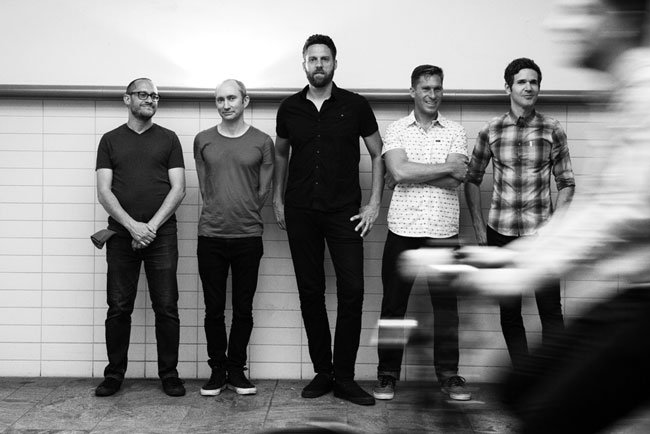
Few bands consistently retain all their original members. Even fewer do so for 16 years.
But the makeup of the five-member electronic jazz ensemble known as Kneebody (pronounced “knee,” not “n-e”) has been the same since their professional debut in 2001. As a result, the group has thrived. In 2009, they earned a Grammy nomination, and in 2007, saxophonist Joshua Redman called their album Low Electrical Worker his top pick of the year.
Get a guide to the region’s booming music scene
Subscribe to the St. Louis Music newsletter to discover upcoming concerts, local artists to watch, and more across an eclectic playlist of genres.
“We wouldn’t have planned it this way—if we could have been playing 200 shows a year 10 years ago we probably would have taken that opportunity,” says keyboardist Adam Benjamin. “But in retrospect, kind of having the slow burn marathon instead of the sprint has been really healthy for the creative growth of the band. Even for the business growth of the band it’s been good.”
As Benjamin, along with drummer Ben Wendel electric bassist Kaveh Rastegar, saxophonist Ben Wendel, and trumpeter Shane Endsley prepare to arrive at Jazz at the Bistro for a four-evening, eight-show engagement starting March 29, he discusses creative balance, creating their own subgenre of jazz music, and the comfort that comes in setting up shop on stage for more than one night.
In addition to being a full time-musician, you are also the director of Jazz Studies at the University of Nevada-Reno. How do you balance the competition of one discipline with the other?
I’m very fortunate because [my program] is very supportive of having professors that are active performers. We’re about to go on tour for a few weeks and I’ll miss a significant chunk of the spring semester, but the university is really conscientious about the value of having professors that are active performers and that are bringing that experience and that energy into the classroom.
When did you realize that there was no turning back in pursuing music as a career?
I think the moment for me was when I first got to college. I went to the Eastman School of Music. I was really involved in music as a young person, but I didn’t really know anything about what was happening in the jazz world in the current time. I knew something about jazz history and older jazz artists, but I didn’t know about the loft scene in New York City in the 80s and 90s, and just how diverse and interesting the whole scene of music [was]—John Zorn and Steve Coleman and Anthony Braxton and Kenny Kirkland and all these people. I started at Eastman at age 18 with two of the other guys that are in Kneebody with me—Shane Ensley, the trumpet player and Ben Wendel, the saxophone player. Our teachers, and just the energy at the school at that moment, I think that we all knew that we were in it for the long haul and it turned out that project that we’ve sustained now—20 years later amazingly—is with those same folks that were there at that moment.
How did the band arrive on the name “Kneebody”?
It was a nonsense word that a friend of ours came up with. We decided that we wanted a band name that didn’t give you any preconceived notion of what the music would sound like. We didn’t want it to be the Shane Ensley Quintet and sound like it was going to be jazz, and we didn’t want something that sounded like it was going to be a rock band or any particular kind of group. We just wanted something that had no connotations at all.
Your sound is not that of a traditional jazz band—it’s a blend of electronic, rock, soul, and more. How did you arrive in creating that fusion, and how has that shaped your impression in the modern jazz world?
For us, it was very natural. As kids growing up in the 70s and 80s and listening to a lot of rock music and punk music and reggae and fusion, it was really natural for us to blend all those influences. It wasn’t until later that we realized some musicians or some schools thought of that as sacrilegious—to take jazz and really go so far in another direction with it. It just made sense for us. We’re so distant in a lot of ways from the people who grew up and created more traditional jazz and more historical jazz, so we had to do it our own way, and there wasn’t really a way to describe it. So we just kept doing it and in a way now Kneebody is the term that people use for other bands. If they sound a little bit similar they’re like ‘Yeah, it’s kind of a Kneebody-type sound.’ There’s no good name for it so we kind of created our own name.
Your band has the gift of still having the same five members in it—no more, no less—than when you professionally debuted 16 years ago. How have you all been able to hold it together?
We all need the band as kind of our musical and creative home base—and we all do a lot of other things. Everyone in the band has a very busy career outside of the band, but this is kind of our home base. We come back to check in and it’s always changing. We can always bring what we’ve learned from our other musical experiences back to Kneebody and have the band grow through that, so it’s really important to us. It’s a very healthy relationship where we can all do as much outside of the band as we’re able to and because the band is always changing because of those outside influences.
You’re going to be at Jazz at the Bistro for four nights. How does having that spread of time differ from playing in a place for just one evening?
There’s really a creative freedom and comfort level that comes out of playing multiple nights in the same setups. Walking into the room—everything is already set up. You know the sound, you know the situation, and you’re free to just take the music wherever it’s going to go. That’s a big part of the history of jazz. If you look at all of the great jazz records from the 20th century, pretty much all of them are from clubs where the band would be booked for a week or a month or sometimes even a year. I think the audience can expect a nice, relaxed, comfortable performance where we’re really able to dig into the music and take it as far as it can go.