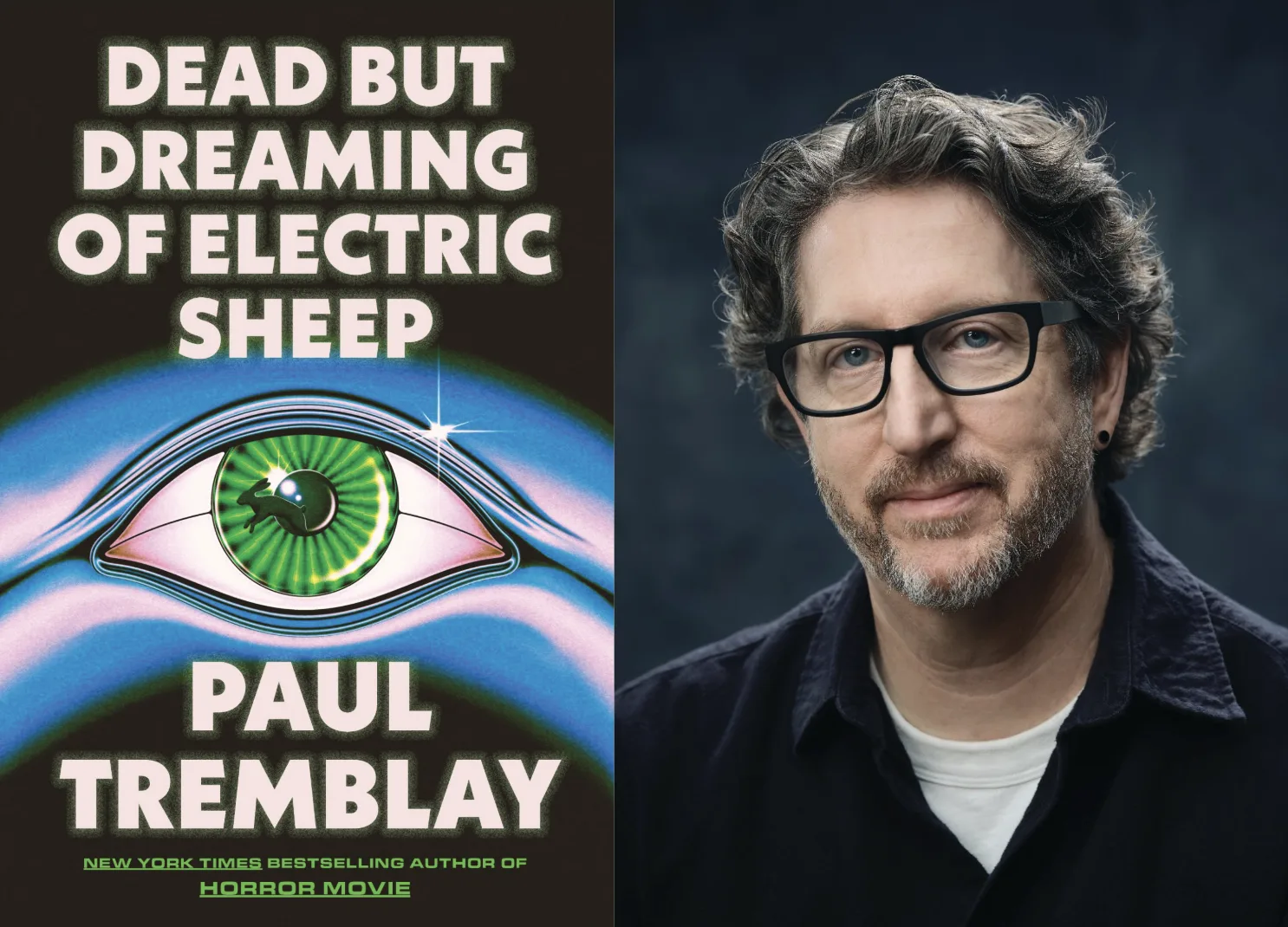
Author Paul Tremblay, who has made a name for himself as one of the most exciting horror and science-fiction writers working right now, will head to St. Louis on July 13 as part of the St. Louis County Library Foundation’s Favorite Author Series, co-presented by The Novel Neighbor, for a discussion and Q&A with Meredith Hopping at the Clark Family Branch.
Tremblay’s latest novel, Dead but Dreaming of Electric Sheep, expertly blends science fiction, AI fears, existential horror, and Coen Brothers-esqe dark humor. The novel follows Julia Flang, a former semi-professional gamer who is roped into piloting a mostly dead body she calls Bernie (in a reference to Weekend at Bernie’s) across the country. The book splits its perspectives between Julia (linear, first-person, relatively normal) and the perhaps less-dead-than-expected Bernie (abstract, second-person, existentially horrifying).
Stay up-to-date with the local arts scene
Subscribe to the weekly St. Louis Arts+Culture newsletter to discover must-attend art exhibits, performances, festivals, and more.
Ahead of his visit to St. Louis, SLM got to chat with Tremblay about the origins of Dead but Dreaming of Electric Sheep, the joy and power of human art, and what to expect from his stop at Clark Family Branch.
Can you tell us a bit about the origins of Dead but Dreaming of Electric Sheep, where the idea for the book came from?
Before I was even considering writing this book, probably four-ish years ago, I was reading Mary Roach’s book Stiff. She’s a wonderful science writer, and the book Stiff is a survey of what happens to the human body after death. I think she was talking about the transportation of bodies, and I just happened to flash on a weird image of being on an airplane and having a dead person next to me, but someone’s able to remote control them, which at the time seemed like a really silly “what if?” I try to keep in a good habit of rewarding my brain for sending me ideas, so I wrote it down and put it away. Fast-forward a couple years, in the summer of 2023, I joined a class action lawsuit against OpenAI’s ChatGPT on behalf of writers, and I pretty quickly learned about that company and others, and that “what if?” occurred to me and it didn’t seem so silly anymore. I was like, Oh, these companies totally would do something like this if it made the money without a second thought to morals or ethics or anything like that.
As a writer who likes to play with form, whether that’s the TV recaps in A Head Full of Ghosts or the movie script in Horror Movie, how did you come upon the idea of setting the stuff in Bernie’s head in second-person?
As you pointed out, clearly I’m not averse to typographical tricks. I like them in other books as long as they’re not a gimmick. If I come up with an idea, I have to make sure that it’s the best way for me to tell the story. So in the case of Bernie, whose consciousness has been hacked—or colonized is probably a better way of saying it—I really wanted that to be very strange for the reader. With second-person, I wanted to try to remove as many filters as I could to try to make the reader as close to what Bernie’s experiencing as possible. And going along with that was the typographical stuff, because I wanted to show a mind that was, if not broken, at least forced into multiple tracks, with parts of his mind that were not necessarily his anymore. But it’s hard to identify that, for him, initially anyway.
There’s a real horror that comes from reading that. It’s very jarring, especially at the beginning there, getting used to Bernie’s perspective.
A hundred percent. To me, it’s one of the scariest things—whether or not there’s an AI sort of taking over your mind, the idea that the mind isn’t your own, that yourself isn’t the self, that’s where the self is housed. Again, obviously this focuses on AI, but I’m getting of an age where you start to worry about Alzheimer’s and dementia, especially if you’ve got family members who’ve gone through it. One of the scariest things that I could think about is losing yourself and how aware you are when you are losing yourself.
There are a lot of movie references throughout Dead but Dreaming of Electric Sheep. Were there any films that were pinging in your mind as you were working on this book?
Every time I start a book, I always start from a place of being a fan, of being a reader and obviously a movie viewer. I like taking sparks from my favorite things and trying to create something new. Julia Flang, the 24-year-old who’s hired to pilot Bernie across the country, she’s someone who’s just enamored with old films, and one film in particular that she uses as her comfort movie [is] The Big Lebowski. I also really wanted Julia to represent in some ways the joy of art, the joy of human art. How it informs our outlook, how much of it is a part of our day-to-day lives, and it’s a way to communicate with other people when you talk about your favorite movies, books, or music. That’s just a human thing to do, and that’s being torn asunder by AI. Later on in the book you get a little bit more of an AI version of it. It’s funny; I hope not in the same way it’s funny when Julia does it, because when Julia does it, you have that human connection. When AI does it, it’s more uncanny, and the laughter that comes from it hopefully is a bit more nervous.
What was the experience of writing this book like? How did it differ from the way you approached your past novels?
There were a lot of things that were different. I try to curate it to be different because, for me, it’s both a fun and weird space where now I’ve written 10 novels. I want to balance the confidence of, Hey, you’ve written a novel before, and you can do it again, with making it feel like a new experience, because I don’t want to write the same book over and over. One of the things I did with this book was less on the science research side, but I knew I wanted to have some humor. I think one of the comps is the Coen Brothers’ films, and obviously we also referenced Weekend at Bernie’s. Before writing, I would sit down and reread three to four pages of one of my favorite literary humorists, Patrick deWitt, whose humor is very close in style to the Coen Brothers. I sat and read three pages of his book, The Librarianist, before I would start my writing day. It was a fun thing to do. He put me in a good mood. It was almost like a pre-reward. Like, Oh, I get to reread one of my favorite books piece by piece each day before I sit down at the laptop. Otherwise, this book became way longer than I ever thought it was going to be. Most of my novels are pretty short, and for me, this was a really long novel. From draft to final product, I had to cut 30,000 words out of it.
Now that the book is out, what excites you most about having Dead but Dreaming of Electric Sheep out in the world?
I’m most excited by having people react to it. I’ve had some good reviews and some really good reader responses. I know it’s a strange book. It’s hopefully not too didactic, but it definitely is part anti-AI polemic. In some ways, this is the fun part. The month leading up to the book is always full of anxiety and wondering, Is anybody going to read it? But now that I’m in it and I get to go to different cities and talk to readers, that’s the fun part.
What can folks expect from your upcoming event at the St. Louis County Library’s Clark Family Branch?
It’ll be mostly like a Q&A format with Meredith Hopping. I know she’s a comedian, and there is a comedy aspect to this book, so hopefully she likes it. I’m a little nervous about that part of it, to have a comedian read what I hope is, in parts, a funny book. But I’m looking forward to it. When I was there two years ago at the same library for Horror Movie, I was blown away by how many people came. I think it’s definitely been, by far, my most attended event. It was a wonderful night, and I was really, really thankful.
For more information about the event, visit slcl.org/events/paul-tremblay