After nearly three decades in New York, photographer Jacob Blickenstaff is returning to St. Louis with an exhibition that feels both deeply personal and quietly radical. Show of Hands, opening March 6 at Clayton’s Bruno David Gallery, turns away from celebrity faces and toward the physical labor of making music—fingers, palms, gestures, touch.
Blickenstaff, 46, spent part of his childhood in University City and came of age in Olivette. The answer to the perpetual St. Louis question is Ladue’s Horton Watkins High School, Class of ’97. He went on to get a degree in 2001 at NYU’s Gallatin School of Individualized Study.
Stay up-to-date with the local arts scene
Subscribe to the weekly St. Louis Arts+Culture newsletter to discover must-attend art exhibits, performances, festivals, and more.
Since then, he has contributed images to more than 50 albums, including notable covers for Natalie Merchant, Makaya McCraven, Sharon Jones & the Dap-Kings, The Cactus Blossoms, Joe Jackson, and John Pizzarelli. In the 2010s, he photographed numerous culture assignments for the New York Times to complement the work of its critics. His photo essays have also been published by NPR, Rolling Stone, and Mother Jones.
Blickenstaff traces his early fascination with music and imagery to places like Vintage Vinyl and the Saint Louis Art Museum. He has spent decades photographing musicians across genres and generations. For this show, he isolates hands not as a gimmick, but as a way of seeing—and listening—more closely.
Blickenstaff shared with St. Louis Magazine what hands reveal that faces don’t, which photo in the show he finds most touching, and why he could only do this show in St. Louis.
This exhibition isolates musicians’ hands rather than faces. When did you realize hands could carry as much emotional and narrative weight as a portrait?
I think I’ve been using hands in my photos for a long time, but the challenge of this show, which came as a suggestion from Bruno David, was to use hands as the initial theme and then create around it. But I’ve been aware of their importance for a long time.
When you look at paintings and sculpture in museums, hands are always very important elements. I think of Renaissance painters—Caravaggio, Bernini, Michelangelo—who always have so much happening with hands, often using them to direct the eye and the reading of the work. In portraiture going back much further, hands are carefully placed, sometimes holding subtle clues to the meaning and intent of the work.
Hands can suggest labor, discipline, tenderness, age, even injury. What do you hope viewers read into these images beyond musicianship?
As I thought about the theme of the show and began to sift through the images in my archive, I found all those things. I was fascinated and excited to expand the idea of music beyond technical skill.
Many of these hands belong to artists whose faces are instantly recognizable. What changes when identity is implied rather than shown outright?
I think the identity is there and not just implied. It’s just more subtle and takes a minute to examine and absorb.
I hope people just enjoy and experience the work. If I have an agenda, it is to question the convention of focusing on that “instantly recognizable” quality—usually the face—that becomes somewhat superficial as you see it over and over again. Recognizability is essentially fame and getting excited about that is fandom. But how famous an artist is is not that important to understanding why you love their music.
Were these images captured intentionally with hands in mind, or did the theme emerge later?
In my documentary work, hands and gestures have always been a big part of the dynamics of the composition. On a simple level, they direct the eye, like an arrow.
But it wasn’t until I started working on this show that I saw so many more shades of meaning. Once the idea of the show was in place, I had the opportunity to create new work, and I paid close attention to ways that hands could be the central theme. Focusing on that, I saw a lot more subtleties in how unique the use of hands is from artist to artist.
Some of the artists in the show—like Pino Palladino or Daniel Lanois—are famously understated performers. Do quieter musicians reveal more through their hands?
Those artists are great examples of musicians’ musicians. They use their hands predominantly to transmit their music and don’t have a flashy presence onstage.
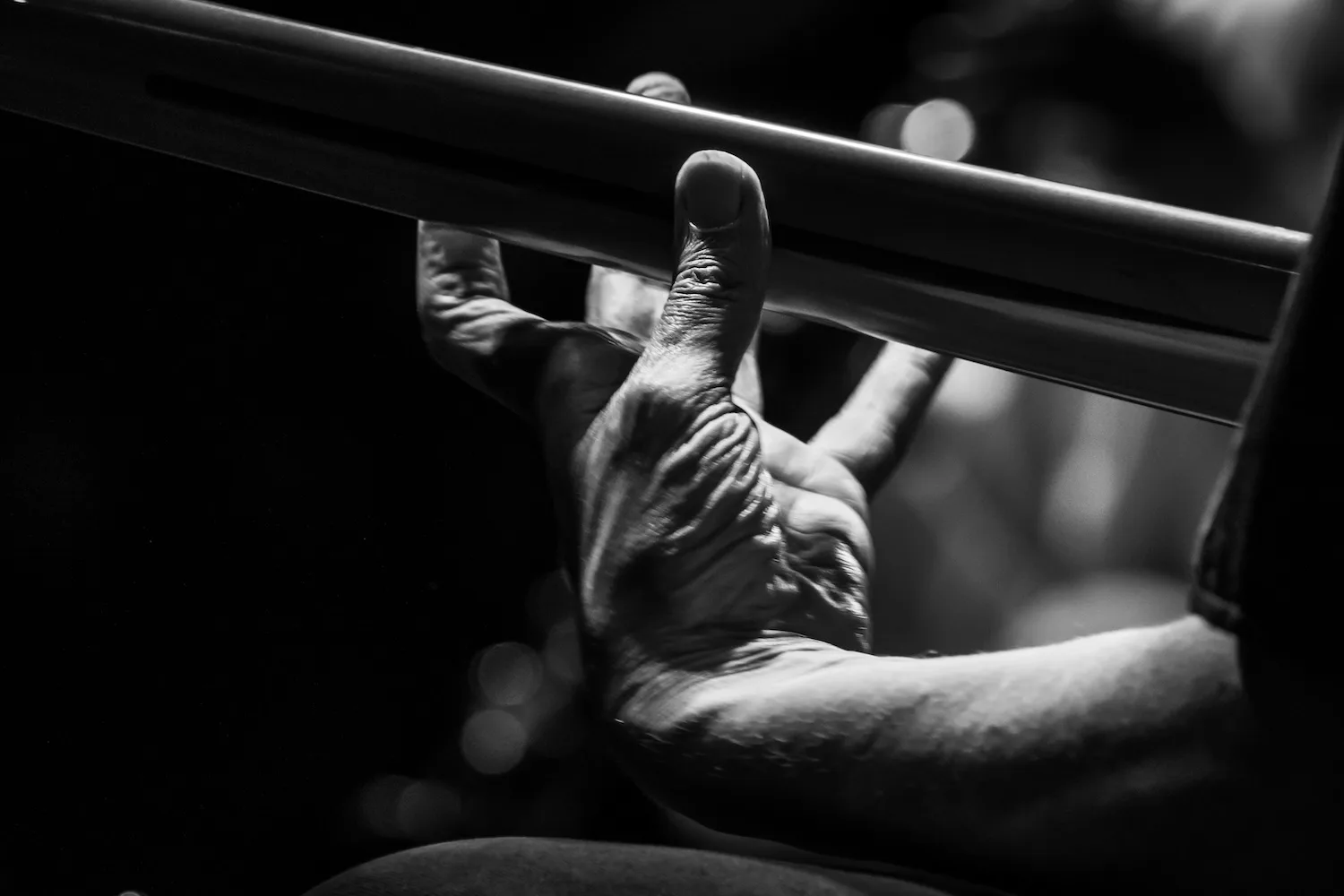
They’ve both developed very specific and idiosyncratic techniques. Daniel is very much a mechanical and technical wizard—he twists a dial on a sampler or triggers a custom switch with the same finesse as a violinist. And Pino just has these massive, alien-like hands that can contort and grab in ways I’d never seen before. Being able to closely observe them at work gave me a deeper understanding of their unique artistry.
Hands age in a way faces often don’t. Did time and mortality factor into your curatorial choices?
Live music is very ephemeral—it only exists in the air across a span of time and then it’s gone. A big part of the power of photography is memory and preservation. Photos serve as temporal reminders of the way something once was, or someone who aged or passed away.
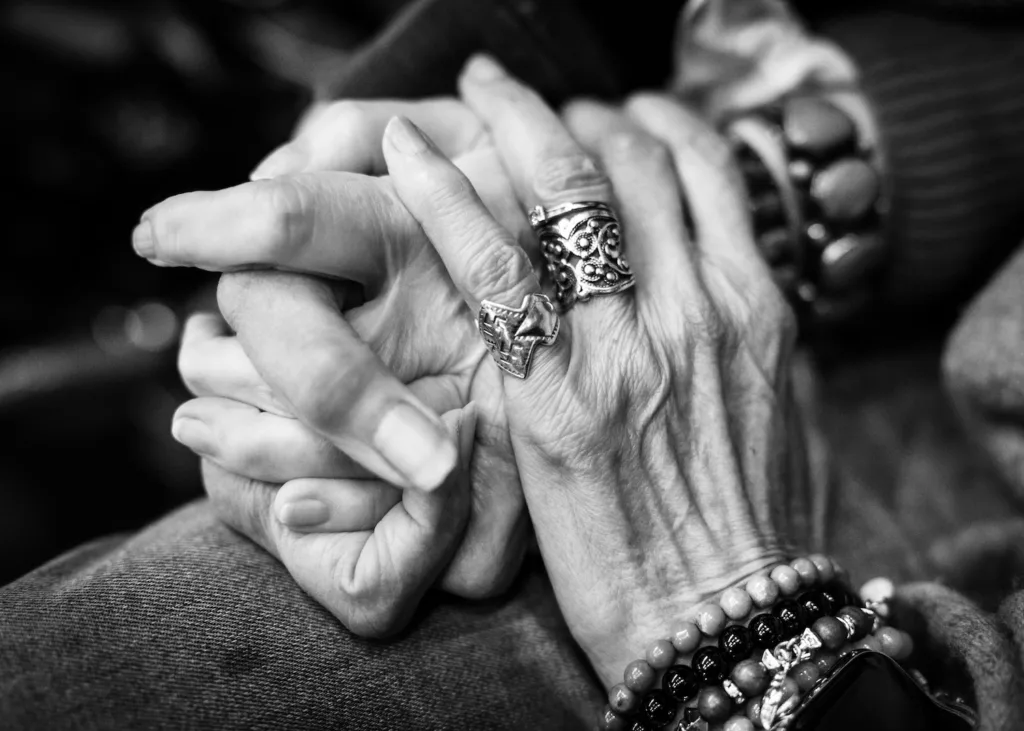
There are a few images that really stand out for me. One is the close-up of Joan Baez tenderly holding the hand of Linda Ronstadt at rehearsals for Joan’s tribute concert. Linda has a degenerative condition and is now in a wheelchair, but she came to be with her peers.
I looked over my shoulder and saw them sitting together, just calmly present for each other. I approached quickly but gently and asked if I could photograph their hands. It was maybe two frames in about five seconds. That tender connection summed up the energy of everyone who had gathered and certainly spoke of mortality.
Another subject is the late Sharon Jones, who I documented for many years. The images in the show are from her comeback concert after cancer treatment. Her hands were painful from chemo, but despite that vulnerability she tapped into a deep well of strength. There’s a photo where she waves as she leaves the stage—it’s triumphant and poignant. It will always feel like a goodbye.
Did you think about sequencing the show musically, like a set list?
I’ve always tried to make photos that feel musical, with gestures and moods inspired by internal qualities of music. Originally, I thought the show would just be single images, but I stumbled into offering sequences.
Seeing eight or ten subtle variations of an image together allowed me to introduce rhythm and time. A single image freezes things, but sequences can convey motion across an evening.
What does it mean to bring this work back to St. Louis? Would it feel different in New York?
I’m grateful to work with a thoughtful gallery like Bruno David. Being in St. Louis and not New York gives me more space to breathe and not compete with as much cultural noise.
It’s like musicians feeling more connected in an intimate venue than a stadium.
It’s also meaningful personally. My excitement about music and photography started here—digging through used records at Vintage Vinyl, seeing a Roy DeCarava retrospective at the Saint Louis Art Museum my senior year. The book from that show was called The Sound I Saw. That kind of sums it all up for me.
If someone walks through Show of Hands knowing nothing about the musicians, what do you hope stays with them?
Every artist in the show makes music that I love, so I hope visitors find clues that point them toward their own discoveries. It’s the infinite variety of subtle things that makes music—and everything else—enjoyable and rewarding. I hope the show encourages people to really look and listen.
Jacob Blickenstaff’s photo essays can be seen at ThatMillionDollarBash.substack.com. His show at the Bruno David Gallery (7513 Forsyth Boulevard) celebrates its opening reception with the artist from 6-8 p.m. Friday, March 6. Blickenstaff will present an artist talk at 4 p.m. on Saturday, March 7. Exhibition on view through April 10. Hours 12-6 p.m. Wednesday-Friday; Saturday 11-4 p.m. For more info, contact [email protected].